
School Pressure in India: Causes, Effects & How Parents Can Help Children Cope

Indian mother comforting stressed daughter studying for exams at home

Edited by: MomSaathi Editorial Team

Reviewed by: Based on the latest research from the National Mental Health Survey (2024-2025) and trusted baby name & child development sources.

The lights are on at 2:00 AM in a middle-class apartment in Bengaluru. Inside, a 15-year-old is hunched over a thick physics textbook, nursing a cold cup of tea. This isn’t an isolated incident; it is the reality for millions of students across the country.

In India, education isn’t just about learning; it’s often seen as the only ticket to a secure future. While ambition is good, the school pressure in India has reached a boiling point. From theKota cultureto the obsession with scoring 95% in Boards, our children are running a race that has no finish line.

As parents, we want the best for our kids. But how do we differentiate between encouraging them and inadvertently crushing them under the weight of expectations? Let’s dive deep into understanding this crisis and how we can be the support system our children truly need.

What Exactly is School Pressure in India?

Academic pressure is the mental and emotional strain students feel to achieve high grades and meet specific educational milestones. In the Indian context, this pressure is unique because it ismulti-layered.

It isn’t just about the school syllabus. It’s the coaching culture that starts as early as Class 6, the relentless competition for a handful of seats in premier institutes like IITs or AIIMS, and the societal narrative thatif you don’t become an engineer or doctor, you’ve failed.

The pressure on School Children is often a mix of an internal desire to please parents and an external environment that equates a student’s worth with their marksheet.

Major Causes of School Pressure

Why has the situation become so intense? Several factors contribute to this high-stakes environment:

1. Sky-High Parental Expectations

In many Indian households, a child’s academic success is seen as a reflection of the parents’ upbringing. Thisprestigefactor leads parents to push children toward perfection, often ignoring the child’s natural aptitude or interest.

2. The Dreaded Competitive Exams (JEE, NEET, Boards)

The sheer volume of applicants for exams like JEE and NEET creates ado or dieatmosphere. When 20 lakh students compete for a few thousand seats, the academic pressure on students becomes a constant companion from a very young age.

3. Overwhelming School Workload

Between six hours of school, three hours of coaching, and two hours of homework, where is the time to be a child? The modern Indian curriculum is dense, leaving little room for extracurricular activities or creative thinking.

4. Social Comparison & Peer Pressure

TheSharma ji ka betasyndrome is real. Seeing peers excel in multiple areas—coding, sports, and academics—can make a student feel inadequate, even if they are doing well in their own right.

Effects of Academic Pressure on Students

When the mind is constantly insurvival mode,it takes a toll. The impact of student mental health in India is a growing concern for psychologists and educators alike.

Mental Health Impact

  • Chronic Anxiety: Constant worrying about the next test orwhat if I fail.
  • Burnout: A state of physical and emotional exhaustion where the student simply loses interest in everything.
  • Depression: Feelings of hopelessness when they cannot meet the expectations set for them.

Physical Health Declines

Stress doesn’t just stay in the head. It manifests as:

  • Sleep Deprivation: Staying up late to study leads to a weakened immune system and poor concentration.
  • Fatigue & Headaches: Constant tension often leads to physical pain and low energy levels.
  • Eating Disorders: Stress-eating or a complete loss of appetite.

Emotional Struggles

The fear of failure can lead to extremely low self-confidence. If a child believes their value is tied to their grades, a single bad score can shatter their sense of self-worth.

Signs Your Child is Under School Pressure

Children often find it hard to articulate that they are stressed. Instead, theyshowit through their behavior. Look out for these red flags:

  • Sudden Mood Swings: Increased irritability, crying spells, or uncharacteristic anger.
  • Withdrawal: If your usually social child starts spending all their time locked in their room.
  • Physical Complaints: Frequent stomach aches or headaches, especially on school mornings.
  • Lack of Interest: Giving up on hobbies they once loved, like painting or football.
  • Changes in Habits: Difficulty falling asleep or eating significantly more/less than usual.

How Parents Can Help Children Cope: Practical Parenting Tips

Small image panels showing practical parenting tips for reducing school pressure in India: destigmatizing failure, praising effort, prioritizing rest, and encouraging movement.

As parents, we are the first line of defense. Here is how you can implement parenting tips for stressed students to create a healthier home environment.

1. Change the Narrative Around Failure

Teach your child that failure is a comma, not a full stop. Share your own stories of professional setbacks and how you bounced back. When they know you won’t love them any less for aBgrade, their anxiety levels drop significantly.

2. Prioritize Effort Over Results

Instead of asking,How many marks did you get?, ask,What was the most interesting thing you learned today?orI saw how hard you worked on that project, I’m proud of your dedication.

3. Open the Channels of Communication

Spend at least 15 minutes a day talking to your child about things other than school. Be a safe space where they can vent without being judged or immediately givenadvice.

4. Help with Time Management (Without Micromanaging)

Assist them in creating a schedule that includesguilt-freeplay or relaxation time. A student who rests well actually performs better than one who grinds 24/7.

5. Encourage a Balanced Lifestyle

Ensure they get physical exercise. Even a 20-minute walk or a game of badminton can release endorphins that naturally combat stress.

The Role of Schools in Reducing Pressure

While parents play a huge role, schools must also step up. A healthier academic environment should include:

  • Balanced Curriculum: Reducing the emphasis on rote learning and focusing on conceptual understanding.
  • Mental Health Support: Having trained counselors on campus who are accessible to students without any stigma.
  • Teacher Sensitivity: Training teachers to identify signs of burnout and to encourage students rather than using fear as a motivator.

Tips for Students to Manage Stress

If you are a student reading this, remember: you are more than your marksheet. Here are a few ways to keep your head above water:

  • Break it Down: Don’t look at the whole syllabus at once. Focus on one chapter, or even one topic, at a time.
  • Practice Mindfulness: Simple breathing exercises for 5 minutes a day can help calm the nervous system before an exam.
  • The 50/10 Rule: Study for 50 minutes, then take a total break for 10 minutes. No phones during the break—just stretch or grab a snack.
  • Ask for Help: If a subject is too hard, tell your parents or teachers. Asking for help is a sign of strength, not weakness.

Conclusion: Strive for Balance, Not Perfection

The journey of education in India is undoubtedly tough, but it shouldn’t come at the cost of a child’s childhood or mental peace. Our goal as parents should be to raise resilient, happy individuals who are capable of handling life’s ups and downs—not just exam papers.

Let’s replace the pressure to bethe bestwith the encouragement to betheir best.A happy child will eventually find their path to success, whether it’s in a lab, a boardroom, or an art studio.

Disclaimer: While this article provides general guidance, if your child shows severe signs of depression or anxiety, please consult a certified mental health professional or a school counselor immediately.

5 Frequently Asked Questions (FAQs)

How do I know if my child’s stress is “normal” or serious?

Occasional stress before an exam is normal. However, if the stress interferes with their sleep, appetite, or basic daily functioning for more than two weeks, it’s time to seek professional help.

Is the “Kota culture” really that bad?

While many succeed, the high-pressure environment in coaching hubs can be detrimental to a student’s mental health if they don’t have a strong emotional support system.

How can I talk to my child about low grades without discouraging them?

Focus on the “why” rather than the “what.” Ask if they found the paper difficult or if they need more help with a specific topic, and work on a solution together.

Does physical exercise really help with academic performance?

Yes! Exercise increases blood flow to the brain and reduces cortisol (the stress hormone), which actually improves memory and focus.

How much sleep does a high school student actually need?

Ideally, 8–9 hours. Sleep is when the brain processes and stores what was learned during the day. Cutting sleep to study is often counterproductive.

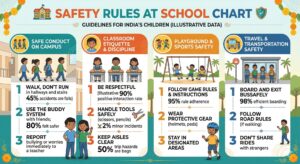

Essential Safety Rules at School: A Guide for Parents and Kids

Infographic poster: safety rules at school chart for children in India

Edited by: MomSaathi Editorial Team

Reviewed by: Based on the latest child safety guidelines, educational policies, and expert-backed parenting practices.

The sound of the school bell often brings a mix of excitement and a little bit of anxiety for parents. We spend our mornings packing nutritious dabbas and ensuring bags are packed, but the most important thing we send our children to school with isn’t in their backpack—it’s the knowledge of how to stay safe.

When we talk about safety rules at school, we aren’t just talking about preventing scraped knees on the playground. We are talking about creating an environment where children feel secure enough to learn, grow, and express themselves. In an Indian context, where schools can be crowded and hallways bustling, understanding these rules is non-negotiable.

In this comprehensive guide, we’ll break down everything from the 10 safety rules at school for child development to creating a safety rules at school chart that actually works.

What Are Safety Rules at School?

Simply put, safety rules at school are a set of guidelines designed to protect students from physical harm, emotional distress, and environmental hazards. They act as a “code of conduct” that dictates how a child should move, interact, and react within the school premises.

In many Indian schools, these rules cover everything from how to board the school bus to how to walk in the corridors during lunch break. These aren’t just “restrictions”; they are the foundation of a disciplined and happy school life.

Why Are Safety Rules Important for Children?

Children are naturally curious and often impulsive. Without clear boundaries, their energy can lead to accidents. Here is why prioritizing safety is essential:

  • Physical Protection: Schools have stairs, playgrounds, and laboratories. Rules prevent falls, burns, and collisions.

  • Emotional Security: When children know there are rules against bullying or rough play, they feel emotionally safe to participate in class.

  • Discipline and Habit Building: Learning to follow rules at school prepares children for the responsibilities of adult life.

  • Emergency Readiness: In the rare event of a fire or a medical emergency, knowing the safety protocol can literally be life-saving.

10 Safety Rules at School for Children

If you are a parent or a teacher, these are the top 10 safety rules at school for child safety that every student must memorize and practice.

  1. Walk, Don’t Run, in Corridors: Corridors are often slippery or crowded. Running can lead to nasty falls or bumping into others, especially during the hectic “recess” time.

  2. Use the “Buddy System”: Never go to the washroom or a secluded part of the school alone. Always take a friend along to ensure someone can call for help if needed.

  3. Stay Within School Bounds: Children should never leave the school gates without an authorized adult. This is the most basic rule for preventing kidnapping or accidents on the road.

  4. Follow Playground Instructions: Only use the swings and slides as they are intended. No standing on swings or jumping off moving merry-go-rounds!

  5. Listen to Your Teacher: Teachers are the primary guardians at school. If they say “stay away from the construction area,” there is a very good reason for it.

  6. Do Not Share Personal Information: Teach children never to give their home address or phone number to strangers, even if the person claims to know their parents.

  7. Be Careful on the Stairs: Always hold the railing and stay to the left (or right, as per school policy). Avoid playing or pushing on the staircase.

  8. Know Emergency Exits: Every child should know where the nearest exit is and what the school’s fire alarm sounds like.

  9. Report Bullying Immediately: Safety isn’t just physical. If someone is making a child feel scared or uncomfortable, it must be reported to a teacher at once.

  10. Sanitation and Hygiene: Especially post-pandemic, washing hands before eating and after using the restroom is a vital health safety rule.

Infographic poster: safety rules at school chart for children in India

Safety Rules in the School Classroom

The classroom is where students spend the bulk of their day. Maintaining safety rules in school classroom environments ensures that the focus remains on education.

  • Furniture Safety: Children should avoid leaning back on chairs or climbing on desks. In many Indian classrooms, wooden desks can have sharp edges or splinters if handled roughly.

  • Proper Use of Stationery: Scissors, compasses, and even sharpened pencils can be dangerous. Teach kids to pass these items “handle-first” and never point them at others.

  • Keep Aisles Clear: Bags and water bottles should be kept under the desk, not in the path where someone might trip over them.

  • Interaction with Peers: Respecting personal space is a safety rule. No “play-fighting” or pushing inside the room.

Safety Rules at School Chart (For Kids)

Charts are incredible tools because they act as a constant visual reminder. Well-placed safety rules at school, charted in the hallway or classroom, help children internalize the rules without feeling lectured.

Sample Layout for a School Safety Chart:

Category The Rule The “Why”
Movement Walk in a line To avoid tripping and falling
Play Wait for your turn on the slide To keep everyone safe from hits
Interaction Use kind words To keep our hearts happy
Bus Keep your hands inside the window To prevent accidents on the road
Emergencies Stay calm and quiet So you can hear the teacher’s instructions

[irp]

Safety Rules at School Pictures (Visual Learning)

Why do we look for safety rules in school pictures? Because children—especially younger ones—are visual learners. An image stays in their mind much longer than a list of words.

Recommended Image Ideas for Your School Projects:

  1. The “Yellow Line” Picture: An image of students standing behind a yellow line while waiting for the school bus.

  2. The “Helping Hand” Picture: An older student helping a younger one on the stairs.

  3. The “Corridor Walk” Picture: A clear illustration of a student walking with their hands to their side, not running.

  4. The “Emergency Map”: A bright, colorful map showing the exit routes of the school.

Note: If you are making a project, try to find photos that reflect the local school environment (students in uniforms, Indian school buses) to make it more relatable.

Common Mistakes Children Make at School

Even with the best intentions, kids make mistakes. Identifying them early helps in correction:

  • The Mistake: Hiding an injury because they are afraid they will get in trouble for “playing rough.”

    • The Solution: Encourage an “open-door” policy where kids know that their health is more important than the rules they might have broken.

  • The Mistake: Following a stranger because they have a “cool toy” or “sweet.”

    • The Solution: Role-play “stranger danger” scenarios at home so the child knows exactly what to say.

  • The Mistake: Running to the gate as soon as the bell rings.

    • The Solution: Teach them that the bell signifies the start of the exit process, not a race to the finish line.

Tips for Parents & Teachers to Teach Safety Rules

Teaching safety shouldn’t be about scaring children; it should be about empowering them.

  • For Teachers: Conduct a “Safety Walk” once a month. Walk the kids through the corridors and point out the fire extinguishers, the nurse’s office, and the emergency exits.

  • For Parents: Don’t just tell them the rules—explain the “Why.” Instead of saying “Don’t run,” say “We walk so we don’t fall and hurt our knees before the weekend trip.”

  • Use Positive Reinforcement: When you see a child following a safety rule, praise them. “I love how safely you used the stairs today!” goes a long way.

FAQ Section

Q1: What is the most important safety rule at school?

A: While all are important, “Listening to the Teacher” is the umbrella rule. If a child follows instructions, they are likely to stay safe in almost any situation.

Q2: How can I make a safety rules at school chart at home?

A: Use a large chart paper, divide it into “Dos” and “Don’ts,” and let your child draw safety rules at school pictures for each point. This involvement makes them more likely to follow the rules.

Q3: My child is being bullied; is this a safety issue?

A: Absolutely. Emotional safety is just as vital as physical safety. School safety rules strictly prohibit bullying, and it should be reported to the school administration immediately.

Q4: Are there specific safety rules for the school bus?

A: Yes. Rules include staying seated until the bus stops, keeping hands/heads inside, and never talking loudly to avoid distracting the driver.

Q5: How can visual aids help in teaching school safety?

A: Visual aids like posters and videos help children recognize hazards instantly. They are especially effective for kindergarten students who may not yet be able to read complex rules.

Conclusion

Ensuring safety rules at school are followed is a collective responsibility. It takes a village—parents, teachers, bus drivers, and the students themselves—to create a secure environment.

When children feel safe, their brains move out of “survival mode” and into “learning mode.” By teaching these rules today, you aren’t just preventing an accident; you are giving your child the peace of mind to become the best version of themselves. Let’s make safety a habit, not an afterthought!

Official School Safety Resources

For more detailed safety protocols and official guidelines, please visit the following organizations:

LKG/UKG Admission 2026–27 Karnataka: Dates, Fees, Process & Interview Tips

Karnataka moms, the season is here! If your child is turning 4–5 years old, LKG/UKG admissions for 2026–27 are in full swing, especially in cities like Bengaluru, Mysore, and Mangalore. With competition high in top CBSE/ICSE schools, many parents start panicking about dates, fees, age rules, and those nerve-wracking “interviews” (often parent-child interactions).

This guide covers everything Karnataka parents need: important dates, age criteria, average fees, RTE quota details, admission process, interview tips, and practical advice to make the process smoother.

Age Criteria for LKG/UKG Admission in Karnataka 2026–27

Karnataka follows NEP 2020 guidelines:

  • LKG: Child should be 4 years complete by June 1, 2026 (some schools allow up to 5 years).
  • UKG: 5 years complete by June 1, 2026 (up to 6 years).

Many schools calculate age as of March 31 or June 1, 2026. Always check the school’s official notice – flexibility varies (e.g., CBSE schools are stricter). Proof of age (birth certificate) is mandatory.

For RTE 25% free seats (economically weaker sections), age rules are similar, but priority for disadvantaged categories.

Key Admission Dates & Timeline (2026–27)

Admissions vary by school (private vs government-aided), but typical Karnataka timeline:

  • Application opens: October 2025 – January 2026 (many started in October, e.g., Bishop Cotton Boys’ School from Oct 16, 2025).
  • Online registrations peak: November 2025 – February 2026 (forms close when seats fill).
  • Interaction/Observation/Interviews: January – March 2026.
  • Lottery/Selection results: February – April 2026.
  • RTE applications: March – April 2026 (online via sdcedn.karnataka.gov.in; trial/mock in early March, last date ~April 15, 2026).
  • Final enrollment: May – June 2026.

Top schools like Kumarans, DPS Electronic City, or Bishop Cotton often close Pre-KG/LKG early due to demand. Apply ASAP!

Average Fees for LKG/UKG in Karnataka (2026–27 Estimates)

Fees vary widely by board (CBSE/ICSE/State) and location:

  • Bangalore premium schools (e.g., Bishop Cotton, Indus, Inventure): ₹80,000 – ₹2,00,000+ per year (including admission, tuition, activity fees).
  • Mid-range CBSE/ICSE (e.g., Edify, Presidency): ₹50,000 – ₹1,20,000 annually.
  • Affordable private/State-board: ₹30,000 – ₹70,000 per year.
  • RTE 25% quota: Free or minimal fees in participating private schools (lottery-based for eligible families).

Additional costs: Uniforms, transport, books (~₹10,000–30,000). Application fee: ₹500–₹1,000 (non-refundable).

Admission Process Step-by-Step

  1. Research & Shortlist: Visit school websites, check reviews on parent forums, focus on curriculum (CBSE/ICSE), facilities, safety, and distance.
  2. Online/Offline Application: Fill form on school portal (e.g., upload birth certificate, photos, address proof). Pay application fee.
  3. Document Submission: Birth certificate, Aadhaar, photos, vaccination record, address proof.
  4. Interaction/Interview: Parent-child meet (not formal test for LKG/UKG).
  5. Selection & Fee Payment: Lottery/results via email/SMS; pay admission fee within deadline.
  6. RTE Route: Apply online via Karnataka RTE portal for 25% free seats (eligibility: income <₹2.5 lakh/year, etc.).

Minority schools or those with only Pre-Primary may have different rules.

Interview Tips for LKG/UKG Admission (What Schools Really Look For)

LKG/UKG “interviews” are usually relaxed parent-child interactions (20–30 mins):

  • For Child: Basic identification (colors, shapes, body parts, family members), simple rhymes/songs, confidence in speaking. No pressure – they observe readiness & social skills.
  • For Parents: Be honest about child’s routine, strengths, any concerns. Show enthusiasm for school values. Dress neatly.
  • Preparation Tips:
    • Practice simple questions: “What is your name?”, “Show me red color”, “Sing a rhyme”.
    • Encourage independence (e.g., eating, toilet use).
    • Stay calm – schools assess family fit more than child’s “performance”.
    • Arrive early, bring required docs.
    • Avoid coaching pressure – focus on play-based learning.

Many schools now emphasize observation over testing.

Final Thoughts for Karnataka Moms

LKG/UKG admission 2026–27 is competitive, but with early planning, you can secure a good spot. Prioritize schools that match your child’s needs and your budget – and don’t forget RTE if eligible. Trust the process; your little one is ready for this big step!

Momsaathi.com provides content for informational and educational purposes only. It is not intended to serve as a substitute for professional advice. Check official school websites and Karnataka RTE portal for latest updates, as dates/fees can change. Consult schools directly for personalized guidance.

Frequently Asked Questions (FAQs)

What is the age limit for LKG in Karnataka 2026?


Typically 4 years complete by June 1, 2026 (some schools use March 31 cutoff).

October 2025 – January 2026 for most private schools; RTE in March–April.

₹50,000–₹2,00,000 annually in Bangalore; lower in other cities or RTE seats.

Yes – usually parent-child interaction to assess readiness and family fit.


Online via sdcedn.karnataka.gov.in; eligibility based on income/category; lottery system.

Typically 4 years complete by June 1, 2026 (some schools use March 31 cutoff).

October 2025 – January 2026 for most private schools; RTE in March–April.

₹50,000–₹2,00,000 annually in Bangalore; lower in other cities or RTE seats.

Yes – usually parent-child interaction to assess readiness and family fit.


Online via sdcedn.karnataka.gov.in; eligibility based on income/category; lottery system.

Related Articles on Momsaathi.com:

External Resources:

Middle School Struggles: Psychologist Shares Parenting Tips for the ‘Crucial Years’ (India 2026)

Momsaathi.com provides content for informational and educational purposes only. It is not intended to serve as a substitute for professional medical advice, diagnosis, or treatment. Always consult a child psychologist, counselor, or pediatrician if your child shows signs of anxiety, depression, aggression, social withdrawal, or any mental health concerns.

Middle school (classes 6–8, ages 11–14) is often called the “crucial years” — and for good reason. In 2026, Indian parents are seeing more intense struggles: heavy school pressure, phone/social media addiction, peer comparison, identity questions, mood swings, and the sudden shift from “child” to “teen”.

Psychologists working with Indian families (especially in urban Karnataka and metro cities) say these years are make-or-break for emotional health, self-esteem, and academic motivation. The good news? With mindful parenting, most children come out stronger and more resilient.

Here are practical, psychologist-backed middle school parenting tips India that many families are using successfully in 2026.

1. Understand What’s Really Happening in Their Brain & Body

Middle school is puberty + prefrontal cortex remodelling. That means:

  • Emotions are intense and unpredictable
  • Impulse control is still developing
  • Peer approval feels more important than parents’
  • They crave independence but still need guidance

Tip: Remind yourself daily: “This is biology, not bad behaviour.” It reduces anger and helps you respond calmly.

2. Replace Lectures with Listening & Curiosity

Lectures and “you should” statements usually shut teens down. Instead, psychologists recommend curiosity-based conversations.

Phrases that work better:

  • “What’s been the hardest part of school this week?”
  • “How did that fight with your friend make you feel?”
  • “What do you think would happen if you tried…?”

Indian mom hack: Start talks during late-night chai or car rides — less eye contact = less pressure.

3. Set Firm but Fair Screen & Phone Boundaries

Phone addiction peaks in middle school. In 2026, Indian teens average 4–6 hours/day on screens (Instagram, YouTube Shorts, Free Fire).

Realistic boundaries:

  • No phones in bedroom after 9 PM (charge in living room)
  • Screen time 1–1.5 hours/day on weekdays (after homework)
  • Family “no-phone” zones (meals, study time)
  • Use apps like Google Family Link or Apple Screen Time together — make it collaborative

Tip: Explain the “why” — “Screens affect sleep and focus, which affects your marks and mood.”

4. Help Them Handle School Pressure & Peer Comparison

CBSE/ICSE/State board pressure + social media comparisons create anxiety and low self-worth.

What works:

  • Focus on effort & progress (“I see how hard you studied”) not marks
  • Teach growth mindset: “You’re not bad at math — you’re still learning it”
  • Celebrate non-academic wins (sports, art, kindness)
  • Limit social media exposure (private accounts, no reels before bed)

Desi tip: Many Karnataka families use “family study time” — everyone studies/reads together 45 min/day — reduces isolation.

5. Teach Emotional Regulation & Problem-Solving

Middle schoolers feel everything 10× more intensely.

Simple tools:

  • 4-7-8 breathing (inhale 4, hold 7, exhale 8)
  • “Name it to tame it” — “You seem angry — want to talk about it?”
  • Problem-solving steps: “What happened? How do you feel? What can we try?”

Tip: Model it yourself — when you’re upset, say “I’m feeling frustrated, so I’m taking 5 deep breaths.”

6. Protect Sleep & Nutrition (Often Overlooked)

Sleep deprivation + junk food = worse mood, focus, and immunity.

2026 Indian parent checklist:

  • Bedtime 9:30–10 PM (10–11 hours sleep needed)
  • No screens 60 min before bed
  • Dinner by 8 PM (light: roti-sabzi, curd rice)
  • Limit packaged snacks — prefer fruits, nuts, boiled egg

When to Seek Professional Help (Don’t Wait)

Contact a child psychologist or counselor if you see:

  • Persistent sadness, withdrawal, or loss of interest
  • Extreme irritability or anger outbursts
  • Refusing school or activities they used to love
  • Self-harm talk or risky behaviour
  • Sudden drop in marks + sleep/eating changes

In India (2026): Many schools now have counselors. Government options include NIMHANS (Bengaluru), RBSK camps, or tele-counseling via 104/108 helplines.

Final Words for Indian Moms & Dads

Middle school is tough — for kids and parents. But with empathy, clear boundaries, open communication, and self-care, most families come out stronger.

You’re not failing — you’re guiding a human through one of the hardest phases of growth.

Which middle school struggle are you facing right now? Share in the comments — let’s support each other, Karnataka parents!

Related Articles on Momsaathi.com:

External Resources:

Indian Parents 2026 – Top 5 Most Searched Topics: Schools, Phonics, Worksheets, Handwriting & Olympiad Tips

Momsaathi.com provides content for informational and educational purposes only. It is not intended to serve as a substitute for professional medical advice, diagnosis, or treatment. Always consult school authorities, teachers, pediatricians or child psychologists for personalized advice on education, learning difficulties, or child development.

In 2026, Indian parents (especially in Karnataka and metro cities) are searching more than ever for practical solutions to give their children the best start. From “best schools near me” to phonics, worksheets, handwriting, and Olympiad preparation, these five topics dominate Google, YouTube, and parenting groups.

This guide brings all five together in one place — realistic, up-to-date tips tailored for busy Indian families in 2026.

1. Best Schools Near Me in Karnataka & India – How to Choose in 2026

The phrase “best schools near me” is one of the top searches every admission season.

What Indian parents really want in 2026:

  • Strong academics + good board results (CBSE/ICSE most popular)
  • Affordable fees (₹50k–₹4 lakh/year)
  • Safe transport, CCTV, hygiene
  • Focus on sports, arts, life skills
  • English medium + value-based education

Quick checklist before visiting:

  • Check board affiliation & past 3 years’ Class 10/12 results
  • Read Google & Justdial reviews (look for patterns)
  • Ask about teacher-student ratio (ideal 1:25–35)
  • Visit during school hours — observe classrooms & playground
  • Talk to current parents (not just school staff)

Popular categories in Karnataka:

  • CBSE schools in Bengaluru (e.g. Delhi Public School, National Public School)
  • ICSE schools (e.g. Bishop Cotton, Inventure Academy)
  • State-board + affordable options (for Tier-2 cities)

Tip: Admissions usually open October–January for next academic year. Start early.

2. Phonics for Kids – How Indian Parents Can Teach at Home

Phonics is now the preferred method in most good schools (CBSE/ICSE) — helping kids read faster and spell better.

Why phonics for kids is huge in India 2026:

  • Builds strong foundation before Class 1
  • Reduces rote learning pressure
  • Helps with English fluency (important for competitive exams)

Easy 4-step home method (10–15 min/day):

  1. Letter sounds first (not names): “a” says /æ/ like apple
  2. Blend sounds: c-a-t → cat
  3. Use flashcards + apps (Jolly Phonics, Starfall, YouTube channels like Jack Hartmann)
  4. Play games: “I spy something beginning with /b/” or rhyming songs

Desi twist: Sing Hindi/Kannada rhymes with English phonics — e.g. “A for Apple, A for Aam”

When to start: 3.5–4.5 years (before UKG)

[fc-dietchart]

3. Worksheets for LKG/UKG – Free & Printable Ideas for Indian Moms

LKG/UKG worksheets are among the most downloaded resources in India.

What Indian parents need in 2026:

  • Alphabet tracing, number recognition, shapes/colors
  • Pre-writing lines & patterns
  • Simple Hindi/Kannada letters (if bilingual school)
  • No heavy academic pressure — focus on fun

Quick printable ideas (make at home):

  • Alphabet tracing sheets (A–Z upper & lower case)
  • Number 1–20 with counting dots
  • Shape matching (circle, square, triangle)
  • Color by number or pattern completion
  • Stand-up puppet craft (stick on ice-cream sticks)

Tip: Limit to 10–15 min/day. Praise effort (“Wow, you traced so nicely!”) — not perfection.

4. How to Improve Handwriting – Simple Tips for Indian School Kids

Bad handwriting is a common complaint in Indian schools — affects marks in board exams.

Step-by-step improvement plan:

  1. Correct grip: Tripod grip (thumb + index + middle finger)
  2. Right posture: Sit straight, paper tilted 30°, light from left
  3. Daily practice: 10 min tracing → copy writing → free writing
  4. Fun activities: Sand writing, finger painting, mazes
  5. Use right tools: Thick triangular pencils, 4-line notebooks

Tip: Start at age 4–5. Praise progress (“Your letters are getting so neat!”).

When to seek help: If grip is awkward, letters are reversed, or pain occurs — consult occupational therapist.

5. Olympiad Preparation Tips – How Indian Kids Can Excel in 2026

Olympiads (IMO, NSO, IEO, NCO) are huge in India — many schools push participation.

Realistic preparation tips for 2026:

  • Start in Class 1–2 (fun level) or 3–4 (serious level)
  • Understand syllabus (SOF, SilverZone, Unified Council)
  • Daily 30–45 min: 10–15 questions + past papers
  • Books: MTG Olympiad books, Disha, Arihant
  • Focus on concepts — not rote learning
  • Mock tests every weekend

Indian parent tip: Balance with school — don’t overburden. Reward effort, not just medals.

Final Thoughts for Indian Parents in 2026

These five topics — best schools near me, phonics for kids, worksheets for LKG/UKG, how to improve handwriting, and Olympiad preparation tips — are dominating searches because every parent wants their child to thrive.

Start small, stay consistent, and trust your instincts. You’re already doing an amazing job.

Which topic are you focusing on right now? Share in the comments — let’s help each other, Karnataka moms and parents!

Related Articles on Momsaathi.com:

External Resources:

Who Can Adopt a Child in India? Complete Eligibility Criteria 2026

Adoption Eligibility Criteria in India: A Complete Guide for Prospective Parents

Adopting a child is a heartfelt way to build your family, offering a loving home to a little one in need. In India, the process is regulated by the Central Adoption Resource Authority (CARA) under the Juvenile Justice (Care and Protection of Children) Act, 2015, and the Adoption Regulations, 2022. These rules ensure the child’s best interests while making adoption accessible to eligible parents.

If you’re considering adoption, understanding the eligibility criteria for adoptive parents in India is the first step. This guide breaks it down simply, covering resident Indians, NRIs, OCIs, and foreigners.

Who Can Adopt a Child in India?

CARA allows adoption for:

  • Indian residents.
  • Non-Resident Indians (NRIs).
  • Overseas Citizens of India (OCIs).
  • Foreigners (from Hague Convention countries).

Both married couples and single individuals can apply, with some specific conditions.

General Eligibility Requirements

Prospective adoptive parents (PAPs) must meet these core criteria:

  • Physical and Mental Health: You should be physically fit, mentally sound, emotionally stable, and free from any life-threatening medical conditions.
  • Financial Stability: You need a steady income to support the child’s needs (specific minimums apply based on family size).
  • Criminal Record: No history of serious crimes or child abuse.
  • Motivation: A genuine desire to provide a nurturing home.

Eligibility for Married Couples

  • Must be in a stable marital relationship for at least 2 years.
  • Both partners must consent to the adoption.
  • Age limits (composite age of couple):
    • Up to 90 years for adopting a child under 4 years.
    • Up to 100 years for a child aged 4-8 years.
    • Up to 110 years for a child aged 8-18 years.
  • The minimum age for each parent is 25 years, with at least a 25-year gap between the parent and child.

Eligibility for Single Parents

  • Single women can adopt a child of any gender.
  • Single men can only adopt a male child (not a girl child, for safety reasons).
  • Age limits:
    • Up to 45 years for adopting a child under 4 years.
    • Up to 50 years for a child aged 4-8 years.
    • Up to 55 years for a child aged 8-18 years.
  • Minimum age: 25 years, with the required age gap to the child.

Special Considerations

  • NRIs, OCIs, and Foreigners: Additional steps like home study reports from authorized agencies and adherence to Hague Convention rules apply. Foreigners typically adopt older children or those with special needs.
  • Adopting Multiple Children: Possible, but siblings are prioritized to stay together.
  • Health Conditions: Minor correctable issues may be allowed, but serious conditions could disqualify.

Quick Summary Table: Age Criteria at a Glance

Applicant Type Child Age (0-4 yrs) Child Age (4-8 yrs) Child Age (8-18 yrs)
Married Couple (Composite Age) Up to 90 years Up to 100 years Up to 110 years
Single Parent Up to 45 years Up to 50 years Up to 55 years

These are general guidelines—exact details may vary slightly based on updates from CARA.

Next Steps If You’re Eligible

  1. Register online on the CARA portal (cara.wcd.gov.in).
  2. Complete a home study report.
  3. Get referred a child and proceed with legal formalities.

Adoption in India is a rewarding journey that requires patience—waiting times can vary from months to years depending on preferences.

Disclaimer: This information is based on current CARA guidelines as of 2026 and is for educational purposes only. Rules can change, so always check the official CARA website or consult a licensed adoption agency/legal expert for the latest details and personalized advice.

If you’re ready to start, reach out to CARA-registered agencies in your area. Building a family through adoption is truly special—best wishes on your journey

Choosing the Right School Board: School Admission Guide for Parents

Choosing the right school and education board is one of the most important decisions in a child’s academic journey. From understanding admission procedures to selecting the appropriate board, parents often find themselves overwhelmed. This guide simplifies the process and helps you make an informed choice for your child’s future.

Understanding the School Admission Process

School admissions usually begin several months before the academic year starts. The process may include filling out application forms, submitting required documents, attending interaction sessions, and sometimes entrance assessments. Parents should keep track of admission timelines, eligibility criteria, and age requirements to avoid last-minute stress.

Key documents commonly required include birth certificates, address proof, previous academic records, and transfer certificates. Early preparation ensures a smooth admission experience.

Along with admissions, ensuring your child’s safety matters — check out our toddler safety tips.

Types of School Boards in India

India offers a variety of education boards, each with its own curriculum and teaching approach:

  • CBSE (Central Board of Secondary Education): Focuses on a structured syllabus with national-level competitive exam preparation.

  • ICSE (Indian Certificate of Secondary Education): Known for its detailed curriculum and strong emphasis on English and overall development.

  • State Boards: Follow state-specific curricula and are often preferred for regional language focus and affordability.

  • International Boards (IB / Cambridge): Offer global exposure, inquiry-based learning, and international recognition.

Choosing the right board depends on your child’s learning style, long-term goals, and adaptability.

Factors to Consider While Choosing a School

Apart from the board, parents should evaluate infrastructure, teaching quality, student-teacher ratio, extracurricular activities, safety measures, and distance from home. A balanced environment that supports both academics and personal growth is essential.

Choosing the right school is part of thoughtful parenting — explore our parenting support guides for more insights.

[fc-walking-test]

Tips for Parents

  • Start researching schools at least a year in advance

  • Attend school open houses or virtual tours

  • Understand the curriculum and assessment pattern

  • Prioritize your child’s comfort and learning needs

Final Thoughts

School admission and board selection play a crucial role in shaping a child’s educational foundation. By staying informed and proactive, parents can ensure their child receives the right start, paving the way for academic success and holistic development.

Primary Classes (1–5): Building the Strong Foundation for Your Child’s Future

Primary class study material helps children build strong basics in Maths, English, Hindi, and EVS. At MomSaathi, we provide free worksheets and notes for Class 1 to 5 students.

Primary education plays a crucial role in shaping a child’s academic journey and overall personality. Classes 1 to 5 are the years when children develop essential learning skills, values, and confidence that stay with them for life. A strong foundation during these early school years helps students succeed not only in academics but also in social and emotional development.

Importance of Primary Classes (1–5)

Primary classes focus on nurturing curiosity, creativity, and a love for learning. During this stage, children transition from basic recognition skills to structured learning. Subjects such as Mathematics, English, Environmental Studies, and regional languages help improve logical thinking, communication, and awareness of the world around them.

Well-designed primary education encourages children to ask questions, explore ideas, and develop problem-solving abilities. It also helps build discipline, responsibility, and teamwork through classroom activities and group learning.

Curriculum Focus in Primary Education

The curriculum for Classes 1–5 is designed to be child-centric and activity-based. Instead of rote learning, students are encouraged to understand concepts through examples, stories, projects, and practical exercises.

Key learning areas include:

  • Language Skills: Reading, writing, vocabulary, and communication

  • Mathematics: Numbers, basic operations, reasoning, and patterns

  • Environmental Studies: Nature, society, health, and surroundings

  • Creative Learning: Art, craft, music, and physical education

This balanced approach ensures overall growth and keeps children engaged and motivated.