3 Years Baby Girl Haircut: 25+ Cute & Easy Hairstyles for Toddlers

3 Years Baby Girl Haircut: 25+ Cute, Easy & Practical Hairstyles for Your Toddler Princess  

Every mom of a lively 3-year-old girl knows the morning struggle — messy tangles, hair falling into eyes, and tears before playschool. Finding the perfect 3 years baby girl haircut makes daily life easier while keeping your little one looking adorable and confident.

At MomSaathi, we understand the special needs of Indian families — managing humid weather, school routines, and balancing cute looks with practicality. This complete guide covers the best haircuts, expert tips, hair care routines, and real mom experiences.

Why the Right Haircut Matters for a 3-Year-Old Girl

By age three, most girls’ hair has grown significantly. Fine, wavy, or curly hair (very common in Indian children) tends to tangle easily. A well-chosen haircut offers several benefits:

  • Keeps hair away from her eyes for better safety and vision during play
  • Reduces morning battles before preschool or daycare
  • Makes washing and combing less stressful
  • Boosts her confidence — many toddlers love looking in the mirror

Best Time to Get Your 3-Year-Old’s Haircut

Look for these signs:

  • Hair constantly falls into her eyes
  • Frequent tangles at the nape
  • Split ends or uneven growth
  • Starting playschool
  • Complaints during combing

Best season in India: Post-monsoon or winter.

25+ Adorable 3 Years Baby Girl Haircut Styles

Here are 25 practical and cute styles suitable for Indian toddlers:

Classic Blunt Bob with Soft Bangs

Straight, clean cut at chin or shoulder level with straight bangs — timeless doll look.

Baby girl with a classic blunt bob haircut and soft bangs, shown in front, side, and back views in a cozy pastel-themed hairstyle guide image.

Layered Bob

Light layers throughout for volume and easy maintenance. Best for thin Indian hair.

Little Indian girl with a layered bob haircut featuring soft light layers for added volume, shown in front, side, and back views in a pastel hairstyle guide infographic.

Mushroom Cut / Rounded Bob

Rounded shape that curves around the jaw — super cute for round faces.
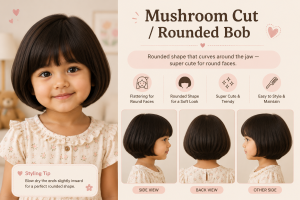
Little girl with a mushroom cut rounded bob hairstyle featuring soft curved ends around the jawline, shown in front, side, and back views in a pastel hairstyle infographic.

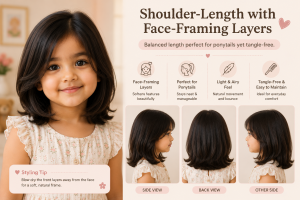
Shoulder-Length with Face-Framing Layers

Balanced length perfect for ponytails yet tangle-free.
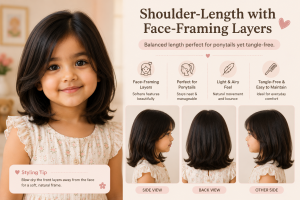
Young girl with a shoulder-length haircut and soft face-framing layers, shown in front, side, and back views in a pastel hairstyle infographic highlighting ponytail-friendly and tangle-free styling.

Pixie with Longer Top

Short sides with longer, textured top — bold and very low-maintenance.
Little girl with a pixie haircut featuring short sides and a longer textured top, shown in front, side, and back views in a pastel hairstyle infographic highlighting its bold and low-maintenance style.

Curly Shag / Textured Layers

Celebrates natural curls and waves while controlling frizz.
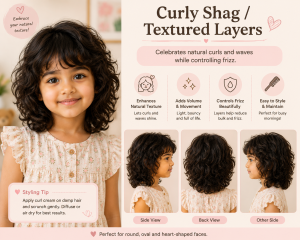
Little girl with a curly shag haircut and textured layers, shown in front, side, and back views in a pastel hairstyle infographic highlighting natural curls, volume, and frizz control.

Long Layers with Curtain Bangs

Soft, side-swept bangs with flowing layers — very trendy.
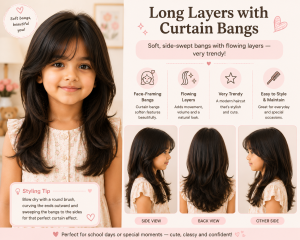
Young girl with long layered hair and soft curtain bangs, shown in front, side, and back views in a pastel hairstyle infographic highlighting flowing layers and trendy face-framing bangs.

Asymmetrical Bob

One side slightly longer for a fun, playful personality.
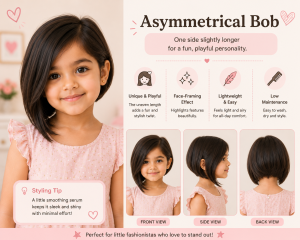
Little girl with an asymmetrical bob haircut featuring one side slightly longer than the other, shown in front, side, and back views in a pastel hairstyle infographic highlighting its playful and stylish look.

A-Line Bob

Slightly longer at the back, shorter in front — elegant shape.
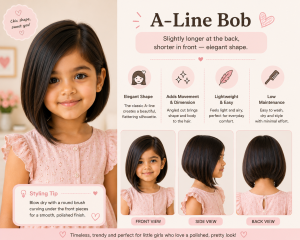
Little girl with an A-line bob haircut featuring a shorter front and slightly longer back, shown in front, side, and back views in a pastel hairstyle infographic highlighting its elegant and polished shape.

Chin-Length Bob

Short and neat, perfect for hot Indian summers.
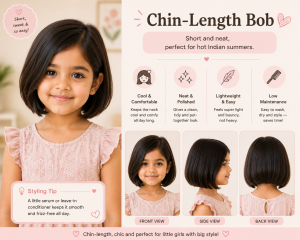
Little girl with a chin-length bob haircut featuring a short, neat style, shown in front, side, and back views in a pastel hairstyle infographic highlighting its lightweight and summer-friendly look.

V-Cut Layers

Layers forming a soft V shape at the back — adds beautiful movement.
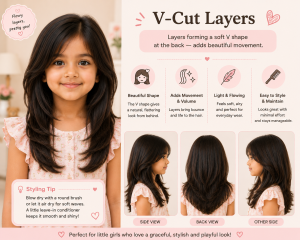
Little girl with long V-cut layered hair featuring a soft V shape at the back, shown in front, side, and back views in a pastel hairstyle infographic highlighting movement and flowing layers.

Baby Bangs with Medium Length

Short, wispy bangs with shoulder-length hair.
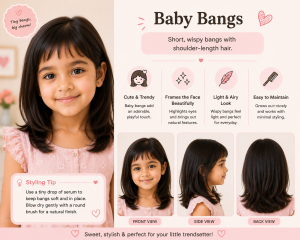
Little girl with short wispy baby bangs and shoulder-length hair, shown in front, side, and back views in a pastel hairstyle infographic highlighting its cute and trendy look.

Side-Swept Bangs Bob

Bangs swept to one side for a sweet, soft look.
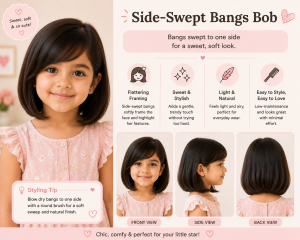
Little girl with a side-swept bangs bob haircut, featuring bangs brushed to one side and a soft bob style, shown in front, side, and back views in a pastel hairstyle infographic.

Textured Crop

Short, choppy layers all over — modern and sporty.
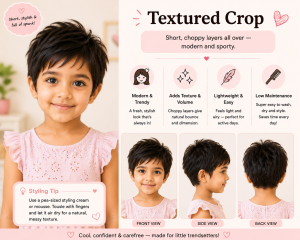
Little girl with a textured crop haircut featuring short choppy layers, shown in front, side, and back views in a pastel hairstyle infographic highlighting its sporty, modern, and low-maintenance style.

Butterfly Cut Light, feathered layers that frame the face beautifully.
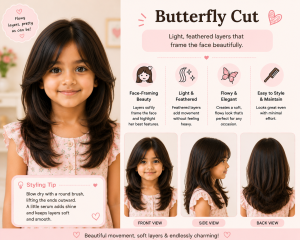
Little girl with a butterfly cut hairstyle featuring light feathered layers framing the face, shown in front, side, and back views in a pastel hairstyle infographic highlighting soft movement and flowy layers.

Shaggy Bob Messy, textured bob with lots of movement.
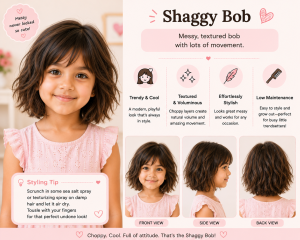
Little girl with a shaggy bob haircut featuring messy textured layers and wispy bangs, shown in front, side, and back views in a pastel hairstyle infographic highlighting movement and volume.

French Bob Classic short bob with slight inward curl at the ends.

Little girl with a French bob haircut featuring a classic short bob and softly curled inward ends, shown in front, side, and back views in a pastel hairstyle infographic highlighting its chic and timeless look.

Ponytail-Friendly Medium Cut Layers that can be easily tied up or left loose.
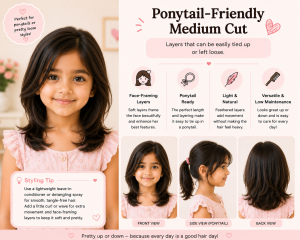
Little girl with a ponytail-friendly medium haircut featuring soft layers that can be tied up or worn loose, shown in front, side ponytail, and back views in a pastel hairstyle infographic.

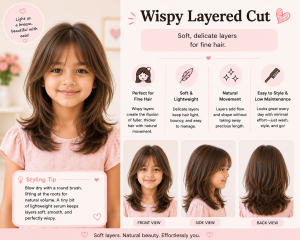
Wispy Layered Cut Soft, delicate layers for fine hair.
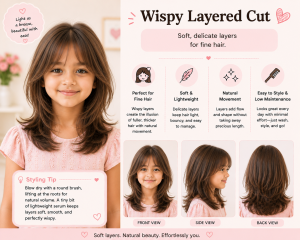
Little girl with a wispy layered haircut featuring soft delicate layers for fine hair, shown in front, side, and back views in a pastel hairstyle infographic highlighting lightweight movement and natural volume.

Heart-Shaped Face Framing Layers Layers designed to soften and flatter heart-shaped faces.
Little girl with heart-shaped face framing layers featuring soft layered hair designed to flatter heart-shaped faces, shown in front, side, and back views in a pastel hairstyle infographic.

Blunt Cut with Hidden Layers Clean blunt exterior with invisible internal layers for thickness.
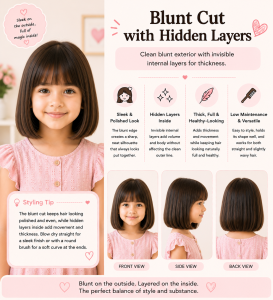
Little girl with a blunt haircut featuring hidden internal layers for added thickness, shown in front, side, and back views in a pastel hairstyle infographic highlighting its sleek and polished look.

Half-Up Friendly Bob Perfect length for half-up styles and clips.

Pageboy Cut Classic rounded style with bangs — vintage yet adorable.

Soft Feathered Layers Gentle feathering around the face for a delicate look.

Minimal Trim with Long Layers Just trimming ends + light layers to maintain length for traditional hairstyles.

Bouncy Layered Lob (Long Bob) Shoulder-to-armpit length with bouncy layers.

Curtain Bangs + Shoulder Bob Most requested combination in 2026.

Indian Mom Favorites

  • School-ready two ponytails with layers
  • Festival bob with flower clips or gajra
  • Gentle trim to keep length for choti and family functions

How to Prepare Your Toddler for Haircut Day

  • Read positive books about haircuts
  • Role-play with dolls
  • Choose a kid-friendly salon
  • Carry favorite toy and snacks
  • Book morning appointments

Daily Hair Care Routine

  • Wide-tooth comb or detangling brush
  • Coconut/almond oil before bed
  • Mild shampoo 2–3 times a week
  • Trim every 8–12 weeks
  • Easy styles: bubble ponytails, half-up buns, simple braids

🌸

More Helpful Resources

Trusted websites for 3 years baby girl haircut ideas & tips

💡 These are external resources for additional reading. Always consult a professional for your child’s hair.

FAQs About 3 Years Baby Girl Haircut

What is the best 3-year-old baby girl haircut for Indian hair?

The Layered Bob and Shoulder-Length with Face-Framing Layers are the most recommended for Indian hair. They reduce tangles in humid weather, add volume to fine hair, and are easy to maintain for daily school routines.

At what age should I get my baby girl’s first proper haircut?

Most experts suggest between 18 to 36 months. At 3 years, most toddlers have enough hair length to benefit from a proper style while still being manageable.

Will cutting my daughter’s hair make it grow thicker or faster?

No. This is a common myth. Hair thickness and growth rate are determined by genetics. A good haircut only makes the hair look healthier, shinier, and fuller.

Should I keep her hair short or long at age 3?

Shoulder-length is usually the sweet spot. It is long enough for cute ponytails and braids but short enough to avoid constant tangles and discomfort in Indian summers.

How often should I trim my 3-year-old’s hair?

Every 8–12 weeks is ideal. Regular trims prevent split ends and help maintain the shape of the haircut.



Gentle Sleep Training: No-Cry Methods for Babies

Gentle sleep training for babies using no-cry methods with mother soothing sleeping infant in a calm nursery

Edited by: MomSaathi Editorial Team

Reviewed by: Certified Infant Sleep Consultant & Pediatric Team

Every exhausted parent knows the drill. You rock, feed, bounce, and sing your baby to sleep only to tiptoe out of the room and hold your breath—hoping this time they’ll stay down. Minutes later, the cries start again. If you’ve been searching for a kinder way to teach independent sleep without leaving your little one to cry it out alone, gentle sleep training might be the answer you’ve been waiting for.

Gentle sleep training, often called “no-cry” or “low-cry” sleep training, focuses on gradual, responsive methods that respect your baby’s emotional needs while building healthy sleep habits. Unlike more rigid cry-it-out approaches, it emphasizes presence, consistency, and small steps that help your baby learn to self-soothe without feeling abandoned. Parents love it because it aligns with attachment parenting values while still delivering real results—longer stretches of sleep for everyone.

In this comprehensive guide, we’ll walk through everything you need to know: why gentle sleep training works, when to start, the most effective methods, a complete step-by-step plan, troubleshooting tips, and long-term success strategies. By the end, you’ll feel confident creating peaceful nights that nurture your baby’s security and your sanity.

Why Baby Sleep Matters More Than You Think

Babies aren’t born knowing how to sleep through the night. Their tiny bodies are wired for frequent wake-ups—evolutionarily designed for safety and feeding in those early months. Newborns sleep in short cycles of 45-60 minutes, waking often between light and deep sleep stages. By 4-6 months, their circadian rhythms mature, and they become capable of longer stretches.

Yet many parents face fragmented nights long after that. Poor sleep in babies leads to crankiness, feeding struggles, and developmental hiccups. For parents, chronic sleep deprivation raises risks of postpartum anxiety, relationship strain, and even unsafe driving. Quality sleep supports brain development, immune function, and emotional regulation in your little one. Gentle sleep training bridges the gap between your baby’s natural needs and sustainable rest—without forcing independence too soon.

What Is Gentle Sleep Training Exactly?

At its core, gentle sleep training teaches babies to fall asleep (and back to sleep) with minimal parental intervention—but never in isolation. You stay responsive, offering comfort while slowly fading your involvement. The goal isn’t zero tears (some fussing is normal during any change), but far less distress than traditional methods.

Popular experts like Elizabeth Pantley (The No-Cry Sleep Solution), Tracy Hogg (The Baby Whisperer), and Kim West (The Sleep Lady’s Good Night, Sleep Tight) pioneered these approaches. They focus on three pillars:

  • Responsiveness: Responding promptly to cries builds trust.
  • Gradual fading: Slowly reduce hands-on help over nights or weeks.
  • Consistency: Same routine, same cues, same loving boundaries.

This differs sharply from cry-it-out (extinction) or even check-and-console (Ferber) methods, where babies are left alone for set intervals. Gentle approaches take longer—often 2-4 weeks—but many families report less parental guilt and stronger bonds. Research shows all sleep training methods can improve sleep without long-term harm when done lovingly, but gentle ones often feel more intuitive for sensitive babies or parents.

The Proven Benefits of Gentle Sleep Training

Parents who choose gentle methods often see:

  • Better overall sleep: Longer nighttime stretches and more predictable naps within weeks.
  • Emotional security: Babies learn self-soothing while knowing a caregiver is nearby, reducing separation anxiety later.
  • Stronger parent-child bond: No “training against” your instincts.
  • Healthier family dynamics: Less stress means happier days and better parental mental health.
  • Sustainable habits: Skills that last through toddlerhood and beyond.

Studies confirm sleep training (gentle or otherwise) reduces bedtime resistance and night wakings, with benefits persisting months later. Babies get more restorative deep sleep, which fuels growth and learning. Parents report lower anxiety and more energy.

One mom I spoke with (we’ll call her Priya from Bangalore) shared: “My 5-month-old screamed for 45 minutes with Ferber checks. With pick-up-put-down, she fussed for 10-15 minutes the first few nights, but she always knew I was right there. Now she settles in under five minutes—and we both wake up smiling.”

When Is Your Baby Ready for Gentle Sleep Training?

Most experts agree the sweet spot is 4-6 months. By then, babies have:

  • Developed a more mature circadian rhythm.
  • Dropped most night feedings (or can go 5-6 hours without one).
  • Shown signs of self-soothing (sucking fingers, rolling to a favorite position).

Look for readiness cues: consistent bedtime fussiness that isn’t hunger or discomfort, ability to stay awake longer during the day, and interest in exploring hands or toys. Never start during major changes like teething, illness, travel, or developmental leaps (hello, 4-month and 8-month regressions).

If your baby is under 4 months, focus on establishing soothing routines instead. Premature or medically complex babies may need pediatrician clearance first.

Popular Gentle Sleep Training Methods: Which One Fits Your Family?

Here are the most effective, parent-tested approaches:

  1. Pick-Up/Put-Down Method (Tracy Hogg’s favorite) Place your drowsy but awake baby in the crib. If they cry, pick them up and soothe (rock, pat, shush) until calm—but not fully asleep. Put them back down. Repeat as needed. Over nights, your touch becomes briefer. Ideal for 4-8-month-olds who need lots of reassurance. Many parents see progress in 7-14 days.
  2. Chair Method (Camping Out or Sleep Lady Shuffle): Sit in a chair beside the crib while your baby falls asleep. Offer verbal reassurance or a gentle pat without picking up. Each night, move the chair farther away (toward the door, then the hallway). This gradual distancing teaches independence while keeping you visible. Perfect for babies who protest separation. Takes 2-3 weeks but feels very low-stress.
  3. Fading/Bedtime Fading Method: Gradually reduce the intensity of your current sleep associations. If you rock for 20 minutes now, rock for 15, then 10, then just pat in the crib. Or shift bedtime 15 minutes earlier each night to match natural tiredness. This method is highly customizable and often produces the least crying.
  4. Scheduled Awakenings For babies who wake predictably at night, gently wake them 15-30 minutes before their usual cry time and help them resettle. Over time, the pattern breaks. Great for night-waking specialists.

Many families combine elements—starting with pick-up-put-down and fading into the chair method. Choose what matches your energy and your baby’s temperament.

Building the Perfect Sleep Foundation First

Success starts before any training begins. Create an optimal environment:

  • Dark, cool room (68-72°F / 20-22°C) with white noise.
  • Safe crib: Firm mattress, no pillows or blankets under 12 months (use sleep sacks).
  • Consistent bedtime routine (30-45 minutes): Bath, dim lights, massage, book, lullaby, feed, crib. Use the same “key words” like “night-night time” every night.

Aim for age-appropriate wake windows: 2-3 hours for 4-6-month-olds. Over-tired babies fight sleep harder.

Your 14-Day Gentle Sleep Training Plan

Days 1-3: Preparation Phase Track current sleep for 3 days. Establish the routine. Practice putting the baby down drowsy but awake at naps.

Days 4-7: Introduce Your Chosen Method. Follow the steps above at bedtime first (easiest time). Stay consistent. Log progress in a simple notebook: bedtime, wake-ups, settling time.

Days 8-14: Fade and Reinforce. Reduce support further. Celebrate small wins—maybe a longer stretch or quicker self-settling. If nights feel tough, return to more support temporarily.

Remember: Consistency beats perfection. One off night won’t undo everything.

Handling Challenges Like a Pro

  • Sleep regressions: Teething, milestones, or illness can disrupt progress. Pause training, offer extra comfort, then gently restart.
  • Partner differences: Team up—one handles bedtime, the other supports. Discuss your “why” together.
  • Parental doubt: It’s normal to second-guess. Remind yourself: responsive doesn’t mean no boundaries.
  • Daycare or shared care: Share your routine notes so everyone stays aligned.

If crying feels overwhelming, take breaks and reassess with your pediatrician.

Pro Tips for Lasting Sleep Success

  • Track sleep with a simple app or journal.
  • Prioritize your own rest—tag-team with partners or family.
  • Avoid sleep props that create new dependencies (like always feeding to sleep).
  • Transition to toddler beds mindfully around 18-24 months.
  • Celebrate milestones: A full night’s sleep deserves cake!

Busting Common Myths About Gentle Sleep Training

Myth: Gentle methods mean no crying ever. Fact: Some fussing happens during change—it’s communication, not distress.

Myth: It spoils babies. Fact: Responsive parenting builds secure attachment.

Myth: Only cry-it-out works fast. Fact: Gentle methods may take longer but often stick better long-term.

Myth: All babies need the same method. Fact: Every child is unique—adapt and observe.

Your Peaceful Nights Are Closer Than You Think

Gentle sleep training isn’t a quick fix, but it’s a loving investment in your family’s well-being. By honoring your baby’s need for closeness while teaching independence, you create a foundation of trust that lasts far beyond infancy.

Start small, stay consistent, and trust the process. Thousands of parents worldwide have transformed chaotic nights into restful ones using these compassionate techniques. You can too.

If your baby has special health needs or you’re struggling after two weeks, consult your pediatrician or a certified infant sleep consultant. Sweet dreams—your whole family deserves them.

Trusted Resources for Gentle Sleep Training

Frequently Asked Questions About Gentle Sleep Training

How long does gentle sleep training actually take?

Most families notice real progress within 7–14 days, with solid independent sleep habits forming in 2–4 weeks. Every baby is different—some settle quickly, while others need the full gradual fade. Patience and consistency are key; rushing usually backfires.

Is gentle sleep training safe for my baby’s emotional health?

Yes. Gentle methods keep you present and responsive, which supports secure attachment. Studies show no long-term negative effects on emotional development when sleep training is done with love and sensitivity. Your baby learns that you’re there for them even as they gain independence.

Can I start gentle sleep training with a newborn?

It’s best to wait until 4–6 months when your baby’s sleep cycles mature. For newborns, focus on responsive feeding, soothing routines, and safe co-sleeping or bassinet habits instead. Starting too early can create unnecessary stress for both of you.

What if my baby has always been rocked or fed to sleep?

Gentle sleep training is actually designed for babies with strong sleep associations. The fading methods slowly replace rocking or feeding with lighter support, so the transition feels natural rather than abrupt. Many parents successfully retrain 6–9-month-olds who have relied on these habits for months.

How much crying is normal during gentle sleep training?

Expect some fussing or protesting—usually 5–15 minutes the first few nights—but it’s typically much less intense than cry-it-out methods. If crying escalates beyond 20 minutes or seems truly distressed, pause, offer full comfort, and try the next night again. Trust your parental instinct.

Does gentle sleep training work if I’m still breastfeeding at night?

Absolutely. You can keep night feeds while training. Simply nurse or bottle-feed first, then use your chosen method to settle baby back in the crib drowsy but awake. Over time, many babies naturally space out feeds as they learn to link sleep cycles.


Best Weight Gain Foods for Babies: The Ultimate Guide for Indian Parents

Indian diet plan for baby weight gain, ragi for babies

Edited by: MomSaathi Editorial Team

Reviewed by: Based on infant nutrition and complementary feeding guidelines from WHO & UNICEF

Every Indian mother has likely heard the phrase, “Baby thoda kamzor lag raha hai” (The baby looks a bit weak) from a well-meaning relative. As parents, our world revolves around those tiny milestones, and seeing the weight scale budge even a little feels like a personal victory.

If you are constantly worried that your little one isn’t “chubby” enough or if you’re struggling with a picky eater, you aren’t alone. While every baby has a unique body type, ensuring they get the right nutrients is vital for their overall development. In this guide, we will explore the most effective weight-gain foods for babies, specifically tailored for the Indian kitchen, to help your child grow healthy, strong, and active.

Why is Weight Gain Important for Babies?

Weight gain isn’t just about “chubby cheeks.” In the first two years of life, a baby’s body and brain undergo rapid transformation. Proper weight gain is a primary indicator that your baby is receiving adequate nutrition.

  • Brain Development: Healthy fats are essential for the formation of brain tissues and the nervous system.

  • Immunity: A well-nourished baby has a stronger immune system to fight off common Indian seasonal infections like colds and stomach flu.

  • Physical Milestones: Babies need energy (calories) to reach milestones like crawling, standing, and walking.

  • Organ Growth: Consistent weight gain ensures that internal organs are developing at the right pace.

You can track your baby’s progress using the official WHO Child Growth Standards to see if they are within the healthy range for their age.”

Common Reasons for Poor Weight Gain in Babies

Before we dive into the baby weight gain diet, it is important to understand why some babies struggle to put on weight:

  1. Distracted Eating: As babies become more mobile, they are often too busy exploring to focus on eating.

  2. Frequent Illness: Common bouts of teething, diarrhea, or cough can lead to temporary weight loss.

  3. Metabolism: Just like adults, some babies simply have a high metabolic rate.

  4. Low Calorie-Density: Sometimes, a baby’s tummy gets full of water or thin soups (like plain dal paani) before they get enough calories.

  5. Prematurity: Babies born early may take longer to catch up on the growth chart.


Top 15 Weight Gain Foods for Babies (India Edition)

When looking for foods for baby weight gain in India, we are lucky to have a pantry full of nutrient-dense options. Here are the top 15 foods to include in your baby’s meals:

1. Breast Milk

Benefits: It is the ultimate superfood. It contains the perfect balance of fats, proteins, and vitamins tailored specifically for your baby.

  • Age: 0 to 2 years.

  • How to give: On-demand feeding for infants under 6 months; as a supplement to solids after 6 months.

2. Ghee (Clarified Butter)

Benefits: Ghee is a powerhouse of healthy fats and is incredibly calorie-dense. It aids digestion and improves bone health.

  • Age: 6+ months.

  • How to give: Add half a teaspoon to dal, khichdi, or mashed potatoes.

3. Bananas (Kerala Banana/Nendran Powder)

Benefits: High in potassium, Vitamin C, and carbohydrates. It is a classic weight-gain food for babies.

  • Age: 6+ months.

  • How to give: Mashed ripe banana or steamed and powdered Kerala banana porridge (Kannankaya).

4. Ragi (Finger Millet)

Benefits: Rich in calcium, iron, and dietary fiber. It helps in healthy bone development and weight gain.

  • Age: 6+ months.

  • How to give: As a sweet or savory porridge (Ragi malt) made with milk or water.

5. Sweet Potatoes

Benefits: They are easy to digest and packed with Vitamin A and fiber. The natural sugars provide a steady energy boost.

  • Age: 6+ months.

  • How to give: Boiled, mashed, or pureed with a drop of ghee.

6. Pulses and Dals

Benefits: Dals like Moong and Masoor are excellent sources of plant-based protein.

  • Age: 6+ months.

  • How to give: Start with “Dal Paani” (water), then move to thick mashed dal and khichdi.

7. Full-Fat Yogurt (Curd)

Benefits: Provides calcium and healthy fats while the probiotics keep the baby’s gut healthy.

  • Age: 7-8+ months.

  • How to give: Plain homemade curd or mixed with fruit purees like mango or banana.

Read Also: How to Soothe a Teething Baby: A Mother’s Guide

8. Avocado (Butter Fruit)

Benefits: Though not traditionally Indian, it is widely available now and is the best source of healthy monounsaturated fats.

  • Age: 6+ months.

  • How to give: Mashed avocado on its own or spread on a small piece of roti.

9. Eggs

Benefits: A complete protein source. The yolk contains healthy fats and cholesterol needed for brain growth.

  • Age: 8+ months (start with yolk; introduce whites after 1 year if there are no allergies).

  • How to give: Hard-boiled mashed yolk, scrambled eggs, or egg bhurji.

10. Paneer (Cottage Cheese)

Benefits: High in protein and calcium. It is a great finger food for toddlers.

  • Age: 8+ months.

  • How to give: Small cubes, grated into parathas, or mashed with vegetables.

11. Dry Fruit Powder

Benefits: Almonds, cashews, and walnuts are calorie-dense and rich in micronutrients.

  • Age: 8+ months (Powder form only to prevent choking).

  • How to give: Add a teaspoon of homemade dry fruit powder to milk, porridge, or halwa.

12. Chickpeas (Chole/Hummus)

Benefits: High in protein, fiber, and iron.

  • Age: 8-10+ months.

  • How to give: Boiled and mashed or made into a mild hummus.

13. Potatoes

Benefits: A great source of carbohydrates that are very easy on a baby’s stomach.

  • Age: 6+ months.

  • How to give: Mashed with ghee and a pinch of cumin (jeera) powder.

Check out our Indian baby food chart for 6 to 12 months.

14. Full-Fat Dairy Milk

Benefits: Provides essential fats and Vitamin D.

  • Age: Strictly after 12 months.

  • How to give: Use it to make kheer, puddings, or give it in a glass twice a day.

15. Chicken or Fish

Benefits: Excellent sources of lean protein and Omega-3 fatty acids.

  • Age: 8+ months.

  • How to give: Finely shredded chicken in khichdi or steamed, deboned fish mash.

“For a complete list of nutritious meals, check out our Indian Baby Food Recipes library.”

Indian Diet Plan for Baby Weight Gain

Creating a baby weight gain diet requires a balance of carbohydrates, fats, and proteins. Here is a sample plan:

For 6 to 12 Months

  • Early Morning: Breast milk or formula.

  • Breakfast: Ragi porridge with a teaspoon of ghee.

  • Mid-Morning: Mashed banana or chikoo.

  • Lunch: Moong Dal Khichdi (mashed) with ghee and carrots.

  • Evening: Stewed apple or pear.

  • Night: Breast milk or formula.

For 1 to 2 Years

  • Breakfast: One small stuffed aloo paratha (with ghee) or an egg omelet.

  • Mid-Morning: A cup of full-fat yogurt or a small bowl of fruit.

  • Lunch: Roti soaked in dal/chicken curry or curd rice with a side of steamed veggies.

  • Evening: Suji halwa or a glass of dry-fruit milk.

  • Dinner: Paneer bhurji with soft rice or vegetable oats.

“Ragi is a miracle grain for growth. Learn how to make the perfect Ragi Malt for Babies in under 10 minutes.”

Healthy Tips to Increase Baby Weight

Beyond just the food, how you feed matters. Here are some healthy baby weight gain tips:

  1. Don’t Force Feed: This creates a negative association with food. Let the baby decide when they are full.

  2. Add Healthy Fats: Always add a teaspoon of ghee, butter, or olive oil to every meal.

  3. Offer Frequent, Small Meals: A baby’s stomach is about the size of their fist. They need to eat every 2-3 hours.

  4. Limit Fluids Before Meals: Don’t give water or juice 30 minutes before a meal, as it fills up their tiny stomachs.

  5. Make Food Visually Appealing: Use colorful vegetables and different shapes to pique their interest.

  6. Encourage Self-Feeding: Letting them touch and feel food (even if it’s messy!) encourages them to eat more.

Foods to Avoid

While we want weight gain, we want healthy weight gain. Avoid these “empty calories”:

  • Sugar and Salt: Avoid for babies under 1 year.

  • Fruit Juices: They are mostly sugar and lack the fiber of whole fruit.

  • Canned/Processed Foods: High in sodium and preservatives.

  • Junk Food: Biscuits, chips, and candies offer no nutritional value.

  • Whole Nuts: These are a major choking hazard; always use powder or paste.

When to Consult a Doctor

It is important to remember that a “thin” baby is not necessarily an unhealthy baby. However, consult your pediatrician if:

  • The baby stops gaining weight for more than two months.

  • The baby is consistently crossing downward on their growth centile charts.

  • The baby is lethargic, unusually pale, or shows signs of extreme pickiness.

  • The baby has persistent diarrhea or vomiting.

If you are concerned about your baby’s growth, it is always best to consult a professional. For more detailed medical milestones, refer to the Mayo Clinic’s guide on infant growth.

FAQs (Frequently Asked Questions)

1. Which fruit is best for a baby’s weight gain?

Bananas, Chikoo (Sapodilla), and Mangoes are the best high-calorie fruits for babies in India. They are rich in natural sugars and easy to digest.

2. Can I give my 7-month-old ghee every day?

Yes, you can add about half a teaspoon of ghee to your baby’s meals daily. It provides essential healthy fats for brain development.

3. Is Ragi good for weight gain?

Absolutely. Ragi is one of the best foods for baby weight gain in India. It is calorie-dense and loaded with calcium and iron.

4. Why is my baby not gaining weight despite eating well?

It could be due to a high activity level, a recent illness, or a high metabolism. If you are concerned, check with a doctor to rule out any underlying malabsorption issues.

5. Can I give cow’s milk to my 10-month-old?

No. Cow’s milk should only be introduced as a primary drink after 12 months, as it is difficult for an infant’s kidneys to process and may lead to iron deficiency.

Trusted Expert Resources for Parents

WHO Child Growth Standards

Track your baby’s weight, height, and development using the globally accepted growth charts by the WHO.

View Growth Charts →

NHS – Help Your Child Gain Weight

Practical and safe advice from the UK’s NHS on helping underweight children gain weight healthily.

Read NHS Guide →

Mayo Clinic – Infant Growth Guide

Understand normal growth patterns in your baby’s first year, including weight and milestones.

Explore Guidelines →

Indian Academy of Pediatrics (IAP)

Trusted Indian pediatric guidelines on child nutrition, feeding practices, and healthy growth.

Visit IAP Website →

Conclusion

Patience is the most important ingredient in any baby weight gain diet. Every child grows at their own pace, and as long as your baby is active, meeting milestones, and happy, you are doing a great job! Focus on providing a variety of nutrient-dense weight-gain foods for babies and keep the mealtime environment positive.

For more expert advice on baby care tips and a detailed feeding guide, stay tuned to MomSaathi.com.

What is your baby’s favorite weight-gain food? Let us know in the comments below!

Do Diapers Expire? Is It Safe to Use Old Diapers for Baby?

do diapers expire safety and shelf life guide

Edited by: MomSaathi Editorial Team

Reviewed by: Based on baby care safety and hygiene guidelines from WHO & parenting health resources

Because babies use so many nappies every day, many parents choose to buy them in bulk to save time and money. But this often makes people wonder: Do nappies go bad?

You might be wondering if an old pack of nappies you found at home or ones you plan to use again for your next baby, are still safe.

The good news is that nappies don’t usually have a strict expiration date, but they can stop working over time.

This guide will tell you everything you need to know about the shelf life of nappies, how to use or store old nappies safely, and more.

Do Nappies Go Bad?

The short answer is no, nappies don’t really go bad.

Nappies don’t go bad as baby formula or medicines do. They are made of things like absorbent polymers, paper pulp, and plastic, which don’t get dangerous over time.

Experts say, though, that nappies can be used for about 2–3 years. Even though they are still safe to use, this means they might not work as well after this time.

[irp]

Why Don’t Nappies Have an Expiration Date?

Nappies don’t go bad because:

  • They don’t have any active ingredients that go bad
  • Their materials stay stable chemically
  • If you store them right, they don’t grow bacteria

👉 This is why nappies that haven’t been opened can stay safe for years.

What Happens to Nappies as Time Goes On?

Nappies don’t go bad, but time can change how well they work.

1. Less Absorbent

The gel that absorbs moisture in nappies may break down, making them less effective at doing so.

2. Change of Colour

Nappies that are older may turn yellow when they are in the light and air. This doesn’t make them dangerous; it’s just a normal change.

3. Weak Elastic

Over time, the leg bands may lose their stretch, which can lead to leaks.

4. Bad Adhesive

The sticky tabs might not work right, which could make the nappy loose or not work at all.

Is It Safe to Use Old Nappies on Babies?

Yes, it is usually safe to use old nappies.

They don’t get dangerous or poisonous to your baby’s skin.

👉 But the most important thing is performance, not safety.

[irp]

Problems That Could Happen:

  • Leakage
  • Not a good fit
  • Less absorption
  • Skin irritation (if moisture doesn’t get absorbed well)

If your baby gets rashes or is uncomfortable, stop using the nappy and get a new one.

When Should You Not Use Old Nappies?

You should not use old nappies if:

  • They are older than 2 or 3 years
  • The elastic isn’t tight
  • The tabs with glue don’t stick
  • There is a weird smell
  • The nappy looks ripped or damaged

👉 These signs mean that the nappy might not work right anymore.

How to Safely Use Old Nappies

Follow these tips if you want to use older nappies:

Look Before You Use

Check the nappy for damage, smell, or a drop in quality every time.

Check How Well It Absorbs

Add a little water to see how well it soaks up.

Use for Short Periods

You can use old nappies during the day when you can change them often.

Don’t Use at Night

It’s best not to use them at night because they might leak.

How to Keep Nappies in the Right Place

Nappies can last a long time if they are stored correctly.

Tips for Storing:

  • Store in a cool, dry place
  • Stay away from sunlight and moisture
  • Keep in the original packaging
  • Stay away from dust and water

👉 Nappy materials can be damaged by heat and humidity, which makes them less effective.

Should You Buy a Lot of Nappies at Once?

Buying in bulk can save you money, but think about:

👍 Pros:

  • Saves cash
  • Always have nappies on hand

👎 Cons:

  • The baby may outgrow the size quickly
  • Nappies might not be used for a long time

👉 Tip: Instead of buying a lot, buy a little at a time.

Do Cloth or Eco-Friendly Nappies Go Bad?

  • Cloth nappies don’t go bad, but they might wear out over time
  • Eco-friendly nappies also don’t go bad, but the materials may break down faster

👉 How you store them has a big effect on how long they last.

Dangers of Using Very Old Nappies

Very old nappies may not be dangerous, but they may:

  • Often leak
  • Make things uncomfortable
  • Keep moisture in, which can cause nappy rash

👉 Always put your baby’s comfort and cleanliness first.

When Should You Get Rid of Nappies?

Throw nappies away if:

  • They don’t soak up well
  • They have a strange smell
  • The structure is broken
  • They cause discomfort

👉 It’s better to get rid of them than to put your baby through pain.

Last Thoughts

So, do nappies go bad? Not really. But they don’t last very long in practice.

Most of the time, old nappies are safe, but they might not work as well as new ones.

👉 The key is easy:

  • Check the quality
  • Put away correctly
  • Put your baby’s comfort first

You can safely use unused nappies without worry if you take care of them properly

FAQ: Do Nappies Go Bad?

Do nappies have a date when they will no longer be useful?

No, nappies don’t have a strict expiration date, but you should use them within 2 to 3 years.

Are nappies that are old safe for babies?

Yes, old nappies are safe, but they may not work as well over time.

Do old nappies make rashes?

If they don’t soak up moisture properly, they can cause skin irritation.

For how long can you keep nappies?

If you store them correctly, nappies can last for up to two to three years.

Can I use nappies on my second child?

Yes, as long as they are in good shape and stored correctly.

🔗 Expert Insights & Resources

When Do You Stop Burping a Baby? Complete Guide

Edited by: MomSaathi Editorial Team

Reviewed by: Based on women’s reproductive health and anatomical guidelines from WHO & trusted medical sources

One of the first things new parents learn after feeding their baby is how to burp them. You may find that you give your baby a gentle pat on the back every day. But as your baby gets older, you might start to wonder, “When do you stop burping a baby?”

Not every child will get the same answer. Some babies don’t need to be burped as often as others do. To know when to stop, you need to know how your baby is growing and what they are trying to tell you.

👉 You can explore infant care basics from World Health Organization guidelines.

We’ll tell you everything you need to know in this guide, like when to stop burping your baby, how to tell if they’re ready, and how to make feeding easier.

Why Do Babies Need to Burp?

When babies eat, whether they are breastfeeding or bottle-feeding, they swallow air. It can be uncomfortable, make you fussy, and even make you spit up if you have trapped air.

Burping helps get rid of this air and makes your baby feel better.

Why babies need to be burped often:

  • Not yet fully developed digestive system
  • Quickly eating or gulping down milk
  • Crying while eating
  • Bottle feeding (more air intake)

👉 Burping gets rid of gas and helps stop colic-like pain.

👉 Parenting tips on infant digestion can also be found via UNICEF resources.

When Should You Stop Burping a Baby?

Most babies don’t need to be burped as often after they are 4 to 6 months old.

At this point:

  • Their digestive system gets better
  • They take in less air while eating
  • They can move their bodies more easily, which helps them pass gas naturally

But every baby is unique. Some babies may stop burping earlier, while others may still need to be burped from time to time after 6 months.

👉 Pediatric guidance is also supported by organizations like the American Academy of Pediatrics.

Signs That Your Baby Doesn’t Need to Be Burped Anymore

Look for these signs instead of just looking at age:

1. Baby Eats Calmly

Your baby drinks milk without making a fuss or gulping it down.

2. Less Spitting Up

After feeding, you see less spit-up.

3. No Fussiness After Eating

Your baby looks like they are at ease and comfortable.

4. Let’s Out Gas Naturally

Older babies can move, roll, or sit, which helps them get rid of gas on their own.

5. Goes to Sleep Easily After Eating

A comfortable baby often sleeps soundly without needing to be burped.

👉 If your baby shows these signs all the time, you can slowly stop burping.

Babies Who Are Breastfed vs. Bottle-Fed Babies

How you feed your baby can change how often you need to burp them.

Babies Who Are Breastfed

  • Usually takes in less air
  • Might not need to burp as often
  • Often stop needing to be burped sooner

Babies Who Are Bottle-Fed

  • Tend to take in more air
  • Could need to burp more often
  • It might take longer to stop burping

👉 Choosing the right bottle and feeding position can help them take in less air.

How to Stop Burping

You don’t have to stop burping right away. You can slowly cut it down.

A step-by-step approach:

  • Start by not burping once a day
  • Watch how your baby reacts
  • If your baby is comfortable, lower it even more
  • Keep going only if you need to

👉 Instead of following a strict rule, always listen to what your baby is telling you.

What Happens If You Stop Burping Too Soon?

Stopping too soon could lead to:

  • Fussiness
  • Gas pain
  • Crying after eating
  • More spit-up

If you see these signs, stop burping and try again later.

Do You Have to Burp a Baby Who Is Sleeping?

Not all the time.

You don’t have to wake your baby up to burp them if they fall asleep while eating and look comfortable.

But if your baby tends to get gas or reflux, gentle burping might help.

When Should You Keep Burping?

You might need to keep burping if:

  • Your baby has gas
  • Shows signs of being in pain
  • Has problems with reflux
  • Very fast feeding

👉 Some babies still need to be burped now and then after 6 months.

The Best Ways to Burp

Knowing the right way to burp can help, even if you’re trying to stop.

1. The Over-the-Shoulder Method

Keep your baby upright and gently pat their back.

2. Position of Sitting

Put your baby on your lap and hold their chin up.

3. On Your Lap Face-Down

Put your baby on your lap and gently pat them.

👉 Be gentle all the time; there’s no need to be forceful.

Things Parents Often Do Wrong

Don’t make these mistakes:

  • ❌ Making burps happen
  • ❌ Burping for too long (more than 5 minutes)
  • ❌ Not paying attention to the baby’s comfort signals
  • ❌ Putting too much pressure on them

👉 Burping should be soft and natural.

When to See a Doctor

If you have any of the following, see a paediatrician:

  • Your baby is very fussy after eating
  • A lot of vomiting happens
  • Not gaining enough weight
  • Signs of severe reflux

👉 You can also refer to guidance from the National Health Service for infant health concerns.

Tips for Making Feeding More Comfortable

  • Feed while standing up
  • Take breaks while feeding
  • For bottles, use nipples that flow slowly
  • Keep your baby calm while you feed them

Parents’ Emotional Support

It’s normal not to know when to stop burping your baby. There isn’t a strict set of rules for being a parent.

Every baby is different. What works for one person might not work for another. Follow your gut and watch how your baby acts.

You’re doing a great job of taking care of your baby.

FAQ: When Should You Stop Burping a Baby?

When can I stop burping my baby?

Most babies don’t need to be burped anymore after 4 to 6 months, but it depends on how they are growing and how comfortable they are.

Can I stop burping my baby when they are 3 months old?

Some babies may not need to be burped as often at three months, but it’s best to watch how comfortable they are before stopping completely.

What will happen if I don’t burp my baby?

Your baby might feel gassy or uncomfortable, which could make them fussy or spit up.

Do babies who are breastfed need to burp less?

Yes, babies who are breastfed usually swallow less air and may not need to be burped as often.

Do I need to burp my baby after every meal?

Not all the time. You can burp your baby less as they get older, depending on how comfortable they are.

Potty Trainer Game: Fun & Easy Toilet Training for Toddlers

Edited by: MomSaathi Editorial Team

Reviewed by: Based on child development, storytelling, and moral education practices from UNICEF & trusted learning resources

Potty training is a big step in a toddler’s development, and for parents, it can be both exciting and scary. A lot of moms are worried about accidents, resistance, and how long it will take.

But what if potty training didn’t have to be hard at all?

That is where the idea for a potty training game comes from. Instead of making your child stick to a schedule, you can help them learn by doing fun, playful things that come naturally.

Kids between the ages of 1.5 and 3 are naturally curious and enjoy playing games. Making potty training fun lowers fear, boosts confidence, and speeds up the learning process.

👉 For general child development guidance, you can refer to the World Health Organisation’s child development resources.

This in-depth guide will show you useful potty training games, expert advice, common mistakes to avoid, and a step-by-step method that works best for Indian families.

Why Potty Trainer Games Are So Effective

Toddlers don’t like being pushed, but they love to play.

This is why potty training games work so well:

1. They Help You Feel Less Afraid and Anxious

For a lot of kids, the toilet can be strange or even scary. Playing games makes the place friendly and safe.

2. They Help People Be Independent

Kids are more likely to join in when they feel they’re “playing a role” in a game rather than being told what to do.

3. They Make Good Connections

Kids are more likely to go to the toilet when they know it will be fun, rewarding, or a chance to bond with someone.

4. They Make Learning Faster

Games naturally get kids emotionally and mentally involved, which helps them learn faster.

👉 UNICEF parenting resources also recommend parenting strategies like positive reinforcement.

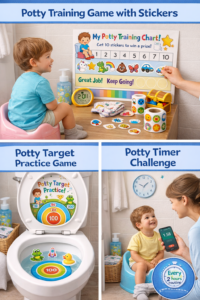
The Best Potty Trainer Games That Really Work

Parents swear by these tried-and-true potty training games:

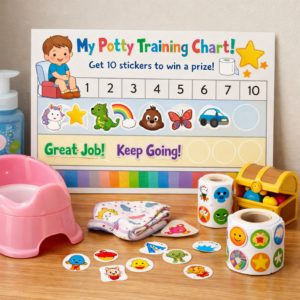
1. Game with Stickers as Rewards

This is one of the easiest but most effective ways.

How to play:

  • Make a potty chart with lots of colours
  • Every time your child sits down or uses the potty, give them a sticker
  • Celebrate big events, like getting five or ten stickers

Why it works:
Visual rewards make toddlers want to do things and make them feel like they’ve done something good.

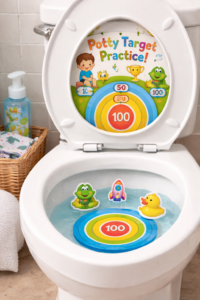
2. Target Practice Game (for Boys in Particular)

Add a goal to make potty time more fun.

How to play:

  • Put a small object that floats, like tissue paper, in the toilet
  • Tell your child to aim at it

How it works:
It makes a boring task into an exciting challenge.

3. The Potty Timer Challenge

When potty training, you need to be consistent.

How to play:

  • Every hour or two, set a timer
  • You can call it a “Potty Time Game” or “Potty Mission”
  • When the timer goes off, take your child to the toilet

Why it works:
It makes things fun while also making a routine that you can count on.

4. Game of Potty Song

Anything can be fun with music, even potty training!

How to play:

  • Sing a special potty song
  • You could also sing a short rhyme while your child is on the potty

How it works:
It calms the child down and takes their mind off their fear or pain.

5. Game for Potty Training with Toys

Kids love to copy their favourite toys.

How to play:

  • Use a doll or a stuffed animal
  • Show how the toy goes to the toilet
  • Tell your child to “teach” the toy

Why it works:
Role-playing helps kids learn and copy how to act.

6. Game of Surprise Rewards

Make the process a little more fun.

How to play:

  • Keep little surprise gifts like stickers, candy, and toys
  • Give them randomly after they use the potty correctly

How it works:
Rewards that come out of nowhere make people more excited and motivated.

7. The Potty Champion Game

Make your child a “champion.”

How to play:

  • Make a badge or title for “Potty Champion”
  • Celebrate your daily or weekly wins

How it works:
It makes people feel good about themselves and gives them more confidence.

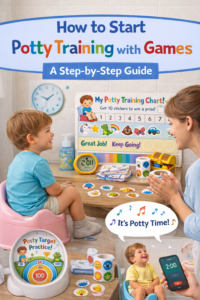
How to Start Potty Training with Games?

A Step-by-Step Guide

If you don’t know where to start, use this simple plan:

Step 1: Look for Signs of Readiness

Make sure your child is ready before you start:

  • Stays dry for at least two hours
  • Is interested in toilets
  • Can follow simple directions
  • Shows that it hurts when they have dirty nappies

👉 You can also explore readiness signs explained by the American Academy of Paediatrics.

Getting started too soon can be frustrating.

Step 2: Pick the Right Setup for the Potty

  • Get a potty seat that is safe for kids
  • If you can, let your child choose their potty
  • Make it easy to get to and comfortable

Step 3: Slowly Start Playing Games

Start with one game, like sticker rewards, and then add more over time.

Step 4: Make a Plan

  • Time to go to the toilet in the morning
  • After eating
  • Before going to bed

Being consistent is more important than being perfect.

Step 5: Celebrate Small Victories

Sitting on the potty is a step in the right direction!

Mistakes Parents Make When Potty Training Their Kids

Even when playing games, mistakes can slow things down.

  • ❌ Making the Child Do It
  • ❌ Starting Too Soon
  • ❌ Punishing Mistakes
  • ❌ Putting Kids Up Against Each Other
  • ❌ Not being consistent

Fear and resistance can come from pressure, and every child grows at their own speed.

Signs That Your Child Is Ready to Start Potty Training

Knowing when you’re ready is very important for success.

Check for these signs:

  • Pulling on wet nappies
  • Hiding while going to the toilet
  • Being interested in how people use the toilet
  • Talking about basic needs

It’s time to start if your child shows more than one sign.

🇮🇳 Tips for Indian Parents on How to Potty Train

There are both good and bad things about potty training in Indian homes.

1. Use Language You Know

Use words your child knows, like “sushoo” or “potty.”

2. Think About Indian Toilets

If you have to use a squat toilet, start with a potty seat to make it more comfortable.

3. Get Help from Family

Grandparents can help kids stick to their routines.

4. Pick Clothes That Are Easy to Wear

Don’t wear complicated clothes when you train.

5. Change for the Weather

Make sure your child is warm and comfortable in colder places.

Tips for Potty Training at Night

Training at night usually takes longer than training during the day.

This is how to make it easier:

  • Don’t drink a lot before bed
  • Before bed, take your child to the toilet
  • Use waterproof mattress covers
  • Be patient; night control takes time to develop

How Long Does It Take to Train a Child?

Every kid is unique.

  • Some learn in just a few days
  • Some people might take weeks or months

The most important things are being consistent, patient, and in a good place.

Emotional Support Matters More Than Technique

The most important thing is that your child feels safe and comfortable while using the potty trainer game.

  • Be calm
  • Encourage a lot
  • Don’t show your anger

Keep in mind that your child is learning something new.

FAQ: Potty Trainer Game

What is a potty trainer game?

A potty trainer game is a fun and interactive way to teach toddlers how to use the toilet. It uses activities like sticker rewards, songs, toys, and challenges to make potty training enjoyable instead of stressful.

Most children are ready for potty training between 18 months and 3 years. However, readiness depends on signs like staying dry for longer periods, showing interest in toilets, and following simple instructions.

Experts like the American Academy of Paediatrics recommend focusing on readiness rather than age.

Potty training can take anywhere from a few days to several weeks or months. Every child learns at their own pace, so patience and consistency are important.

Some of the most effective potty trainer games include:

  • Sticker reward charts
  • Target practice game
  • Potty timer challenge
  • Potty songs
  • Toy role-play games
  • Surprise rewards

These games make learning fun and reduce resistance.

If your child refuses:

  • Take a break for a few days
  • Avoid forcing or scolding
  • Reintroduce potty training using games
  • Encourage gently and stay positive

Pressure can delay learning, while play-based methods improve success.

Accidents are normal during potty training.

  • Stay calm and supportive
  • Avoid punishment
  • Remind your child gently
  • Keep extra clothes ready

Organisations like UNICEF emphasise positive reinforcement over punishment.

Yes, potty trainer games are highly effective because they:

  • Reduce fear and anxiety
  • Increase motivation
  • Build independence
  • Improve learning speed

Play-based learning is one of the best ways for toddlers to understand new habits.

Full Parent’s Guide For Introducing Juices To Infants: At What Age Can Infants Start Drinking Juice?

AAP recommendations for baby juice, whole fruits vs juice for infants, safe juice introduction after 12 months.

Edited by: MomSaathi Editorial Team

Reviewed by: Based on infant nutrition and feeding guidelines from WHO, AAP, and UNICEF

The question that almost all new parents have is: “When is it appropriate to give my baby juice?” This is especially true when your baby starts reaching for your drinks or when you are looking for ways to diversify your baby’s diet.

Juice is generally recommended for babies after 12 months of age according to the American Academy of Pediatrics (AAP). Babies under 12 months are advised against juice consumption, unless there are specific medical reasons (e.g., constipation) as detailed by their doctor.

This guide answers the multitude of questions parents have, including the risks, safe alternatives, and the best practices for when your baby is able to drink juice.

Most Parents’ Guide To Infant Juice Consumption

  • Under 6 months: No juice is recommended. Infants should consume only breast milk or infant formula.
  • 6–12 months: No consumption of juice is recommended by the AAP. Infants should consume breast milk or formula. Additionally, 100% fruit juice offers no advantages over whole fruit and can take the place of important nutrients from milk or formula.
  • 12 months and over: It is recommended that babies have juice, but only in moderation. Infants aged 1–3 years should consume no more than 4 ounces (120 ml) of juice per day.

For older kids:

  • Ages 4–6: Limit to 4–6 ounces daily.
  • Ages 7 and older: Up to 8 ounces daily is the upper limit.

Always give preference to whole fruits rather than juice, especially as your baby gets older. Whole fruits are a better choice because they contain more nutrients and more fiber. This can help your baby’s digestive system as well as keep blood sugar stable.

Why Children Under 1 Year Old Should Not Drink Juice

There are several reasons why juice shouldn’t be given to children before they turn 1 year old:

  • Juice contains a large amount of sugar. Even though the sugar in juice comes from fruit, there are still a lot of calories, which can lead to weight gain and trigger an early preference for sweet tastes.
  • Juice does not contain fiber. The lack of fiber can lead to constipation or diarrhea in some cases.
  • Juice can also lead to early childhood cavities (tooth decay).
  • Juices can displace the intake of breast milk, formula, and iron-rich foods.
  • Babies do not need juice because they receive their vitamins from milk, and later from solid foods.

Official AAP Policy on Fruit Juice: Fruit Juice in Infants, Children, and Adolescents

Exceptions

There are some rare exceptions when it is okay to give a child juice. The most common is when a child is constipated and is more than 6 months old. In that case, a doctor may recommend some diluted juice. However, this must be done exactly as the doctor says. Self-prescribing is not acceptable.

What You Should Know After Your Baby Turns One

After your child turns 1, you can give juice, but follow these rules carefully:

  • Only give 100% pure fruit juice (not fruit drinks or juice cocktails).
  • Dilute the juice with water.
  • Serve it in a cup, not a bottle.
  • Keep juice away from bedtime.
  • Limit juice to mealtimes so your child does not have prolonged exposure to sugars.

Better Alternatives to Juice

  • Whole fruits (mashed, pureed, or served as soft pieces)
  • Plain water
  • Breast milk or infant formula (up to 12 months)
  • Whole cow’s milk or fortified plant-based milk (after 1 year)

Tips for Parents

  • Whole fruits are better than juice because they are more satisfying and provide more nutrients.
  • Water is advised for babies older than 6 months and can be given in small sips during meals.
  • When buying juice, look for labels that say “100% juice” and be cautious of added sugars.
  • If your baby has loose stools or seems unusually fussy after drinking juice, talk to your pediatrician and remove it from their diet.
  • If you want your child to drink milk or water, it’s a good idea to drink those yourself as a role model.

Final Advice

When can babies drink juice? If you want to be safe, don’t let them have any before 12 months, and then let them have as little as possible. Water, milk, and whole fruits are far better for your baby than juice, and they will support their growth and health for a long time.

All babies are unique, so it’s best to check with your pediatrician before giving your baby any new beverages, especially if they have any health problems like reflux, allergies, or constipation.

Further Reading & Official Resources

Have you given your baby juice yet? We want to hear your baby’s age or your baby juice experience in the comments below!

Cluster Feeding Newborns: Why It Happens & What To Do (2026 New Mama Guide)

Edited by: MomSaathi Editorial Team

Reviewed by: Based on medical breastfeeding guidelines and newborn feeding research

Hey, amazing but tired mama! It’s 7 pm, and your newborn has been at your breast for two hours. You’ve changed diapers and done all the sides, rocks, burps, and every magic trick to get your baby to sleep. Little did you know, the moment you put them down, they will start crying and rooting again. This is cluster feeding and is one of the most common (but tiring) things your baby will do when you start breastfeeding (this is a big part of the first few months of your baby’s life). At Momsaathi, we hear this story every day. In this guide, you will learn the reasons why and when cluster feeding is normal. You will learn how long it usually lasts, and most importantly, some practical, gentle ways to survive this feeding frenzy without losing your mind (or your milk). You’ve got this. Let’s convert those endless feeding marathons into manageable and more restful routines.

What Is Cluster Feeding in Newborns?

Cluster feeding is when your baby wants to nurse very frequently. In fact, cluster feeding can look like a baby wants to nurse consistently every 30-60 minutes, and this can last several hours, and generally happens in the evening. This behavior is completely normal, especially between the 2-8 week age range. Babies will cluster feed every evening on a consistent schedule. Although it can seem very overwhelming, cluster feeding serves a very important purpose for both parent and baby.

If your baby is spitting a lot during these feeding sessions, you may want to check out our guide to baby spit up: Why Does My Baby Spit Up After Every Feeding? Safe Remedies.

Why Does Cluster Feeding Happen?

There are several biological reasons behind cluster feeding, and in this case, we will start with Growth Spurts. Around 2-3 weeks, 6 weeks, and around 3 months, babies will have very rapid growth spurts. With every growth spurt comes increased nursing. This is because babies are in need of more calories than usual and therefore need to nurse much more frequently.

Increasing Milk Supply. Your body learns to produce milk more efficiently the more times a baby breastfeeds. If the baby breastfeeds a lot during the evening, the milk supply for the next day is increased.

Soothing and Comfort During the evening, it is not uncommon for a baby to be fussy. Nursing a baby can help soothe the baby, provide skin-to-skin contact, and help them settle down. Big brain and nervous system changes make babies extra needy. Cluster feeding helps them feel secure during developmental leaps. Infants have sleep cycles. If infants have a short breastfeeding, become distracted, or don’t feed during a certain time, they may breastfeed again to make up for it during the evening.

Understanding the “why” makes it easier to respond with patience instead of frustration.

When is cluster feeding most common?

Cluster feeding is most intense between 2 and 8 weeks. The peak of cluster feeding is at 6 weeks, which is when the baby is going through a growth spurt. Most babies will cluster feed again at 3,6 month, and 3-month growth spurts. Most babies tend to cluster feed in the late evening.

Good newborn routines will help with cluster feeding and sleep. More tips can be seen in the Newborn Sleep Schedule (0-3 Months Complete Guide) guide.

Tips for Preparing for Cluster Feeding

Here are some gentle ideas that are actually helpful:

Prepare for it. Prepare a feeding station that is comfortable for you, and consider putting some water and snacks, your phone, and a good movie or podcast. Accept that evenings are going to be busy for some time.

Feed on Demand: Do not try to stretch the time between feeds. Allow your baby to nurse as frequently as they want during cluster feeding. That is how your supply will be boosted.

Switch Sides All The Time During a feeding, offer both breasts to ensure proper drainage and to keep your baby interested.

Use the Football and Laid Back Holds. These can be more comfy during long sessions and will assist you with your letdown.

Get Some Help From Your Partner. Ask your partner to take care of the burping, diaper changes, and soothing between feeds so you can rest your arms and shoulders.

Look After Yourself Make sure to stay hydrated, and eat some snacks that are rich in calories, like oats, nuts, and lactation cookies. It is important to rest when the baby sleeps.

Track Wet Diapers. As long as your baby has more than 6 wet diapers and is gaining weight, they are getting enough milk.

For the official American Academy of Pediatrics guidelines on breastfeeding and cluster feeding, visit: Cluster Feeding and Growth Spurts – HealthyChildren.org.

Will my milk supply/baby’s sleep get affected by cluster feeding?

Actually, the opposite is true. In the long run, cluster feeding helps establish and increase your supply. After the growth spurt, babies often begin to space their feeds out more. Sleep may be disrupted since babies will wake up often. However, this phase should improve as the baby grows, and the parent’s supply becomes more established.

If the night wakings feel too much, our Baby Wake Windows by Age (Newborn to 1 Year Chart) can provide insights on how to manage daytime sleep more effectively.

When to reach out for help

Even though cluster feeding is normal, please reach out to your pediatrician or lactation consultant if:

  • Baby has fewer than 6 wet diapers in 24 hours
  • The baby is not gaining weight well
  • You have severe pain, cracked nipples, or signs of mastitis
  • You feel completely overwhelmed or suspect low supply

Support is out there, and you do not have to figure this out alone.

We appreciate your hard work, mama!

We know it may feel like cluster feeding will never end, but your baby will grow, and your body will adjust. Just try to remember how each session is contributing to your absolutely wonderful baby and your growing supply. You can do it. It won’t feel like this forever. One day, you will remember how your newborn was glued to you, and you will think about it fondly.

We recommend saving this for the next time your baby cluster feeds.

Our momsathi community is here to support and share real tips, so tell us your baby’s age! How do you feel about cluster feeding? Which trick helped you the most?

Send this to a breastfeeding mama to encourage her through the cluster feeding.

This was reviewed by the in-house pediatric and lactation consultant last updated March 2026. Always visit your pediatrician and lactation consultant to get specific recommendations.

Baby Wake Windows by Age (Newborn to 1 Year Chart + Guide for Moms)

Edited by: MomSaathi Editorial Team

Reviewed by: Based on pediatric sleep guidelines and baby wake window research

Hi mama, are you stressing, wondering, “How long should my baby stay awake?” You are not alone. Many parents are asking the same question. It is one of the top categories of baby questions in the first year. That is why we took the time to create a guide that includes a baby awake window chart from 0 to 12 months of age. You will learn the answer to “what are wake windows?”, why do wake windows matter, age recommendations for wake windows, and practical tips to help improve awake window time. We are not going to box you into a strict schedule. We are going to give you realistic, gentle guidance. We are going to turn those overtired meltdowns into happy babbles.

What Are Baby Wake Windows?

Baby wake windows are the duration of baby wake time. It starts when the baby wakes up and ends at the next nap or sleep time.

Why do they matter?

Newborns and young babies have very short attention spans and tire quickly. Staying awake for too long can lead to overtiredness and make it difficult for babies to fall and stay asleep. Conversely, putting them down too early can be frustrating. As babies develop, their brains and nervous systems change rapidly. This is why wake windows change as babies grow. To improve your baby’s night sleep and daytime naps, it’s important to learn the appropriate time to put them to sleep based on their age.

For more information on newborn sleep, check our guide on it: Newborn Sleep Schedule (0–3 Months Complete Guide).

Baby Wake Windows by Age Chart (Newborn to 1 Year)

Here’s a chart that is clear and easy to reference, which shows wake windows by age. These are average, and a baby’s wake windows can be less or more. So, use this as a guide, and be sure to look out for your baby’s sleep cues.

Age Wake Window Range Typical Number of Naps Total Daytime Sleep Notes
0-4 weeks 30-60 minutes 5-8 short naps 8-10 hours Very short! Watch for subtle cues like yawning or staring.
4-8 weeks 45-90 minutes 4-6 naps 7-9 hours Day-night confusion starts improving.
2-3 months 60-120 minutes 4-5 naps 6-8 hours Longer awake periods possible.
3-4 months 75-120 minutes 3-4 naps 5-7 hours Naps consolidate
4-6 months 90-150 minutes 3-4 naps 4-6 hours Many babies drop to 3 naps
6-9 months 2-3 hours 2-3 naps 3-4 hours Longer morning and afternoon naps.
9-12 months 2.5-4 hours 2 naps 2-3.5 hours Morning nap may shorten or drop.

Pro Tip: Always prioritize sleepy cues over the clock. If your baby is yawning, rubbing eyes, or getting fussy, it’s time for sleep — even if the wake window isn’t “perfect.”

Why Wake Windows Change So Much in the First Year

In the newborn stage, your baby’s brain is still learning how to regulate sleep. Short wake windows prevent overstimulation and help them fall asleep before becoming overtired.

As your baby grows: Their stomach grows → longer stretches between feeds Circadian rhythm matures → better day-night distinction Nap needs decrease → longer awake periods

Missing the sweet spot often leads to the “second wind” phenomenon — your baby suddenly seems wide awake and hyper after being overtired.

If you are also experiencing frequent night wakings, check out our guide to Newborn Sleep Schedule (0 to 3 Months Complete Guide), which can be used in conjunction with wake windows.

How to Apply Wake Windows in Real Life

Track for Several Days. For a couple of days, document wake time, signs of tiredness, and duration of naps. You’ll see a pattern in your baby’s sleep cycle.

Be Aware of Sleepy Signs. Some early signs of sleepiness include yawning, rubbing of the eyes, staring, and more. A baby is getting tired. Watch for signs of crankiness, crying, and back arching, as these signs mean they are already overtired.

Create a Routine that can be changed. Use wake windows to guide your baby’s feeding, playing, and sleeping. A daily loose rhythm (avoid strict time-to-time schedules) allows your baby to adapt to a routine.

Be Patient and Flexible for Growth Spurts and Achievements. These things can shorten wake windows temporarily: teething, rolling, up-sitting, or being sick.

Combine this with Safe Sleep Behavior. Always follow AAP offer guidelines for sleep: put him to sleep on his back, chopping woods, and for the first 6 months, the baby can share the room.

Typical Mistakes in the Wake Windows that New Mothers Make

Keeping the baby up for too long, expecting a longer sleep later – usually, this backfires, and the baby ends up with shorter and worse naps. The strict nature of the clock will ignore your child’s cues, leading to mistakes. Also, forget that feeding and playing are included in wake windows, not just non-sleep time.

Every baby is different. While some babies are ready for two-hour wake windows by four months, others still require shorter wake windows. It is always best to trust your baby’s cues over a chart.

For the official American Academy of Pediatrics safe sleep recommendations, visit: How to Keep Your Sleeping Baby Safe: AAP Policy Explained.

You’ve Got This, Mama!

Everything is so much easier when you understand baby wake windows. While this does not guarantee you a perfect evening of sleep, you will be able to more accurately respond to your baby’s cues.

Motherhood is this beautiful and chaotic journey where you will be busy and occupied all the time. The first year of the baby’s life will go by so quickly.

You are doing great and taking one step at a time. You may save this chart about wake windows for babies to see the changing patterns of your baby’s growing age, and how it helps you.

Comment below: How old is your baby and how are wake windows working for you? Have you noticed a big difference after the adjustments to the wake windows? Share your experience — our Momsathi community loves it when moms share their experience!

If nap time is a struggle for a mom friend or her babies are overtired, share this guide with her. Sometimes, seeing a chart pampers the baby’s mother with a feeling of relief.

March 2026 was the last time this article was updated and reviewed by the house pediatric consultant. Every infant has a unique developmental trajectory, and it’s best to reach out to your pediatrician for developmental concerns.

AAP Safe Sleep Guide (most authoritative and relevant): How to Keep Your Sleeping Baby Safe: AAP Policy Explained

Baby Wake Windows by Age (Newborn to 1 Year Chart + Guide for Moms)

Edited by: MomSaathi Editorial Team

Reviewed by: Based on pediatric sleep guidelines and age-based wake window research

Hi mama, are you stressing, wondering, “How long should my baby stay awake?” You are not alone. Many parents are asking the same question. It is one of the top categories of baby questions in the first year. That is why we took the time to create a guide that includes a baby awake window chart from 0 to 12 months of age. You will learn the answer to “what are wake windows?”, why do wake windows matter, age recommendations for wake windows, and practical tips to help improve awake window time. We are not going to box you into a strict schedule. We are going to give you realistic, gentle guidance. We are going to turn those overtired meltdowns into happy babbles.

What Are Baby Wake Windows?

Baby wake windows are the duration of baby wake time. It starts when the baby wakes up and ends at the next nap or sleep time.

Why do they matter?

Newborns and young babies have very short attention spans and tire quickly. Staying awake for too long can lead to overtiredness and make it difficult for babies to fall and stay asleep. Conversely, putting them down too early can be frustrating. As babies develop, their brains and nervous systems change rapidly. This is why wake windows change as babies grow. To improve your baby’s night sleep and daytime naps, it’s important to learn the appropriate time to put them to sleep based on their age.

For more information on newborn sleep, check our guide on it: Newborn Sleep Schedule (0–3 Months Complete Guide).

Baby Wake Windows by Age Chart (Newborn to 1 Year)

Here’s a chart that is clear and easy to reference, which shows wake windows by age. These are average, and a baby’s wake windows can be less or more. So, use this as a guide, and be sure to look out for your baby’s sleep cues.
Age Wake Window Range Typical Number of Naps Total Daytime Sleep Notes
0-4 weeks 30-60 minutes 5-8 short naps 8-10 hours Very short! Watch for subtle cues like yawning or staring.
4-8 weeks 45-90 minutes 4-6 naps 7-9 hours Day-night confusion starts improving.
2-3 months 60-120 minutes 4-5 naps 6-8 hours Longer awake periods possible.
3-4 months 75-120 minutes 3-4 naps 5-7 hours Naps consolidate
4-6 months 90-150 minutes 3-4 naps 4-6 hours Many babies drop to 3 naps
6-9 months 2-3 hours 2-3 naps 3-4 hours Longer morning and afternoon naps.
9-12 months 2.5-4 hours 2 naps 2-3.5 hours Morning nap may shorten or drop.

Pro Tip: Always prioritize sleepy cues over the clock. If your baby is yawning, rubbing eyes, or getting fussy, it’s time for sleep — even if the wake window isn’t “perfect.”

Why Wake Windows Change So Much in the First Year

In the newborn stage, your baby’s brain is still learning how to regulate sleep. Short wake windows prevent overstimulation and help them fall asleep before becoming overtired.

As your baby grows: Their stomach grows → longer stretches between feeds Circadian rhythm matures → better day-night distinction Nap needs decrease → longer awake periods

Missing the sweet spot often leads to the “second wind” phenomenon — your baby suddenly seems wide awake and hyper after being overtired.

If you are also experiencing frequent night wakings, check out our guide to Newborn Sleep Schedule (0 to 3 Months Complete Guide), which can be used in conjunction with wake windows.

How to Apply Wake Windows in Real Life

Track for Several Days. For a couple of days, document wake time, signs of tiredness, and duration of naps. You’ll see a pattern in your baby’s sleep cycle.

Be Aware of Sleepy Signs. Some early signs of sleepiness include yawning, rubbing of the eyes, staring, and more. A baby is getting tired. Watch for signs of crankiness, crying, and back arching, as these signs mean they are already overtired.

Create a Routine that can be changed. Use wake windows to guide your baby’s feeding, playing, and sleeping. A daily loose rhythm (avoid strict time-to-time schedules) allows your baby to adapt to a routine.

Be Patient and Flexible for Growth Spurts and Achievements. These things can shorten wake windows temporarily: teething, rolling, up-sitting, or being sick.

Combine this with Safe Sleep Behavior. Always follow AAP offer guidelines for sleep: put him to sleep on his back, chopping woods, and for the first 6 months, the baby can share the room.

Typical Mistakes in the Wake Windows that New Mothers Make

Keeping the baby up for too long, expecting a longer sleep later – usually, this backfires, and the baby ends up with shorter and worse naps. The strict nature of the clock will ignore your child’s cues, leading to mistakes. Also, forget that feeding and playing are included in wake windows, not just non-sleep time.

Every baby is different. While some babies are ready for two-hour wake windows by four months, others still require shorter wake windows. It is always best to trust your baby’s cues over a chart.

You’ve Got This, Mama!

Everything is so much easier when you understand baby wake windows. While this does not guarantee you a perfect evening of sleep, you will be able to more accurately respond to your baby’s cues.

Motherhood is this beautiful and chaotic journey where you will be busy and occupied all the time. The first year of the baby’s life will go by so quickly.

You are doing great and taking one step at a time. You may save this chart about wake windows for babies to see the changing patterns of your baby’s growing age, and how it helps you.

Comment below: How old is your baby, and how are wake windows working for you? Have you noticed a big difference after the adjustments to the wake windows? Share your experience — our Momsathi community loves it when moms share their experience!

If nap time is a struggle for a mom friend or her babies are overtired, share this guide with her. Sometimes, seeing a chart pampers the baby’s mother with a feeling of relief.

March 2026 was the last time this article was updated and reviewed by the house pediatric consultant. Every infant has a unique developmental trajectory, and it’s best to reach out to your pediatrician for developmental concerns.