Baby Weight Gain Chart India 2026: Boys & Girls

Edited by: MomSaathi Editorial Team

Reviewed by: Pediatric Experts as per WHO 2006 Child Growth Standards & Indian Academy of Pediatrics (IAP) Guidelines

As a new parent in India, one of the most common worries is whether your baby is gaining enough weight. Every milestone feels precious, and questions like “Is my baby’s weight normal?” or “How much should a baby gain each month?” pop up constantly during pediatric visits. This guide explains the baby weight gain chart India context, using reliable standards, practical tips, and what to watch for.

Why Baby Weight Gain Matters in India

Healthy weight gain reflects proper nutrition, growth, and overall development. In India, factors like breastfeeding rates, diverse diets, regional nutrition variations, and common issues such as low birth weight influence patterns. Doctors primarily use the WHO 2006 Child Growth Standards for children under 5 years, as recommended by the Indian Academy of Pediatrics (IAP). These standards are based on optimal growth in breastfed babies from multiple countries, including data relevant to Indian contexts.

Indian-specific charts (like revised IAP charts) apply more for older children (5+ years), but for infants, WHO remains the go-to.

Average Baby Weight at Birth in India

  • Healthy full-term babies: Typically 2.5–4 kg.
  • Boys often average slightly higher (around 2.8–3.2 kg) than girls (2.7–3.1 kg).
  • Low birth weight (<2.5 kg) is common in India and requires closer monitoring.

Babies usually lose 5–10% of birth weight in the first week (due to fluid loss) and regain it by 10–14 days.

Baby Weight Gain Chart by Month
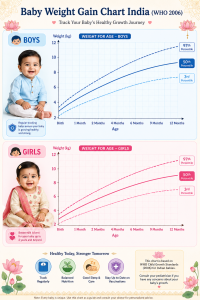
Baby weight gain chart India for boys and girls according to WHO standards 0-12 months

Here’s a practical baby weight chart by month in kg based on WHO standards and Indian pediatric references. These are approximate ranges (3rd to 97th percentile). Every baby is unique—percentiles matter more than absolute numbers.

Also read: Gentle Sleep Training

Track on growth charts during well-baby visits. Consistent curve following is more important than hitting exact averages.

Normal Weight Gain Patterns by Age

  • 0–3 months: Fastest phase – 150–200g per week. Breastfed babies may gain steadily with frequent feeds.
  • 3–6 months: 100–150g per week.
  • 6–12 months: Slows to 70–90g per week as babies become more active and start solids.
  • 12+ months: Focus shifts to balanced growth with family meals.

Factors Affecting Baby Weight Gain in India

Several India-specific elements play a role:

  • Breastfeeding vs. Formula: Exclusive breastfeeding is ideal; the WHO charts suit breastfed babies best.
  • Maternal Nutrition & Health: Postpartum diet, anemia, or gestational issues affect milk supply.
  • Infections & Illnesses: Common colds, diarrhea, or recurrent infections can temporarily slow gain.
  • Socioeconomic & Regional Variations: Access to nutrition, hygiene, and supplements varies across urban/rural India.
  • Genetics & Birth Factors: Family history and prematurity/low birth weight.

When Should You Worry? Red Flags

Consult your pediatrician if:

  • Baby falls below expected percentiles or crosses two lines downward on the chart.
  • Poor feeding, lethargy, fewer than 6–8 wet diapers daily (after the first week).
  • No weight gain for 2–3 weeks or actual weight loss after regaining birth weight.
  • Signs of dehydration, frequent vomiting, or developmental delays.

Early intervention helps most issues.

Also read: Pregnant at 27: Why This Age May Be Perfect for Motherhood

Tips to Support Healthy Weight Gain

  1. Exclusive Breastfeeding for the first 6 months (on demand, 8–12 times/day).
  2. Proper Latch & Technique: Seek lactation support if needed.
  3. Complementary Feeding after 6 months: Nutrient-rich homemade foods like dal-rice khichdi, mashed fruits, fortified cereals.
  4. Regular Check-ups: Follow the IAP/WHO vaccination and growth monitoring schedule.
  5. Skin-to-Skin & Kangaroo Care for low birth weight babies.
  6. Maternal Care: Eat well (include ghee, nuts, dairy, greens in moderation as per cultural practices), stay hydrated, and rest.
  7. Avoid Over-the-Counter Supplements unless prescribed.
Official References & Resources:
→ WHO Child Growth Standards (Official Website)
→ WHO 2006 Growth Charts & Tables (Download)
→ Indian Academy of Pediatrics (IAP) Growth ChartsThese links are provided for reference. Always consult your pediatrician for personalized advice.

Frequently Asked Questions (FAQs)

What is the normal weight gain for a baby in the first month in India?

In the first month, babies typically gain 150–200 grams per week after regaining their birth weight (usually by 10–14 days). This adds up to roughly 600–900 grams in the first month. Breastfed babies on WHO charts often follow this pattern well.

Which growth chart should I use in India – WHO or Indian-specific?

The Indian Academy of Pediatrics (IAP) recommends the WHO 2006 Child Growth Standards for children under 5 years. These are based on healthy breastfed babies from multiple countries, including India. Older Indian charts are no longer preferred for infants.

How do I know if my baby is gaining enough weight?

Track consistent growth along a percentile curve on the chart during regular pediatric visits. Key signs include 6–8 wet diapers daily (after the first week), steady alertness, and meeting developmental milestones. Absolute weight matters less than following the baby’s own growth curve.

Is it normal for Indian babies to weigh less than international averages?

Indian babies often have slightly lower average birth weights (around 2.7–3.2 kg) due to genetic, nutritional, and maternal health factors. However, as long as they follow their growth curve and show no red flags, this is normal. WHO standards account for this diversity.

When should I worry about my baby’s weight gain?

Consult your doctor if:

  • Baby loses more than 10% of birth weight or doesn’t regain it by 2 weeks.
  • No weight gain for 2–3 consecutive weeks.
  • Drops across two or more percentile lines.
  • Shows fewer wet diapers, lethargy, or feeding difficulties.

Screen Time for Toddlers (18 Months to 3 Years): A Practical Guide for Smart, Healthy Use

Edited by: MomSaathi Editorial Team

Reviewed by: Child development specialists and evidence-based pediatric research

In today’s digital world, screens are everywhere — from smartphones and tablets to TVs and laptops. For parents of toddlers, this raises a constant question: Are screens harmful, or can they actually help?

The answer isn’t black and white.

For children between 18 months and 3 years, screens are not automatically bad. What truly matters is how, when, and why screens are used. The difference between passive watching and meaningful engagement can shape your child’s learning, sleep, and overall development.

This guide breaks down everything parents need to know — from age-wise recommendations to practical daily routines — so you can make informed, guilt-free decisions.

Understanding Toddler Brain Development

Between 18 months and 3 years, a child’s brain develops faster than at almost any other time in life. During this stage, toddlers learn primarily through:

  • Real-life interactions
  • Sensory experiences (touch, movement, sound)
  • Conversations with caregivers
  • Play-based exploration

Screens, by nature, are two-dimensional, while the real world is three-dimensional. This creates a learning gap.

A toddler watching something on screen may see a ball, but without guidance, they may not connect it to the ball they play with in real life.

That’s why adult involvement is essential.

Screen Time Guidelines for Toddlers (18 Months to 3 Years)

18 to 24 Months: Careful Introduction

At this stage, it’s best to either avoid screens or introduce them very thoughtfully.

If you do choose to introduce screens:

  • Stick to high-quality, slow-paced content
  • Always watch together
  • Talk about what’s happening on the screen

For example:
“Look, that’s a dog! Just like the dog we saw in the park.”

Without this interaction, toddlers gain very little from screen exposure.

2 to 3 Years: Limited and Structured Use

For children aged 2 to 3 years, screen time can be included in moderation.

Recommended limit:

  • Up to 1 hour per day
  • Focus on educational and age-appropriate content

Even at this stage, co-viewing is strongly encouraged.

Screens should never replace playtime, sleep, or family interaction, as these are critical for brain development.

Why Passive Screen Time Isn’t Effective

Many parents assume that educational videos automatically teach children. However, research and observation show that:

  • Passive watching leads to minimal learning
  • Toddlers struggle to apply what they see to real-life situations
  • Language development suffers without human interaction

The biggest concern isn’t just the screen — it’s what the screen is replacing.

Too much screen time can take away from:

  • Active play
  • Sleep quality
  • Parent-child conversations

These three factors are the foundation of early brain growth.

When Screens Can Actually Help Learning

Not all screen time is equal. When used correctly, screens can support development.

1. Co-Viewing (Most Important)

This is the single most effective way to make screen time beneficial.

Instead of using screens as a babysitter, sit with your child and:

  • Talk about what you’re watching
  • Ask simple questions
  • Relate it to real-life experiences

Example:
“That’s a red ball. You have a red ball too! Where is it?”

This helps toddlers connect digital content with their physical world.

2. Video Calls with Family

Unlike regular screen content, video chatting is interactive.

Platforms like FaceTime or other video call apps allow toddlers to:

  • Hear familiar voices
  • Respond in real-time
  • Build emotional connections

This type of interaction actually supports:

  • Language development
  • Social bonding
  • Emotional security

So yes, talking to grandparents on video calls is not “bad screen time” — it’s meaningful engagement.

How to Manage Toddler Screen Time in Daily Life

Managing toddler screen time doesn’t have to be stressful. With a few simple strategies, it can become a healthy part of your routine.

1. Create a Predictable Routine

Children thrive on structure.

Instead of random screen exposure, set a fixed schedule:

  • “After lunch, we watch for 20 minutes.”
  • “Then we go to the park.”

This predictability reduces tantrums and power struggles.

2. Avoid Screens During Meals

Mealtime should be about:

  • Family bonding
  • Conversation
  • Mindful eating

Screens during meals can lead to:

  • Overeating
  • Reduced attention span
  • Poor communication habits

3. No Screens Before Bedtime

Avoid screens at least 1 hour before sleep.

Why?

  • Blue light affects melatonin (a sleep hormone)
  • Fast-paced visuals overstimulate the brain
  • It becomes harder for toddlers to wind down

Instead, switch to calming activities like:

  • Reading books
  • Storytelling
  • Quiet play

4. Choose Quality Over Quantity

Not all content is created equal.

Look for programs that are:

  • Slow-paced
  • Interactive
  • Language-rich
  • Age-appropriate

Avoid:

  • Fast-cut cartoons
  • Loud, overstimulating visuals
  • Content with no clear learning value

5. Use Screens as a Tool, Not a Habit

Screens should serve a purpose — not fill every gap in the day.

Use them:

  • During specific planned times
  • For educational or social purposes
  • As a shared activity

Avoid using screens as the default solution for:

  • Boredom
  • Tantrums
  • Busy moments

Signs Your Toddler May Be Getting Too Much Screen Time

It’s important to observe your child’s behavior.

Watch out for:

  • Increased irritability
  • Difficulty focusing
  • Delayed speech development
  • Poor sleep patterns
  • Reduced interest in toys or outdoor play

If you notice these signs, consider reducing screen exposure and increasing interactive activities.

Healthy Alternatives to Screen Time

If you’re trying to reduce screen use, here are some simple alternatives:

  • Free play with toys
  • Outdoor activities (park, walks)
  • Reading picture books
  • Music and dance
  • Pretend play
  • Simple art activities

These activities promote:

  • Creativity
  • Motor skills
  • Language development
  • Emotional bonding

Balancing Modern Parenting with Realistic Expectations

Let’s be honest — completely avoiding screens is unrealistic for most families today.

Parents juggle:

  • Work
  • Household responsibilities
  • Personal time

Screens can be helpful when used mindfully.

The goal isn’t perfection. It’s a balance.

If your child watches a show while you finish a task, that’s okay — as long as it doesn’t become the primary form of engagement.

The Role of Parents: What Matters Most

At the end of the day, toddlers learn best from people, not screens.

The most valuable experiences come from:

  • Talking
  • Playing
  • Laughing
  • Cuddling
  • Exploring together

Even when screens are involved, your presence makes all the difference.

A child sitting alone in front of a screen learns very little.
A child watching with a parent learns through connection.

Final Thoughts on Screen Time for Toddlers

Screens are a part of modern life, and they aren’t going away.

For toddlers aged 18 months to 3 years, the focus should not be on eliminating screens, but on using them wisely.

Remember:

  • Keep screen time limited and structured
  • Always prioritize real-world interaction
  • Choose high-quality content
  • Engage with your child during screen use

Because ultimately, it’s not the screen that teaches your child —
It’s the love, conversation, and connection you bring around it.

Frequently Asked Questions (FAQ) on Screen Time for Toddlers (18-24 Months & 2-3 Years)

What is the recommended screen time for toddlers aged 18-24 months?

Screens should be avoided as much as possible. If you do introduce them, use only high-quality, slow-paced, educational content. Always watch together (co-viewing) and talk about what’s happening on the screen to help your child connect it to the real world. Example: “Look, that’s a dog! Just like the one we saw in the park.”

What is the recommended screen time for toddlers aged 2-3 years?

Limit screen time to no more than 1 hour per day. Focus only on high-quality, age-appropriate, educational content. Co-viewing with a parent or caregiver is strongly recommended so your child can learn better and stay engaged.

Why is screen time limited for toddlers in this age group?

Toddlers’ brains grow fastest through real-life interactions, sensory play, conversations, and physical movement. Screens replace these essential activities. Without adult guidance, toddlers often struggle to connect 2D screen images to the real 3D world, leading to less effective learning.

What are the risks of too much screen time for 18-24 month and 2-3 year olds?
  • Delayed speech and language development
  • Increased irritability and tantrums
  • Difficulty focusing and paying attention
  • Poor sleep (blue light affects melatonin)
  • Reduced interest in toys, outdoor play, or real-world exploration
  • Overeating if screens are used during meals

Fast-paced cartoons can overstimulate their developing brain, making it harder to calm down.

What are the benefits of following these screen-time guidelines?
  • Stronger brain development through real-life play and parent-child bonding
  • Better language skills and emotional security
  • Healthier sleep patterns and more physical activity
  • Fewer tantrums and power struggles when routines are predictable

When screens are used thoughtfully with co-viewing, they can actually support learning (especially video calls with family).

What kind of content is considered “good” screen time?
  • Slow-paced, language-rich, and educational (no fast-cut cartoons or loud videos)
  • Interactive or story-based shows that encourage talking
  • Video calls with grandparents or family (these are excellent for social bonding)

Always co-view and relate the content to your child’s real life.

How can parents practically reduce and manage screen time?
  • Create a predictable daily routine (e.g., “After lunch we watch for 20 minutes, then we go to the park”)
  • No screens 1 hour before bedtime
  • Never use screens during meals — use that time for family conversation
  • Avoid screens when your child is bored, throwing a tantrum, or you’re busy — plan ahead with alternative activities
  • Set clear family rules and stick to them
What are healthy alternatives to screen time?
  • Free play with toys
  • Outdoor time (park walks, running, exploring nature)
  • Reading picture books together
  • Music, singing, and dancing
  • Pretend play and simple art/craft activities

These build creativity, motor skills, language, and strong parent-child bonds.

What do experts say about screen time for toddlers? (AAP, WHO, etc.)

The article follows guidelines from the American Academy of Pediatrics (AAP) and World Health Organization (WHO). They emphasize minimal or no screen time under 2 years, maximum 1 hour of high-quality co-viewed content for 2–3 years, and always prioritizing real-life interactions, play, and sleep.

Is it okay to use screens sometimes in modern parenting?

Yes! Completely avoiding screens is unrealistic for many families. The key is mindful, purposeful use — not as a habit or babysitter. Focus on quality over quantity, co-viewing, and balancing with plenty of real-world play, sleep, and love. It’s the conversations and connection around the screen that matter most.


Baby Milestones by Month: What to Expect 0-12 Months (With Red Flags Every Mom Should Know)

Edited by: MomSaathi Editorial Team

Reviewed by: Based on child development milestones and early intervention guidelines

Hey, wonderful mama! If you’re staring at your baby, wondering, “Is my little one developing normally?” or “Should they be doing this by now?”, you’re not alone. Every first-time mom (and even experienced ones) checks baby milestones constantly. Those monthly well-baby visits can feel both exciting and nerve-wracking.

At Momsaathi, we’ve created this ultimate baby milestones by month guide covering 0–12 months. You’ll get clear, realistic expectations for gross motor, fine motor, language, social, and cognitive skills — plus important red flags that mean it’s time to talk to your pediatrician.

This isn’t about comparing your baby to others. Every child develops at their own pace. Think of this as your supportive roadmap, not a strict checklist. Let’s walk through what to expect month by month so you can celebrate the wins and catch any concerns early.

Why Tracking Baby Milestones Matters (But Don’t Stress!)

Baby milestones are skills most children achieve within a certain age range. They help doctors and parents monitor development in four main areas:

  • Gross motor (big movements)
  • Fine motor (small hand skills)
  • Language & communication
  • Social & emotional

Tracking milestones helps spot delays early, when intervention works best. But remember: the ranges are wide. Some babies walk at 9 months, others at 15 — both can be perfectly normal.

For a deeper dive into newborn routines that support development, read our guide: Best Newborn Sleep Schedule 0-3 Months for First-Time Moms.

Baby Milestones by Month: 0–12 Months (With Red Flags)

0–1 Month (Newborn Stage)

What to Expect:

  • Gross motor: Lifts head briefly when on tummy, turns head side to side
  • Fine motor: Grasp reflex (holds finger), fists mostly closed
  • Language: Cries, makes throaty sounds
  • Social: Looks at faces, startles to loud sounds, calms when held

Red Flags (Talk to Doctor If):

  • No response to loud sounds
  • Doesn’t briefly lift head when on tummy
  • Constantly stiff or floppy body
  • No eye contact or tracking moving objects by the end of the month

1–2 Months

What to Expect:

  • Gross motor: Lifts head 45° on tummy, smoother movements
  • Fine motor: Holds hands open more, follows objects with eyes
  • Language: Coos, makes vowel sounds (“ahh”, “ooh”)
  • Social: Social smiles, recognizes parents’ voices

Red Flags:

  • No social smile by 8 weeks
  • Doesn’t follow objects with eyes
  • Arms and legs remain stiff or don’t move equally

2–3 Months

What to Expect:

  • Gross motor: Pushes up on forearms when on tummy, holds head steady when supported
  • Fine motor: Opens and shuts hands, swipes at toys
  • Language: Chuckles, gurgles, begins to “talk back.”
  • Social: Enjoys looking at faces, recognizes familiar people

Red Flags:

  • Still no head control when pulled to sit
  • No smiling or cooing
  • Doesn’t bring hands to mouth

3–4 Months

What to Expect:

  • Gross motor: Rolls from tummy to back, pushes up on hands
  • Fine motor: Holds and shakes toys, brings hands together
  • Language: Babbles with consonant sounds (“ba”, “da”)
  • Social: Laughs out loud, enjoys playtime

Red Flags:

  • Doesn’t reach for objects
  • No rolling or pushing up on arms
  • No babbling or laughing

4–6 Months

What to Expect:

  • Gross motor: Rolls both ways, sits with support, bears weight on legs when held
  • Fine motor: Transfers objects hand to hand, rakes small items
  • Language: Babbles more (“bababa”), responds to name
  • Social: Stranger anxiety may begin, and enjoys mirror play

Red Flags:

  • Doesn’t roll in either direction by 6 months
  • No weight bearing on legs
  • No babbling or responding to sounds

6–9 Months

What to Expect:

  • Gross motor: Sits without support, crawls or scoots, pulls to stand
  • Fine motor: Pincer grasp (thumb + finger), bangs objects together
  • Language: Says “mama”/“dada” (not always specific), understands “no.”
  • Social: Waves bye-bye, plays peek-a-boo, shows preferences

Red Flags:

  • Cannot sit unsupported for 9 months
  • No crawling or attempts to move
  • No babbling with different sounds

9–12 Months

What to Expect:

  • Gross motor: Cruises along furniture, may take first steps, stands alone briefly
  • Fine motor: Points with index finger, puts objects in and out of containers
  • Language: Says 2–3 words with meaning, follows simple commands
  • Social: Separation anxiety peaks, shows affection, plays simple games

Red Flags (Very Important at 12 Months):

  • Not crawling or bearing weight on legs
  • No pointing or gestures
  • Says no words at all
  • Doesn’t respond to name or simple requests

Free Printable Baby Milestones Tracker 0–12 Months (You can screenshot or download the table below)

Age Gross Motor Fine Motor Language Social/Emotional Red Flag Checklist
0-1 mo Lifts head briefly on tummy Grasp reflex Cries, throaty sounds Looks at faces No response to sound
2-3 mo Pushes up on forearms Bring hands to mouth Coos, gurgles Social smile No smiling by 8 weeks
4-6 mo Rolls both ways, sits with support Transfers toys hand-to-hand Babbles (ba, da) Laughs out loud No rolling by 6 months
6-9 mo Sits unsupported, crawls Pincer grasp “Mama/dada” sounds Waves bye-bye Cannot sit for 9 months
9-12 mo Pulls to stand, cruises Points with a finger 2–3 real words Plays peek-a-boo No words or pointing by 12 months

How to Support Your Baby’s Development Every Month

  • Tummy time daily from day one (start with 1–2 minutes, build up)
  • Talk, read, and sing to your baby constantly — language develops through interaction
  • Provide safe toys that encourage reaching, grasping, and exploring
  • Responsive caregiving — answer cries promptly to build secure attachment
  • Limit screen time — zero recommended under 18 months (AAP guideline)

Need help building a daily routine? See our Newborn Baby Care Routine 0-3 Months.

When to Seek Help — Don’t Wait!

If your baby misses several milestones or you notice any red flags, speak with your pediatrician right away. Early intervention services (speech, physical, or occupational therapy) can make a huge difference and are often free or low-cost.

Trust your gut. You know your baby best.

For more on gentle approaches, read: Gentle Parenting Techniques for Newborns and Toddlers.

FAQs About Baby Milestones 0–12 Months

What if my baby is premature?

Use corrected age (subtract weeks born early) until 2 years old for milestone checks.

Is it normal for babies to develop at different speeds?

Yes! Some skip crawling and go straight to walking.

Should I compare my baby to others?

Avoid it — comparison steals joy and creates unnecessary worry.

When do babies usually say their first word?

Between 8–14 months, with “mama” or “dada” often first.

My 10-month-old isn’t crawling yet — should I worry?

Some babies bottom-shuffle or commando crawl. As long as they’re trying to move, it’s usually fine. Check with the doctor if there is no movement by 12 months.

Does early rolling mean my baby will walk sooner?

Not necessarily — each skill develops somewhat independently.

How much tummy time is enough?

Aim for 15–30 minutes total per day by 3–4 months, spread throughout the day.

Can too much screen time delay milestones?

Yes — screens can delay language and social skills. Keep it zero for babies.

What if my baby had a difficult birth?

Some delays are more common; regular check-ups help catch them early.

Are there apps to track milestones?

Yes, but always confirm with your pediatrician. The CDC Milestone Tracker app is reliable.

When should my baby have their first dental visit?

By 12 months or when the first tooth appears.

How do vaccines relate to milestones?

Vaccines protect health but don’t cause developmental delays.

See ourBaby Vaccines Schedule 2025-2026.

You’re Doing an Amazing Job, Mama!

Watching your baby hit milestones is one of the greatest joys of parenthood. Some months will feel like huge leaps, others slower — and that’s perfectly okay. Celebrate every small victory: the first smile, the first roll, the first “mama.”

Keep this baby milestones by month guide bookmarked. Use the table as your quick reference, and never hesitate to reach out to your pediatrician with any concerns.

You’re raising a unique little human with their own perfect timeline. Trust the process, trust yourself, and enjoy every stage — they grow so fast!

Drop a comment below: Which milestone is your baby working on right now? Or share your biggest “wow” moment so far. Our Momsaathi community loves celebrating together!

Life Skills Activities for Kids 2026: At-Home Ideas to Build Confidence (Screen-Smart for US Moms)

Indian American kid doing life skills activities for kids at home chores build confidence 2026

As an Indian mom in the USA, you want your kids to grow independent, capable, and confident — not just from school or apps, but from everyday real-world experiences. In 2026, life skills activities for kids are booming on Pinterest, with searches up +100% as parents prioritize hands-on, intentional parenting over screen time. The Pinterest Parenting Trend Report 2026 shows surges in fun physical activities for kids (+340%), movement activities for toddlers (+145%), indoor fun activities for kids (+130%), and related ideas like sensory play (+1070%) and DIY playgrounds (+630%).

These trends reflect a shift to “experience-rich childhoods” — weaving real world skills for children into daily routines for confidence, responsibility, and resilience. For Indian American kids, blend US screen-smart habits with Desi traditions: kitchen chores, storytelling, gardening, and cultural tasks that teach patience and family values.

Here are 25+ at home activities for kids (toddlers to tweens) to build life skills, all low-cost and screen-free or minimal.

Why Life Skills Activities for Kids Are Trending in 2026

  • Builds independence and self-esteem through real tasks.
  • Reduces screen reliance while boosting creativity and problem-solving.
  • Fits busy US family life — no fancy equipment needed.
  • Desi bonus: Reinforces cultural roots like helping in the kitchen or respecting routines.

Start small: Add one activity daily. Kids gain pride from “I did it myself!”

Kitchen & Household Chores (Life Skills Chores for Indian American Kids)

  1. Meal Prep Helper — Wash veggies, stir dough, or roll chapatis. Teaches measurement and following steps.
  2. Table Setting & Cleanup — Set plates, clear dishes — builds routine and responsibility.
  3. Simple Cooking — Make salads, sandwiches, or no-bake treats. Desi twist: Help with masala mixing.
  4. Laundry Sorting — Sort colors, fold towels — practical independence.
  5. Grocery List Maker — Write or draw items — planning and literacy skills.

Personal Care & Self-Help Skills

  1. Dressing Independently — Choose outfits, button shirts — boosts confidence.
  2. Hygiene Routine — Brush teeth, wash hands/face with timer songs.
  3. Bed Making — Straighten sheets/pillows — daily pride task.
  4. Shoe Tying Practice — Use laces or velcro alternatives.
  5. Packing Backpack — For school/daycare — organization skills.

Movement & Physical Activities (Fun Physical Activities for Kids)

  1. Indoor Obstacle Course — Crawl under chairs, jump over pillows — great movement activities for toddlers.
  2. Yoga or Dance — Simple poses or Garba steps — body awareness.
  3. Ball Games — Toss/catch indoors — coordination.
  4. Simon Says — Follow directions with movement.
  5. Freeze Dance — Play music (hum if no device) — self-control.

Creative & Problem-Solving At Home Activities for Kids

  1. DIY Crafts — Make greeting cards or recycled toys — creativity.
  2. Gardening Pots — Plant herbs like mint/tulsi — patience and science.
  3. Puzzle Building — Age-appropriate puzzles — focus.
  4. Story Creation — Draw and narrate a tale — imagination.
  5. Sensory Bins — Rice/beans with scoops — exploration.

Social & Emotional Real World Skills for Children

  1. Gratitude Journal — Draw/write daily thanks — emotional regulation.
  2. Helping Sibling — Share toys or tasks — empathy.
  3. Role-Play — Pretend doctor/shop — social skills.
  4. Money Concepts — Sort coins, “buy” with pretend money.
  5. Time Management — Use visual timers for tasks.

Tips for Busy NRI Moms in the USA

  • Make it fun: Turn chores into games.
  • Age-adapt: Toddlers help stir; older kids plan meals.
  • Desi integration: Use Hindi names for tools or stories.
  • Track wins: Praise effort (“You tried so hard!”)
  • Safety: Supervise knives, small objects.

Life skills activities for kids in 2026 are about intentional growth — not perfection. Blend these at home activities for kids with Desi warmth, and your children will build lasting confidence.

Which life skills activity will you try first? Share your Desi twist in the comments! Subscribe to Momsaathi for more 2026 trends, gentle parenting, and NRI tips.

Toddler Milestones 2026: CDC Tracker + Gentle Handling Tips for Indian Families in USA

Happy Indian toddler girl stacking toys reaching CDC toddler milestones 1-3 years gentle play 2026

As an Indian mom raising a toddler in the USA, those “terrible twos” questions hit hard: Toddler tantrums why do they happen so often? Why toddlers bite hit pinch when upset? Is my toddler development normal compared to others? And when is the right potty training age USA? These worries are common, especially when blending Desi cultural expectations (respect, family closeness) with US realities (daycare, peer play, independence).

In 2026, the CDC’s “Learn the Signs. Act Early.” program provides the most reliable CDC toddler milestones 1-3 years tracker (updated Feb 16, 2026). Use it to monitor progress in social-emotional, language, cognitive, and movement skills. The good news? Most variations are normal, and gentle, empathetic handling — with Desi twists like storytelling or family routines — helps toddlers thrive.

Understanding Toddler Milestones: What CDC Says in 2026

Developmental milestones are skills most children (75%+) reach by certain ages. Track yours with CDC’s Milestone Tracker app (free for iOS/Android) or online checklists.

Key CDC Toddler Milestones 1-3 Years (1–3 Years Focus):

  • By 18 Months: Walks alone, points to things, says several words, follows simple instructions, scribbles, drinks from cup without lid. Social: Shows affection to familiar people, plays simple pretend.
  • By 2 Years: Kicks ball, builds tower of 4+ blocks, uses 2-word sentences, copies others, begins pretend play. Social: Notices when others hurt, looks at your face for reactions.
  • By 30 Months: Climbs well, uses 50+ words, follows 2-step instructions, engages in parallel play.
  • By 3 Years: Climbs stairs alternating feet, pedals tricycle, speaks in 3–4 word sentences, takes turns, names colors/friends. Social: Shows concern for crying friend, plays cooperatively.

Is my toddler development normal? If your child hits most milestones (not all — every child is unique), they’re likely on track. Red flags (e.g., no words by 2 years, no walking by 18 months) → talk to pediatrician early. Download checklists: CDC 2-Year Milestones | CDC 3-Year Milestones.

Why Toddlers Bite, Hit, Pinch: Toddler Tantrums Why & Gentle Handling

Toddler tantrums why? Toddlers have big emotions but limited words/self-control. Frustration, tiredness, hunger, or overstimulation trigger meltdowns. Why toddlers bite hit pinch? It’s communication — “I’m mad!” “Stop!” “I want that!” — not meanness. Peaks at 18–36 months as language develops slowly.

Toddler biting gentle ways & handling aggression (from Zero to Three experts):

  • Stop the action calmly: Gently hold hands/body to prevent harm — “No hitting, that hurts.”
  • Validate feelings: “You’re angry because I said no — it’s okay to feel mad, but we use gentle hands.”
  • Teach alternatives: “Use words: ‘My turn!'” Practice “gentle touch” when calm.
  • Desi twist: Use Hindi phrases like “Beta, shant ho ja” with deep breaths or simple mantras for co-regulation.
  • Prevent triggers: Watch for hunger/tiredness cues; offer choices (“Red cup or blue?”) to build control.

Aggressive behavior is normal — respond with calm connection to teach empathy.

Potty Training Age USA & Tips for Indian Families

Potty training age USA? AAP recommends readiness signs around 18–24 months, starting ~2–3 years (average completion by 3–4 years). Most children show bladder/bowel control by 18–24 months but need time to learn. Don’t rush — starting too early causes setbacks.

Potty training tips for Indian families USA:

  • Readiness signs: Stays dry 2+ hours, tells you when wet, shows interest in potty, pulls pants up/down.
  • Gentle approach: Use child-sized potty, celebrate successes (no punishment for accidents). Desi twist: Sing potty songs in Hindi/English or make it family ritual.
  • Common challenges: Regression during stress (new sibling, move) — normal, be patient.
  • AAP guidance:The Right Age to Potty Train.

Practical Gentle Tips for Indian-American Moms

  • Daily routines: Consistent wake/sleep/meals reduce tantrums.
  • Cultural blend: Teach respect with empathy — “Say sorry when hurt friend” + hugs.
  • When to seek help: No progress in milestones by 3 years or persistent aggression — consult pediatrician.
  • Track easily: Use CDC app for reminders.

Your toddler is growing fast — celebrate small wins! Toddler milestones 2026 are guides, not strict rules. With gentle handling and Desi warmth, your child will develop confidence and connection.

What’s one milestone your toddler hit recently? Share in comments! Subscribe to Momsaathi for more toddler tips, gentle parenting, and NRI family guides.

No Phone Summer Activities 2026: 25+ Screen Free Ideas for Toddlers & Kids with Desi Twists for Indian American Families

Kids doing no phone summer activities rangoli art screen free fun 2026

Raising kids in the USA as an Indian mom means navigating school tablets, YouTube temptations, and constant digital pull. But 2026 is the year of change—parents are choosing no phone summer activities and digital detox aesthetic parenting to foster real joy, creativity, and family bonds. According to Pinterest’s Parenting Trend Report 2026, searches for “screen free activities” surged +200% year-over-year, “no phone summer” +340%, “family traditions ideas” +200%, and “educational activities for kids” +280%. Families want experience-rich childhoods, not more scrolling.

The American Academy of Pediatrics (AAP) updated its guidance in 2026 to prioritize quality, context, and family conversation over rigid time limits—no screens before 18 months, and thoughtful, high-quality use for ages 2–5. This fits beautifully with Desi parenting: hands-on play, storytelling, cultural games, and chores that build skills without devices.

Here are 25+ no phone summer activities tailored for screen free activities for Indian American kids (toddlers to tweens), blending US trends with Indian twists like rangoli, mythology, and kitchen traditions.

Why No Phone Summer Activities Matter in 2026

  • Boosts focus, better sleep, and emotional balance.
  • Encourages physical movement, imagination, and stronger family ties.
  • Reinforces cultural identity while thriving in US life.
  • Transforms “I’m bored” into creative breakthroughs!

Start easy: Device-free evenings or full no phone summer weekends. Your kids will adapt—and thrive.

Outdoor & Movement Activities for Toddlers + Fun Physical Activities for Kids

  1. Backyard Scavenger Hunt — Hunt for leaves, stones, or red flowers (hibiscus-style). Add Desi flair: find tulsi-like greens or chalk a simple kolam. Perfect movement activities for toddlers.
  2. Nature Mandala Creation — Gather petals, twigs, and leaves for patterns—inspired by rangoli traditions.
  3. Traditional Games Outdoors — Play lagori (seven stones) or kho-kho with soft balls—great fun physical activities for kids.
  4. Seed Planting Fun — Grow mint, tulsi, or veggies in pots—teaches care and links to Indian home gardens.
  5. Neighborhood Walk & Chalk Art — Collect treasures, then draw hopscotch or rangoli on sidewalks.

Screen Free Activities for Toddlers & Sensory Play Ideas Screen Free

  1. Sensory Rice or Bean Bin — Add scoops and cardamom pods for scent—safe, tactile play.
  2. Popsicle Bath Sensory Time — Popsicles in the tub for cooling, messy fun.
  3. Air-Dry Clay Shaping — Mold animals or diyas—tactile and creative.
  4. Water Pouring Station — Buckets, cups, sponges—classic sensory play ideas screen free.
  5. Fabric Touch Basket — Old dupattas, saree scraps, soft toys for exploration.

Educational Activities Without Screens & Life Skills Activities for Kids

  1. Kitchen Helper Sessions — Roll chapatis, chop veggies (supervised), or assemble bhel—name items in Hindi/English. Excellent life skills activities for kids.
  2. Desi Lemonade Stand — Sell nimbu pani; practice math and politeness.
  3. Gardening Responsibilities — Water plants, pull weeds—real-world learning.
  4. DIY Festival Decor — Craft torans or paper lanterns for festive vibes anytime.
  5. Thread Bracelet Making — Use colors inspired by Indian motifs—teaches patterns and gifting.

Family Traditions Ideas Screen Free & Bonding Activities

  1. Mythology Storytelling Circle — Share Akbar-Birbal, Panchatantra, or family tales—act them out!
  2. Bilingual Song & Dance Time — Hum “Soja beta” or do simple Garba steps.
  3. Gratitude or Mood Jar — Daily notes on happy moments; read together weekly.
  4. Cultural Dress-Up Play — Use kurtas, dupattas for pretend adventures.
  5. Desi Tea Party — Decaf chai + biscuits—role-play family gatherings.

Quiet & Creative Indoor Fun

  1. Cozy Reading Nook — Bilingual books like Amar Chitra Katha.
  2. Daily Journal Drawing — Sketch feelings or adventures.
  3. Paper Airplane Races — Fold and fly outdoors.
  4. Simple Weaving — Yarn or thread projects for focus.
  5. Indoor Hopscotch — Tape on floors—adapt traditional games.

Practical Tips for Busy NRI Moms

  • Begin with one no phone summer activity daily.
  • Involve extended family via short calls for stories.
  • Weather backup: Indoor paper kolam on rainy days.
  • Supervise for safety in crafts and play.
  • Celebrate progress: Kids grow more independent and happy.

For even more inspiration, explore Screen-Free Week resources—full of family-friendly ideas.

No phone summer activities in 2026 are about richer, intentional childhoods. Mix US digital detox trends with Desi warmth, and your family will create memories that last.

Which screen free activity for toddlers or life skills activity will you start with? Share your Desi twists in the comments! Subscribe to Momsaathi for more gentle NRI parenting tips, child development guides, and baby care ideas.

My Toddler Speaks Only 5 Words at 2 Years – Is It Speech Delay or Bilingual Delay? (India 2026 Guide)

Many parents in bilingual households across Karnataka and India are concerned when their 2-year-old toddler speaks only a handful of words (like “mama”, “papa”, “ball”, “no”, “water”). In homes speaking Kannada + English or Hindi, it’s common to hear: “Is this speech delay or just because of two languages?”

The good news: Bilingualism itself does NOT cause speech delay. Research shows bilingual toddlers follow the same milestones as monolingual ones, but their vocabulary is spread across languages (total words count combined). However, if milestones are missed, it could indicate a true delay needing support.

This guide explains the difference, typical milestones at 2 years, signs to watch, home language stimulation tips (especially for bilingual families), and when to consult a speech therapist.

Typical Speech Milestones for 2-Year-Olds (IAP & Global Guidelines)

By age 2, most toddlers (bilingual or monolingual) should:

  • Say 50+ words total (across all languages combined)
  • Combine 2 words into simple phrases (e.g., “more milk”, “mama come”, “big ball”)
  • Follow simple instructions (e.g., “give me ball”)
  • Point to body parts or pictures when named
  • Use gestures + words to communicate needs

In bilingual homes (common in India with Kannada/English/Hindi), count total vocabulary – not per language. A child with 30 words in Kannada + 20 in English = 50 total (normal range). Bilingual kids may mix languages (“code-mix”) – this is typical and shows they’re processing both.

Speech Delay vs Bilingual “Quiet Phase” – How to Tell

Bilingual development is normal variation (not delay):

  • Slower in each language but strong total vocabulary
  • Understands both languages well (points, follows directions)
  • Communicates with gestures, sounds, or single words
  • Progresses steadily with exposure

True speech/language delay signs (worry & seek help):

  • Fewer than 50 words total by 24 months
  • No 2-word combinations by 2–2.5 years
  • Limited understanding (doesn’t respond to name, simple commands)
  • Little babbling/gestures or frustration when communicating
  • Regression (loses words previously used)
  • Other red flags: poor eye contact, no pointing, or family history of delays

In India, factors like hearing issues, ear infections (common in monsoon), or limited interaction can contribute – not bilingualism.

Home Tips to Boost Speech in Bilingual Toddlers (Kannada + English/Hindi)

Parents play the biggest role! Use these simple, daily activities:

  1. Talk constantly – Narrate routines (“Ayyo, ball podu! Put the ball here!”) in one consistent language per person (e.g., mom Kannada, dad English).
  2. Read aloud daily – Use picture books in both languages; point and name objects (“This is ಮೊಮ್ಮಗ, mango!”).
  3. Sing songs & rhymes – Nursery rhymes in Kannada/English build rhythm and vocabulary.
  4. Play interactive games – “Simon Says”, hide-and-seek with toys, or pretend play (“Let’s feed baby doll”).
  5. Respond & expand – If child says “ball”, reply “Yes, red ball! Want big ball?”
  6. Limit screens – More face-to-face talk than TV/phone.
  7. One-person-one-language (OPOL) – If possible, each caregiver sticks to one language for clear input.

Consistency and fun interaction matter more than perfect separation.

When to See a Speech Therapist in India

Don’t wait if red flags appear – early intervention works wonders. Consult if:

  • By 2 years: <50 total words or no phrases
  • Limited understanding or social interaction
  • Frustration or behavior issues from communication struggles

In Karnataka/India:

  • Start with pediatrician for hearing check
  • Refer to speech-language pathologist (SLP) via hospitals like NIMHANS (Bengaluru), Cloudnine, or private clinics
  • Government programs or early intervention centers offer free/low-cost support

Early therapy (even bilingual) helps most children catch up quickly.

Final Words for Indian Parents

If your toddler speaks only 5 words at 2 years in a bilingual home, it’s often normal variation – count total words across languages and focus on rich exposure. But trust your instincts: if understanding or communication seems limited, seek professional advice early. Bilingualism is a gift that boosts brain development long-term.

Momsaathi.com provides content for informational and educational purposes only. It is not intended to serve as a substitute for professional medical advice, diagnosis, or treatment. If your toddler shows signs of speech delay (fewer than 50 words total by 24 months, no word combinations, poor understanding), consult a pediatrician or speech-language pathologist immediately.

Related Articles on Momsaathi.com:

External Resources:

Early Puberty in Kids India 2026 – Why It’s Happening & Pediatrician Warning

Momsaathi.com provides content for informational and educational purposes only. It is not intended to serve as a substitute for professional medical advice, diagnosis, or treatment. If your child shows signs of early puberty (breast development before 8 in girls, testicular enlargement before 9 in boys, rapid height growth with body odor), contact a pediatric endocrinologist immediately.

Since February 2026, Indian mom WhatsApp groups, Instagram reels, and Google searches have been flooded with the same worry: “My 6–8 year old is showing puberty signs — is this normal?”

Early puberty in kids India is no longer rare. Pediatricians across Bengaluru, Mumbai, Delhi, and smaller cities are seeing more cases of precocious puberty — girls starting periods at 8–9 years, boys showing pubic hair or voice changes before 9.

This is not just “kids growing up faster”. It’s a real health signal. Here’s what leading pediatric endocrinologists in India are now warning parents about in 2026 — and what you can do at home.

What Is Early Puberty? (Simple Definition for Indian Moms)

Early puberty (precocious puberty) means puberty signs appear much earlier than normal:

  • Girls: Breast buds before age 8, pubic hair, rapid height spurt, periods before 9–10
  • Boys: Testicular enlargement before age 9, pubic/facial hair, voice deepening, sudden height increase

In India, the average age of puberty used to be 10–13 for girls and 11–14 for boys. Now many pediatricians report cases as young as 6–8 years.

Why Is Early Puberty Rising in Indian Children in 2026?

Pediatric endocrinologists point to 5 main modern triggers that have intensified in the last 5–7 years:

  1. Hormone-disrupting chemicals in packaged food
    • Phthalates, bisphenols (BPA), and parabens in plastic packaging, ready-to-eat snacks, instant noodles, and even some baby foods leach into food.
    • These mimic estrogen → trigger early breast development & periods in girls.
  2. Excessive screen time & blue light exposure
    • Screens disrupt melatonin → affect sleep → alter puberty hormones.
    • Kids aged 4–8 now average 3–5 hours/day on phones/tablets (2025 Indian studies).
  3. Childhood obesity & high-sugar/high-fat diet
    • Extra body fat produces more estrogen.
    • Indian kids consume more packaged snacks, sugary drinks, maida-based foods than 10 years ago.
  4. Stress & early exposure to adult content
    • Academic pressure, tuition from age 4–5, and social media exposure raise cortisol → can push puberty earlier.
  5. Environmental & genetic factors
    • Pollution (endocrine disruptors in air/water)
    • Family history (if mom or elder sister had early periods)

Early Puberty Signs Every Indian Mom Should Watch For (Ages 6–8)

Girls:

  • Breast buds (small hard lumps under nipples) before 8
  • Pubic or underarm hair
  • Rapid height growth + body odor
  • Acne or oily skin
  • Periods before age 9–10

Boys:

  • Testicular enlargement before 9
  • Pubic or facial hair
  • Voice deepening
  • Rapid height spurt + body odor
  • Acne

Red flags that need immediate doctor visit:

  • Puberty signs + very fast height gain
  • Sudden mood changes or aggression
  • Vaginal bleeding before age 8
  • Breast development in boys

What Should Indian Parents Do Right Now?

  1. Limit packaged & ultra-processed foods Replace chips/noodles with homemade snacks (roasted chana, puffed rice, fruit chaat).
  2. Cut screen time drastically WHO guideline: max 1 hour/day high-quality for 2–5 years. No screens 1 hour before bed.
  3. Focus on whole foods & healthy fats Include ragi, dal, jaggery, nuts, milk, seasonal fruits daily. Avoid excess sugar/maida.
  4. Encourage outdoor play & physical activity 60 min/day — park time, cycling, skipping — helps regulate hormones.
  5. Monitor & track growth Keep a height/weight diary. Sudden spurt + puberty signs = red flag.
  6. See a pediatric endocrinologist early Don’t wait for periods to start. Early treatment (if needed) can delay progression and protect final adult height.

Indian reality check: Many families delay seeing specialists due to fear or “it’s normal”. But early intervention can make a big difference.

Final Words for Indian Moms & Dads

Early puberty in kids India is rising — but it’s not inevitable. Small changes in diet, screen time, and lifestyle can protect your child’s natural development timeline.

If you’re seeing signs, don’t wait. Talk to your pediatrician or a pediatric endocrinologist soon.

Have you noticed early signs in any child around you? Share (anonymously if you prefer) in the comments — let’s support each other, Karnataka moms and parents.

Frequently Asked Questions

Is early puberty dangerous?

It can affect final adult height, emotional health, and increase risk of certain diseases later. Early treatment helps normalize growth.

No strong evidence in India. The bigger concern is hormone-disrupting chemicals in plastic packaging and ultra-processed food.

Yes — blue light disrupts sleep hormones, which can trigger early puberty. Limit screens & no devices in bedroom.

If puberty signs appear before 8 in girls or 9 in boys — don’t wait for periods or full development.

NIMHANS Bengaluru, government medical colleges, or private pediatric endocrinologists in Cloudnine, Manipal, Rainbow hospitals.

It can affect final adult height, emotional health, and increase risk of certain diseases later. Early treatment helps normalize growth.

No strong evidence in India. The bigger concern is hormone-disrupting chemicals in plastic packaging and ultra-processed food.

Yes — blue light disrupts sleep hormones, which can trigger early puberty. Limit screens & no devices in bedroom.

If puberty signs appear before 8 in girls or 9 in boys — don’t wait for periods or full development.

NIMHANS Bengaluru, government medical colleges, or private pediatric endocrinologists in Cloudnine, Manipal, Rainbow hospitals.

Related Articles on Momsaathi.com:

External Resources:

Middle School Struggles: Psychologist Shares Parenting Tips for the ‘Crucial Years’ (India 2026)

Momsaathi.com provides content for informational and educational purposes only. It is not intended to serve as a substitute for professional medical advice, diagnosis, or treatment. Always consult a child psychologist, counselor, or pediatrician if your child shows signs of anxiety, depression, aggression, social withdrawal, or any mental health concerns.

Middle school (classes 6–8, ages 11–14) is often called the “crucial years” — and for good reason. In 2026, Indian parents are seeing more intense struggles: heavy school pressure, phone/social media addiction, peer comparison, identity questions, mood swings, and the sudden shift from “child” to “teen”.

Psychologists working with Indian families (especially in urban Karnataka and metro cities) say these years are make-or-break for emotional health, self-esteem, and academic motivation. The good news? With mindful parenting, most children come out stronger and more resilient.

Here are practical, psychologist-backed middle school parenting tips India that many families are using successfully in 2026.

1. Understand What’s Really Happening in Their Brain & Body

Middle school is puberty + prefrontal cortex remodelling. That means:

  • Emotions are intense and unpredictable
  • Impulse control is still developing
  • Peer approval feels more important than parents’
  • They crave independence but still need guidance

Tip: Remind yourself daily: “This is biology, not bad behaviour.” It reduces anger and helps you respond calmly.

2. Replace Lectures with Listening & Curiosity

Lectures and “you should” statements usually shut teens down. Instead, psychologists recommend curiosity-based conversations.

Phrases that work better:

  • “What’s been the hardest part of school this week?”
  • “How did that fight with your friend make you feel?”
  • “What do you think would happen if you tried…?”

Indian mom hack: Start talks during late-night chai or car rides — less eye contact = less pressure.

3. Set Firm but Fair Screen & Phone Boundaries

Phone addiction peaks in middle school. In 2026, Indian teens average 4–6 hours/day on screens (Instagram, YouTube Shorts, Free Fire).

Realistic boundaries:

  • No phones in bedroom after 9 PM (charge in living room)
  • Screen time 1–1.5 hours/day on weekdays (after homework)
  • Family “no-phone” zones (meals, study time)
  • Use apps like Google Family Link or Apple Screen Time together — make it collaborative

Tip: Explain the “why” — “Screens affect sleep and focus, which affects your marks and mood.”

4. Help Them Handle School Pressure & Peer Comparison

CBSE/ICSE/State board pressure + social media comparisons create anxiety and low self-worth.

What works:

  • Focus on effort & progress (“I see how hard you studied”) not marks
  • Teach growth mindset: “You’re not bad at math — you’re still learning it”
  • Celebrate non-academic wins (sports, art, kindness)
  • Limit social media exposure (private accounts, no reels before bed)

Desi tip: Many Karnataka families use “family study time” — everyone studies/reads together 45 min/day — reduces isolation.

5. Teach Emotional Regulation & Problem-Solving

Middle schoolers feel everything 10× more intensely.

Simple tools:

  • 4-7-8 breathing (inhale 4, hold 7, exhale 8)
  • “Name it to tame it” — “You seem angry — want to talk about it?”
  • Problem-solving steps: “What happened? How do you feel? What can we try?”

Tip: Model it yourself — when you’re upset, say “I’m feeling frustrated, so I’m taking 5 deep breaths.”

6. Protect Sleep & Nutrition (Often Overlooked)

Sleep deprivation + junk food = worse mood, focus, and immunity.

2026 Indian parent checklist:

  • Bedtime 9:30–10 PM (10–11 hours sleep needed)
  • No screens 60 min before bed
  • Dinner by 8 PM (light: roti-sabzi, curd rice)
  • Limit packaged snacks — prefer fruits, nuts, boiled egg

When to Seek Professional Help (Don’t Wait)

Contact a child psychologist or counselor if you see:

  • Persistent sadness, withdrawal, or loss of interest
  • Extreme irritability or anger outbursts
  • Refusing school or activities they used to love
  • Self-harm talk or risky behaviour
  • Sudden drop in marks + sleep/eating changes

In India (2026): Many schools now have counselors. Government options include NIMHANS (Bengaluru), RBSK camps, or tele-counseling via 104/108 helplines.

Final Words for Indian Moms & Dads

Middle school is tough — for kids and parents. But with empathy, clear boundaries, open communication, and self-care, most families come out stronger.

You’re not failing — you’re guiding a human through one of the hardest phases of growth.

Which middle school struggle are you facing right now? Share in the comments — let’s support each other, Karnataka parents!

Related Articles on Momsaathi.com:

External Resources:

Toddler Health Concerns India 2026 – Milestones, Speech, Autism & Concentration Tips

Momsaathi.com provides content for informational and educational purposes only. It is not intended to serve as a substitute for professional medical advice, diagnosis, or treatment. Always consult your pediatrician or child development specialist if you notice delays, regressions, or concerns in your toddler’s health or development.

The toddler years (1–3 years) are full of exciting changes — but also common health & development concerns that worry Indian moms: slow milestones, picky eating, speech delay, concentration issues, or signs that something might be different. In 2026, with better awareness and early intervention options in India, many of these can be supported at home or with professional help.

This guide covers the most searched toddler health concerns India — month-by-month milestones, fun 1-year activities, speech delay signs, early autism red flags, and simple ways to improve concentration — all with practical desi tips.

Baby Milestones Month by Month – What to Expect (0–12 Months)

Your baby grows fast in the first year. Here’s a quick Indian mom-friendly checklist:

  • Month 1–3: Lifts head, social smile, coos, tracks objects with eyes
  • Month 4–6: Rolls over, sits with support, babbles, reaches for toys
  • Month 7–9: Crawls, pulls to stand, says “mama/dada” (non-specific), pincer grasp
  • Month 10–12: Stands alone, first steps, 2–3 real words, points to objects

Desi tip: Tummy time on a mat with toys or family singing rhymes helps motor skills.

Red flag: If baby isn’t smiling socially by 3 months or not babbling by 9 months — talk to your pediatrician.

1-Year Baby Activities – Fun & Developmental Play Ideas

At 12 months, toddlers are curious walkers/explorers. These 1 year baby activities are screen-free and use everyday Indian home items:

  1. Ragi flour painting (messy fun, iron boost)
  2. Water play in tub (pouring, splashing)
  3. Stack cups/blocks (motor skills)
  4. Peek-a-boo with dupatta (social play)
  5. Ball rolling (hand-eye coordination)
  6. Dance to Bollywood rhymes (gross motor)
  7. Nature hunt (leaves, stones on balcony)

Tip: Rotate 3–4 activities daily. Praise effort (“Wow, you stacked so high!”).

Speech Delay in Toddlers – Early Signs & Home Tips

Many Indian toddlers speak late (especially bilingual homes), but some need support.

Signs of speech delay (by age):

  • 12 months: No babbling or mama/dada
  • 18 months: Fewer than 6 words
  • 24 months: Fewer than 50 words or no 2-word phrases

Home tips:

  • Talk constantly (narrate your day in mother tongue)
  • Read books daily (Amar Chitra Katha, simple rhymes)
  • Reduce screen time (AAP: max 1 hr/day high-quality)
  • Sing rhymes & play sound games

When to see specialist: No words by 18 months or regression — consult pediatrician or speech therapist.

Autism Symptoms in Children – Early Signs Every Indian Parent Should Know

Early detection helps a lot. Autism symptoms in children often appear by age 2–3.

Early signs (social, communication, behavior):

  • No eye contact or social smile by 6 months
  • Not responding to name by 12 months
  • No pointing/showing by 14 months
  • No pretend play by 18 months
  • Repetitive movements (hand flapping, lining up toys)
  • Delayed speech or echolalia (repeating words)

Indian context: Many families notice social differences first (doesn’t play with cousins, prefers solo play). Next steps: Talk to pediatrician → early intervention (RBSK scheme in India offers free screening & therapy).

How to Improve Child Concentration – Practical Tips for Indian Parents

Short attention span is normal in toddlers, but you can support focus.

10 easy tips:

  1. Limit screen time (max 30–60 min/day)
  2. Fixed daily routine (meals, play, nap)
  3. Brain-boosting foods (ragi, dal, nuts, eggs)
  4. Short focused activities (puzzles, stacking)
  5. Reading/storytelling daily
  6. Physical play (park, dance)
  7. Quiet time (no distractions)
  8. Praise effort (“You focused so well!”)
  9. Reduce overstimulation (fewer toys out at once)
  10. Good sleep (11–14 hours/day)

When to seek help: If concentration issues + other red flags (hyperactivity, impulsivity) → consult pediatrician (possible ADHD screening).

Final Thoughts for Indian Moms

Toddler health concerns are normal — most resolve with time, love, and small consistent habits. Trust your instincts, celebrate milestones, and don’t hesitate to seek help when needed.

Which concern are you navigating right now? Share in the comments — let’s support each other, Karnataka moms!

Related Articles on Momsaathi.com:

External Resources: