
Edited by: MomSaathi Editorial Team
Reviewed by: Pediatric Experts as per WHO 2006 Child Growth Standards & Indian Academy of Pediatrics (IAP) Guidelines
As a new parent in India, one of the most common worries is whether your baby is gaining enough weight. Every milestone feels precious, and questions like “Is my baby’s weight normal?” or “How much should a baby gain each month?” pop up constantly during pediatric visits. This guide explains the baby weight gain chart India context, using reliable standards, practical tips, and what to watch for.
Why Baby Weight Gain Matters in India
Healthy weight gain reflects proper nutrition, growth, and overall development. In India, factors like breastfeeding rates, diverse diets, regional nutrition variations, and common issues such as low birth weight influence patterns. Doctors primarily use the WHO 2006 Child Growth Standards for children under 5 years, as recommended by the Indian Academy of Pediatrics (IAP). These standards are based on optimal growth in breastfed babies from multiple countries, including data relevant to Indian contexts.
Indian-specific charts (like revised IAP charts) apply more for older children (5+ years), but for infants, WHO remains the go-to.
Average Baby Weight at Birth in India
- Healthy full-term babies: Typically 2.5–4 kg.
- Boys often average slightly higher (around 2.8–3.2 kg) than girls (2.7–3.1 kg).
- Low birth weight (<2.5 kg) is common in India and requires closer monitoring.
Babies usually lose 5–10% of birth weight in the first week (due to fluid loss) and regain it by 10–14 days.
Baby Weight Gain Chart by Month
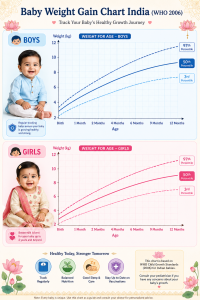
Here’s a practical baby weight chart by month in kg based on WHO standards and Indian pediatric references. These are approximate ranges (3rd to 97th percentile). Every baby is unique—percentiles matter more than absolute numbers.
Also read: Gentle Sleep Training
Track on growth charts during well-baby visits. Consistent curve following is more important than hitting exact averages.
Normal Weight Gain Patterns by Age
- 0–3 months: Fastest phase – 150–200g per week. Breastfed babies may gain steadily with frequent feeds.
- 3–6 months: 100–150g per week.
- 6–12 months: Slows to 70–90g per week as babies become more active and start solids.
- 12+ months: Focus shifts to balanced growth with family meals.
Factors Affecting Baby Weight Gain in India
Several India-specific elements play a role:
- Breastfeeding vs. Formula: Exclusive breastfeeding is ideal; the WHO charts suit breastfed babies best.
- Maternal Nutrition & Health: Postpartum diet, anemia, or gestational issues affect milk supply.
- Infections & Illnesses: Common colds, diarrhea, or recurrent infections can temporarily slow gain.
- Socioeconomic & Regional Variations: Access to nutrition, hygiene, and supplements varies across urban/rural India.
- Genetics & Birth Factors: Family history and prematurity/low birth weight.
When Should You Worry? Red Flags
Consult your pediatrician if:
- Baby falls below expected percentiles or crosses two lines downward on the chart.
- Poor feeding, lethargy, fewer than 6–8 wet diapers daily (after the first week).
- No weight gain for 2–3 weeks or actual weight loss after regaining birth weight.
- Signs of dehydration, frequent vomiting, or developmental delays.
Early intervention helps most issues.
Also read: Pregnant at 27: Why This Age May Be Perfect for Motherhood
Tips to Support Healthy Weight Gain
- Exclusive Breastfeeding for the first 6 months (on demand, 8–12 times/day).
- Proper Latch & Technique: Seek lactation support if needed.
- Complementary Feeding after 6 months: Nutrient-rich homemade foods like dal-rice khichdi, mashed fruits, fortified cereals.
- Regular Check-ups: Follow the IAP/WHO vaccination and growth monitoring schedule.
- Skin-to-Skin & Kangaroo Care for low birth weight babies.
- Maternal Care: Eat well (include ghee, nuts, dairy, greens in moderation as per cultural practices), stay hydrated, and rest.
- Avoid Over-the-Counter Supplements unless prescribed.
→ WHO Child Growth Standards (Official Website)
→ WHO 2006 Growth Charts & Tables (Download)
→ Indian Academy of Pediatrics (IAP) Growth ChartsThese links are provided for reference. Always consult your pediatrician for personalized advice.
Frequently Asked Questions (FAQs)
What is the normal weight gain for a baby in the first month in India?
In the first month, babies typically gain 150–200 grams per week after regaining their birth weight (usually by 10–14 days). This adds up to roughly 600–900 grams in the first month. Breastfed babies on WHO charts often follow this pattern well.
Which growth chart should I use in India – WHO or Indian-specific?
The Indian Academy of Pediatrics (IAP) recommends the WHO 2006 Child Growth Standards for children under 5 years. These are based on healthy breastfed babies from multiple countries, including India. Older Indian charts are no longer preferred for infants.
How do I know if my baby is gaining enough weight?
Track consistent growth along a percentile curve on the chart during regular pediatric visits. Key signs include 6–8 wet diapers daily (after the first week), steady alertness, and meeting developmental milestones. Absolute weight matters less than following the baby’s own growth curve.
Is it normal for Indian babies to weigh less than international averages?
Indian babies often have slightly lower average birth weights (around 2.7–3.2 kg) due to genetic, nutritional, and maternal health factors. However, as long as they follow their growth curve and show no red flags, this is normal. WHO standards account for this diversity.
When should I worry about my baby’s weight gain?
Consult your doctor if:
- Baby loses more than 10% of birth weight or doesn’t regain it by 2 weeks.
- No weight gain for 2–3 consecutive weeks.
- Drops across two or more percentile lines.
- Shows fewer wet diapers, lethargy, or feeding difficulties.