White Discharge in Early Pregnancy (Leukorrhea): Normal Signs Before Missed Period + When to Worry

White Discharge in Early Pregnancy (Leukorrhea): Normal Signs Before Missed Period + When to Worry

Edited by: MomSaathi Editorial Team

Reviewed by: Medical Experts (Gynaecologists)

If you’re scrolling through pregnancy forums or Google at 3 a.m., wondering why there’s suddenly more white discharge in your underwear just one week before your expected period, you’re not alone. The search term “white discharge in early pregnancy” gets thousands of hits every month because many women notice this subtle change right around implantation time—often before a positive pregnancy test or a missed period. It can feel confusing, exciting, or even a little worrying, especially when it looks different from your usual cycle.

The good news? In most cases, this milky-white, thin discharge (medically called leukorrhea) is completely normal and even a healthy sign that your body is preparing for pregnancy. In this comprehensive 1,920-word guide, we’ll break down exactly what white discharge in early pregnancy looks like, why it happens, when it starts, how it differs from pre-period discharge or infections, and what to do next. Backed by trusted sources like the Mayo Clinic, Cleveland Clinic, and NHS, this article will help you feel informed and reassured—no medical jargon overload, just clear, empathetic answers.

Whether you’re actively trying to conceive, tracking your cycle closely, or just noticing changes and wondering “Could this be pregnancy?”, let’s walk through it together. Remember: everybody is unique, and this is not a substitute for professional medical advice. Always chat with your doctor for personalized guidance.

What Is Leukorrhea? Understanding White Discharge in Early Pregnancy

Leukorrhea is the medical term for the thin, milky-white, or clear vaginal discharge that increases during pregnancy. It’s made up of cervical mucus, vaginal secretions, old cells, and beneficial bacteria. Unlike the thicker, stickier discharge you might see before a period, leukorrhea is usually more watery, abundant, and mild-smelling (or completely odorless).

This isn’t new mucus your body is suddenly inventing—it’s the same natural discharge you have throughout your cycle, just ramped up significantly. During pregnancy, rising estrogen levels boost blood flow to the pelvic area and stimulate the cervix and vagina to produce more of it. The result? A gentle, protective layer that helps keep infections at bay and maintains a healthy vaginal pH.

Many women first spot this change in the “1 week before missed period” window—roughly 3–4 weeks pregnant by gestational age (counted from the first day of your last menstrual period). That timing lines up perfectly with implantation, when the fertilized egg embeds in the uterine lining and your hormone levels (especially hCG and progesterone) begin their rapid climb.

Pregnancy Timeline: When Does White Discharge Start in Early Pregnancy?

Pregnancy discharge doesn’t wait for a positive test. Here’s a clear week-by-week look:

  • Days 6–12 after ovulation (about 1 week before missed period): Implantation often happens here. Some women notice a sudden increase in thin, white, or clear discharge as estrogen surges and the body begins to support the embryo.
  • 3–4 weeks pregnant: This is when leukorrhea becomes noticeable for many. It can feel like you’re “wetter” than usual in the luteal phase.
  • First trimester (weeks 4–12): Discharge often peaks early and stays increased. You might need panty liners more often.
  • Later trimesters: It continues (and can become even heavier near the end), helping form the protective mucus plug that seals the cervix.

Not every woman experiences a dramatic change early on. Some notice nothing until after a missed period, while others swear by the extra discharge as one of their very first clues. Both are normal.

Why Does White Discharge Increase in Early Pregnancy? The Science Explained

The main culprits are hormones and increased blood flow:

  1. Estrogen surge: After implantation, estrogen levels skyrocket to support the growing placenta and uterus. This hormone directly stimulates cervical glands to produce more mucus.
  2. Progesterone’s role: It keeps the uterine lining thick and also contributes to relaxed pelvic tissues, leading to more secretions.
  3. Increased blood volume: Your body pumps 30–50% more blood during pregnancy, sending extra fluid to the vaginal area.
  4. Protective purpose: Leukorrhea creates an acidic environment that discourages harmful bacteria and yeast while flushing out dead cells. It’s your body’s natural defense system kicking into high gear.

This process starts subtly around implantation (6–12 days post-ovulation) and ramps up quickly—explaining why some women see it right in that “1 week before missed period” phase.

What Does Normal Early Pregnancy Discharge (Leukorrhea) Look Like?

Healthy leukorrhea in early pregnancy typically has these features:

  • Color: Milky white, clear, or slightly off-white. It may look a bit translucent on toilet paper.
  • Consistency: Thin and watery (sometimes slightly creamy but never thick or clumpy like cottage cheese).
  • Odor: Mild or completely odorless. No fishy, sour, or strong smells.
  • Amount: Noticeably more than your usual pre-period discharge. Some women describe it as feeling “constantly damp.”
  • Texture: Smooth and slippery—no itching, burning, or irritation.

It often leaves a faint white or yellowish stain on underwear (completely normal and not a cause for alarm).

White Discharge in Early Pregnancy vs. Pre-Period Discharge: How to Tell the Difference

This is the question most women ask. Both can look similar because progesterone rises in the luteal phase, whether you’re pregnant or not. Here’s a clear comparison:

Feature: Early Pregnancy Leukorrhea Pre-Period Discharge (PMS)

Color Milky white or clear White, off-white, or cloudy

Consistency Thin, watery, slippery Thick, creamy, sticky

Amount increased and consistent Moderate, then decreases

Odor Mild or none Mild or none

Duration continues and often increases after the missed period. Stops or changes once the period starts.

Other clues may pair with fatigue, tender breasts, and mild cramping. Usually comes with typical PMS symptoms.


Key takeaway: If the discharge stays abundant and thin after your period is due (or continues when PMS symptoms would normally fade), it’s more likely pregnancy-related.

Other Early Pregnancy Symptoms That Often Appear Alongside Leukorrhea

White discharge rarely happens in isolation. Many women notice it alongside:

  • Mild uterine cramping or pulling sensations (implantation)
  • Breast tenderness or tingling
  • Extreme fatigue
  • Bloating or mild constipation
  • Heightened sense of smell or metallic taste
  • Frequent urination

If you’re seeing several of these together in that 1-week-before-missed-period window, it’s worth tracking closely.

When White Discharge Is NOT Normal: Red Flags and When to See a Doctor

While leukorrhea is usually harmless, certain changes can signal an infection or other issue. Contact your healthcare provider right away if you notice:

  • Thick, clumpy, cottage-cheese-like discharge (possible yeast infection)
  • Yellow, green, or gray color
  • Strong, fishy, or foul odor
  • Itching, burning, redness, or swelling
  • Pain during urination or sex
  • Watery discharge that feels like a gush (could indicate leaking amniotic fluid later in pregnancy)
  • Blood-tinged discharge with severe pain or heavy bleeding

Common infections like yeast (candidiasis) or bacterial vaginosis are more common during pregnancy due to hormonal shifts, but are easily treated. Don’t wait—early care keeps both you and baby safe.

How to Manage and Feel More Comfortable with Increased Discharge

You can’t stop leukorrhea (and you shouldn’t—it’s protective!), but you can make it less annoying:

  • Wear breathable cotton underwear and loose clothing
  • Use unscented panty liners (change them often)
  • Wipe front to back after using the toilet
  • Avoid douches, scented soaps, or vaginal wipes—they disrupt healthy bacteria
  • Stay hydrated and eat a balanced diet rich in probiotics (yogurt, kefir)
  • Skip tampons entirely during pregnancy

Most women find the extra discharge becomes part of the “new normal” and eases slightly after the first trimester (though it often returns heavier near delivery).

Myths vs. Facts About White Discharge in Early Pregnancy

Myth: White discharge always means infection or that something is wrong. Fact: Thin, milky, odorless leukorrhea is healthy and protective.

Myth: You can’t have leukorrhea before a missed period. Fact: Many women notice it as early as 1 week before—right around implantation.

Myth: More discharge = higher chance of miscarriage or problems. Fact: Increased leukorrhea alone has no link to complications. Only sudden changes or other symptoms matter.

Myth: Discharge stops once you’re pregnant. Fact: It usually increases and stays throughout all nine months.

Real Experiences: What Other Women Share

From anonymous forums and patient stories: “I thought it was just my usual pre-period stuff, but it kept going and got thinner. My test was positive three days later.” Another mom-to-be said, “The extra white discharge started around day 22 of my cycle—way before my period was due. Paired with sore boobs and exhaustion, it was my first real clue.”

Every journey is different. Some feel nothing early on; others notice every tiny shift.

What to Do Next: Testing, Tracking, and Prenatal Care

If you suspect pregnancy:

  • Wait until the day of or after your missed period for the most accurate home test (first morning urine is best).
  • Retest in 2–3 days if negative, but symptoms continue.
  • Book a prenatal appointment as soon as you get a positive result.
  • Start a prenatal vitamin with folic acid immediately.

Track your discharge, symptoms, and cycle in a simple app or journal—it helps when talking to your doctor.

Conclusion: Listening to Your Body with Confidence

White discharge in early pregnancy—leukorrhea—is one of those quiet, reassuring signals that your body is doing exactly what it’s designed to do: protecting and nurturing new life. Whether it shows up one week before your missed period or a bit later, thin, milky, odorless discharge is usually a positive (and normal) sign.

Trust your intuition, but pair it with facts and professional care. If something feels off, reach out to your doctor sooner rather than later. You’ve got this—your body is already working hard, and that extra discharge is just one small part of an incredible journey.

Frequently Asked Questions

Is white discharge in early pregnancy normal?

Yes — in fact, it’s one of the most common and healthy signs! This thin, milky-white discharge is called leukorrhea. It increases due to rising estrogen and extra blood flow to the pelvic area. It helps protect your vagina from infections and keeps tissues healthy. Most women notice it starting as early as 1–2 weeks after conception (often 1 week before a missed period).

What does normal leukorrhea look like in early pregnancy?

Healthy early-pregnancy discharge is usually thin and watery (sometimes slightly creamy), milky white or clear, and has a very mild or completely odorless smell. It may leave a faint white stain on your underwear but shouldn’t cause itching, burning, or irritation. The amount is noticeably more than your usual cycle discharge.

Can white discharge appear 1 week before a missed period?

Absolutely. Many women first notice increased white discharge right around implantation (6–12 days after ovulation). This timing matches the “1 week before missed period” window and can be one of the earliest clues that you’re pregnant, even before a home test turns positive.

How can I tell the difference between pregnancy discharge and pre-period discharge?

Both can look white, but pregnancy leukorrhea is usually thinner, more watery, and more abundant. Pre-period discharge tends to be thicker, creamier, and stickier, then disappears once your period starts. If the discharge stays increased and thin after your period is due, it’s more likely pregnancy-related.

Is white discharge a definite sign of pregnancy?

Not on its own — but it’s a strong clue when combined with other early symptoms like breast tenderness, fatigue, mild cramping, or bloating. Many women report leukorrhea as one of their first noticeable changes, yet some pregnant women have very little extra discharge. The only way to confirm is with a pregnancy test.

When does increased white discharge usually start in pregnancy?

It often begins in the first 1–2 weeks after conception (around 3–4 weeks pregnant by gestational age) and continues to increase throughout the first trimester. Some women notice it as early as implantation; others see the biggest change after a missed period.

What causes leukorrhea (white discharge) during early pregnancy?

The main reasons are surging estrogen levels, increased blood volume, and progesterone’s effect on cervical glands. Your body produces more mucus to create a protective barrier, maintain healthy vaginal pH, and flush out old cells — all to keep you and your baby safe.

When should I worry about white discharge in early pregnancy?

Contact your doctor right away if the discharge becomes thick and clumpy (like cottage cheese), turns yellow/green/gray, has a strong fishy or foul odor, or comes with itching, burning, redness, pain during urination, or spotting with severe cramps. These can signal an infection that needs prompt treatment.

How can I manage extra white discharge comfortably?

Wear breathable cotton underwear and loose clothing, change unscented panty liners frequently, wipe front to back, and avoid douches or scented products. Stay hydrated and eat probiotic-rich foods (like yogurt) to support healthy vaginal bacteria. Never use tampons during pregnancy.

Can I have no extra discharge and still be pregnant?

Yes! Not every woman experiences noticeable leukorrhea early on. Some have almost no change until later in the first trimester, while others notice it right away. Lack of extra discharge does not mean anything is wrong — every pregnancy is unique.


Sources & Further Reading

This article is based on trusted medical sources. For the latest advice, please consult your healthcare provider.

Important: This content is for informational purposes only and is not a substitute for professional medical advice. Always speak to your doctor about any changes in discharge or other pregnancy symptoms.

1 Week Pregnancy Symptoms Before Missed Period: 10 Early Signs + What They Mean

1 week pregnancy symptoms before missed period early signs

Edited by: MomSaathi Editorial Team

Reviewed by: Medical Experts (Gynaecologists)

If you’re tracking your cycle closely and suddenly wondering why you’re feeling a bit off just one week before your expected period, you’re not alone. The phrase “1 week pregnancy symptoms before missed period” pops up in countless searches because many women notice subtle (or not-so-subtle) changes right around this time—often before a home pregnancy test would even be reliable. These early clues can feel exciting, scary, or confusing, especially when they overlap with premenstrual syndrome (PMS).

In this comprehensive guide, we’ll walk through what “1 week before a missed period” really means in pregnancy terms, the most common symptoms backed by medical sources such as the Mayo Clinic and Cleveland Clinic, why they occur, how they differ from PMS, and practical next steps. Whether you’re hoping for a positive test or just gathering information, this article is here to help you feel informed and supported. Let’s dive in.

Understanding the Pregnancy Timeline: Why Symptoms Can Appear This Early

Pregnancy weeks are counted from the first day of your last menstrual period (LMP), not from conception. So if your cycle is a typical 28 days:

  • Week 1–2 (LMP to ovulation): Your body is preparing for a possible pregnancy. Ovulation usually happens around day 14.
  • Conception: Sperm meets egg, usually within 24 hours of ovulation.
  • Implantation: The fertilized egg (now a blastocyst) travels to the uterus and embeds in the lining. This typically occurs 6–12 days after ovulation—right around 7–10 days before your expected period.
  • Missed period: Around day 28 (4 weeks pregnant), when hCG (human chorionic gonadotropin, the pregnancy hormone) rises enough to stop your period.

That “1 week before missed period” window is roughly 3–4 weeks pregnant (gestational age) or about 1–2 weeks post-conception. At this stage, hCG and progesterone levels begin to rise rapidly after implantation. These hormones are what trigger early symptoms for some women, sometimes as soon as implantation begins.

Not every woman feels anything this early. Some sail through with zero clues until a positive test; others swear by tiny changes that turn out to be the real deal. Bodies are beautifully unique, and that’s completely normal.

The Science Behind Early Symptoms: Hormones at Work

Once implantation happens, your body produces hCG (detectable in blood tests as early as 7–10 days post-ovulation). Progesterone, which supports the luteal phase, continues to rise to maintain the pregnancy. Estrogen also surges. These shifts can affect everything from your breasts and energy levels to your digestion and mood.

Implantation itself can cause minor physical sensations because the embryo burrows into the uterine lining. This is why some symptoms feel like a lighter version of period cramps or spotting.

Common 1 Week Pregnancy Symptoms Before Missed Period

Here are the symptoms most frequently reported in this early window. We’ll cover what they feel like, why they happen, and real-world nuances.

1. Implantation Bleeding or Light Spotting

One of the earliest possible signs is light pink or brown spotting—often called implantation bleeding. It happens when the embryo attaches to the uterine wall and can appear 6–12 days after ovulation (perfectly timed for that “1 week before period” mark).

Unlike a period, it’s very light, lasts 1–2 days max, and doesn’t require a pad or tampon. Many women describe it as a few drops when wiping or light streaks in underwear.

Tip: If bleeding is heavy, bright red, or accompanied by severe pain, contact your doctor immediately—it could signal something else.

2. Mild Cramping or Pulling Sensations

Mild uterine cramps or a “pulling” feeling in the lower abdomen often accompany implantation. These feel like gentle period cramps, but are usually less intense and more localized. They stem from the uterus stretching slightly and progesterone relaxing muscles.

Women often say it feels different from typical PMS cramps—more like a subtle tug or flutter rather than throbbing pain.

3. Breast Tenderness, Swelling, or Tingling

Hormonal changes can make breasts feel sore, heavy, or tingly as early as 1–2 weeks after conception. Nipples may darken slightly or become more sensitive. You might notice veins appearing more prominent or your bra feeling tighter.

This is one of the most commonly reported early signs and can start before a missed period. The good news? Discomfort often eases after the first trimester as your body adjusts.

4. Fatigue and Extreme Tiredness

That sudden wave of exhaustion? Blame rising progesterone, which has a natural sedative effect. Many women feel unusually drained—even after a full night’s sleep—right around the time of implantation.

It’s not just “I’m a little sleepy.” It’s the kind of fatigue where napping feels essential and simple tasks drain you. This can hit as early as one week post-conception.

5. Nausea, Food Aversions, or a Metallic Taste

While full-blown morning sickness often peaks around weeks 6–9, some women experience queasiness, food sensitivities, or a metallic taste in the mouth much earlier—sometimes before a missed period. Certain smells (coffee, meat, perfume) may suddenly turn your stomach.

This is linked to rapidly rising hCG and estrogen. Not everyone gets it early, and it can feel more like mild indigestion than vomiting.

6. Bloating, Constipation, or Digestive Changes

Progesterone slows digestion, giving your body more time to absorb nutrients. The result? Bloating that feels exactly like pre-period puffiness, plus possible constipation.

You might already feel gassy or notice your jeans fitting differently.

7. Mood Swings or Emotional Sensitivity

The hormone rollercoaster can make you tear up at commercials, snap over small things, or feel unusually emotional. These shifts can mimic PMS but sometimes feel more intense.

8. Frequent Urination

Increased blood volume and hormonal changes mean your kidneys work harder, leading to more fluid being sent to your bladder. Some women notice this subtle increase even before a missed period.

9. Heightened Sense of Smell or Other Sensory Changes

Your nose might feel extra sensitive, or you could pick up on smells others don’t notice. Headaches or mild dizziness can also occur due to changes in blood flow.

10. Raised Basal Body Temperature (BBT)

If you’re tracking BBT for fertility, a sustained high temperature after ovulation (beyond your usual luteal phase) can be an early clue. Progesterone keeps it elevated.

How to Tell the Difference: Pregnancy Symptoms vs. PMS

This is the tricky part. Many early pregnancy symptoms overlap with PMS because both involve progesterone. Key differences:

  • Timing and persistence: Pregnancy symptoms often continue or intensify past when your period would start; PMS usually resolves once bleeding begins.
  • Severity: Implantation spotting is lighter and shorter than a period. Breast tenderness in pregnancy may feel deeper or include tingling.
  • Unique clues: A metallic taste, extreme fatigue that doesn’t lift, or food aversions are more pregnancy-specific.
  • No period: The ultimate differentiator, but you won’t know until the due date arrives.

If your symptoms feel “off” from your usual cycle, trust your intuition and test when the time is right.

When to Take a Pregnancy Test for the Most Accurate Results

Home urine tests detect hCG, but levels need time to build. The most accurate time is the day of or after your missed period. Some sensitive tests (like those claiming “early detection”) can detect 5–6 days earlier, but false negatives are common if tested too soon.

  • Blood test: Your doctor can detect pregnancy earlier (as soon as 7–10 days post-ovulation).
  • Pro tip: Test with the first morning urine for the highest concentration. If negative but symptoms persist, wait 2–3 days and retest.

A positive result? Schedule your first prenatal appointment right away.

What to Do Next: Healthy Steps While Waiting or After Confirmation

Whether you’re still in the two-week wait or just got a positive:

  • Start a prenatal vitamin with at least 400 mcg of folic acid immediately.
  • Stay hydrated, eat small, frequent meals if nauseous, and rest when tired.
  • Cut back on caffeine and avoid alcohol, smoking, and certain medications.
  • Track symptoms in a journal—it helps when talking to your doctor.

When to Contact a Doctor Right Away

Most early symptoms are normal, but reach out if you experience:

  • Severe one-sided pain or heavy bleeding (possible ectopic pregnancy).
  • Severe nausea/vomiting is preventing fluids.
  • Dizziness, fainting, or high fever.
  • Any concerns—better safe than sorry.

Early prenatal care makes a huge difference.

Myths vs. Facts About Early Pregnancy Symptoms

Myth: You must have symptoms to have a healthy pregnancy. Fact: Many women feel nothing early on and go on to have perfectly normal pregnancies.

Myth: All spotting means miscarriage—fact: Light implantation bleeding is common and usually harmless.

Myth: Symptoms start the day after conception. Fact: Most begin around implantation, not immediately.

Real Experiences: What Other Women Say

From online forums and patient stories (anonymized), women describe everything from “sudden exhaustion that hit like a truck” to “my breasts felt bruised before my period was even due.” One mom-to-be noticed a faint metallic taste and dismissed it—until her test turned positive days later. Remember: Every journey is different.

Conclusion: Listening to Your Body with Confidence

The 1-week pregnancy symptoms before a missed period can be the first whisper that something beautiful might be happening. Whether you’re experiencing tender breasts, fatigue, light spotting, or none of the above, know that your body is doing incredible work. Trust the process, but always pair intuition with professional medical advice.

If you’re trying to conceive or suspect pregnancy, congratulations on taking this step toward understanding your body better. Start that prenatal vitamin, book an appointment when ready, and be kind to yourself in the waiting. You’ve got this.

Frequently Asked Questions

Can you have pregnancy symptoms 1 week before a missed period?

Yes. Some women notice early signs as soon as 6–12 days after ovulation (roughly 1 week before their expected period). These symptoms are usually caused by rising hCG and progesterone after implantation. Common ones include light spotting, mild cramping, breast tenderness, and extreme fatigue. However, not everyone feels symptoms this early — many feel nothing until after a missed period.

What are the earliest pregnancy symptoms before a missed period?

The most reported early symptoms include:

  • Implantation bleeding or spotting
  • Mild uterine cramping or pulling sensation
  • Breast tenderness, swelling, or tingling
  • Unusual fatigue
  • Bloating or constipation
  • Heightened sense of smell or metallic taste
  • Mood swings

These can appear 1–2 weeks after conception and often mimic PMS.

How soon after conception do pregnancy symptoms start?

Symptoms can begin as early as 1 week after conception (around the time of implantation), but most women notice them between 3–4 weeks pregnant (1 week before or after a missed period). Every body is different — some feel changes within days, while others have no symptoms until later.

How can I tell the difference between early pregnancy symptoms and PMS?

Both are caused by progesterone, so they feel similar. Key differences:

  • Pregnancy symptoms often continue or get stronger after your period is due.
  • Implantation spotting is lighter and shorter than a normal period.
  • Unique clues like a metallic taste, extreme fatigue that doesn’t lift, or strong food aversions point more toward pregnancy.

If symptoms feel “different” from your usual PMS, take a test when your period is late.

Is light spotting 1 week before my period a sign of pregnancy?

It can be! This is called implantation bleeding and happens when the embryo attaches to the uterine lining. It’s usually light pink or brown, lasts 1–2 days, and doesn’t require a pad. Heavy bleeding or bright red blood with severe pain needs immediate medical attention.

When is the best time to take a pregnancy test if I have early symptoms?

For the most accurate result, wait until the day of or after your missed period. Some sensitive early-detection tests work 5–6 days before

Sources & Further Reading

This article is based on information from trusted medical organizations. For the latest advice, please consult your healthcare provider.

Important: This content is for informational purposes only and is not a substitute for professional medical advice.

Pregnancy Cramps: Causes, Symptoms & When to Worry

Pregnancy Cramps: Causes, Symptoms & When to Worry” showing a pregnant woman holding her lower belly in discomfort, alongside icons representing common causes, symptoms, warning signs, and relief tips in a soft pastel medical-style design.

Edited by: MomSaathi Editorial Team

Reviewed by: Obstetricians & Pediatric Nutritionists as per ICMR-NIN Pregnancy Nutrition Guidelines & Indian Academy of Pediatrics (IAP) Recommendations

Pregnancy brings so many new feelings — joy, nervousness, and sometimes worry. One of the most common concerns for expectant mothers is pregnancy cramps. That sudden pulling sensation or mild ache in your lower belly can make your heart skip a beat, especially if it’s your first pregnancy.

You’re not alone. Almost every pregnant woman experiences some form of cramping at different stages. The good news? In most cases, mild pregnancy cramps are completely normal and are just your body adjusting to the changes happening inside. In this guide, we’ll walk through everything you need to know — from what causes them to when you should reach out to your doctor — in a simple, reassuring way.

Quick Summary: Pregnancy Cramps at a Glance

Normal Pregnancy Cramps

  • Mild, period-like pulling or tightening
  • Comes and goes
  • No bleeding or severe pain

When to Be Concerned

  • Severe pain that doesn’t go away
  • Cramping with bleeding
  • Pain with fever, dizziness, or vomiting

Now, let’s understand this topic properly so you can feel more confident and less anxious.

Are Pregnancy Cramps Normal?

Yes, mild pregnancy cramps are very common and usually harmless. Your body is going through massive changes — your uterus is expanding, ligaments are stretching, hormones are shifting, and blood flow is increasing. All these changes can cause discomfort that feels like cramps.

Most women describe it as a dull ache, mild tightening, or a brief pulling sensation in the lower abdomen. As long as the pain is mild and comes and goes, it is often just your body working hard to support your growing baby.

What Do Pregnancy Cramps Feel Like?

Pregnancy cramps can feel different for every woman. Common descriptions include:

  • A mild period-like ache
  • Gentle pulling or stretching sensation
  • Brief tightening in the lower belly
  • Occasional sharp twinges on one side

These feelings are usually short-lived and often improve with rest, changing positions, or a warm bath.

Common Causes of Pregnancy Cramps

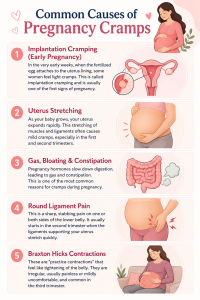
Informative infographic titled “Common Causes of Pregnancy Cramps” explaining implantation cramping, uterus stretching, gas and constipation, round ligament pain, and Braxton Hicks contractions with illustrations of pregnant women and pregnancy-related body changes in soft pastel colors.

Implantation Cramping (Early Pregnancy)

In the very early weeks, when the fertilized egg attaches to the uterus lining, some women feel light cramps. This is called implantation cramping and is usually one of the first signs of pregnancy.

Uterus Stretching

As your baby grows, your uterus expands rapidly. This stretching of muscles and ligaments often causes mild cramps, especially in the first and second trimesters.

Gas, Bloating & Constipation

Pregnancy hormones slow down digestion, leading to gas and constipation. This is one of the most common reasons for cramps during pregnancy.

Round Ligament Pain

This is a sharp, stabbing pain on one or both sides of the lower belly. It usually starts in the second trimester when the ligaments supporting your uterus stretch quickly.

Braxton Hicks Contractions

These are “practice contractions” that feel like tightening of the belly. They are irregular, usually painless or mildly uncomfortable, and common in the third trimester.

Pregnancy Cramps by Trimester

First Trimester Cramps

Mild cramps are very common as your body adjusts. Implantation, uterus stretching, and hormonal changes are the main reasons. As long as there is no heavy bleeding or severe pain, it is usually normal.

Second Trimester Cramps

Round ligament pain becomes more noticeable. Your growing belly puts pressure on ligaments, causing sharp twinges when you change positions suddenly.

Third Trimester Cramps

Braxton Hicks contractions become more frequent. Your body is preparing for labor, but these are usually irregular and not painful.

Pregnancy Cramps Without Bleeding

This is one of the most searched questions by expectant mothers. Mild to moderate cramps without bleeding are usually normal. They are often caused by ligament stretching, gas, or Braxton Hicks. Rest, hydration, and changing positions help most of the time.

When Are Pregnancy Cramps Dangerous?

While most cramps are harmless, you should contact your doctor immediately if you experience:

  • Severe or constant pain that doesn’t go away
  • Cramping along with bleeding or spotting
  • Pain with fever, chills, or vomiting
  • Dizziness or fainting
  • Pain during urination
  • Shoulder pain along with abdominal cramps

Could Pregnancy Cramps Mean Miscarriage?

This is a big fear for many mothers. While cramping can sometimes be a symptom of miscarriage, mild cramps alone rarely mean something is wrong. Miscarriage is usually accompanied by heavier bleeding, severe pain, and other symptoms. Always reach out to your doctor if you’re worried — they would rather check and reassure you than have you anxious.

How to Relieve Pregnancy Cramps Naturally

Here are safe, simple ways that help most women:

  • Rest and lie down on your left side
  • Take a warm (not hot) bath or use a warm compress
  • Stay well hydrated — drink plenty of water
  • Do gentle stretching or prenatal yoga
  • Take a slow walk to ease gas and bloating
  • Practice good posture
  • Wear supportive maternity bands

Foods & Drinks That May Help Reduce Cramps

  • Magnesium-rich foods (bananas, almonds, spinach)
  • Potassium-rich foods (coconut water, bananas, sweet potatoes)
  • Warm milk with turmeric (haldi doodh)
  • Plenty of water and fresh buttermilk

Myth vs Fact: Pregnancy Cramps

Myth: All cramps mean something is wrong. Fact: Most mild cramps are normal and part of a healthy pregnancy.

Myth: You should stay in bed if you have cramps. Fact: Gentle movement often helps more than complete bed rest.

When to Call a Doctor

Don’t hesitate to contact your gynecologist if:

  • Pain becomes severe or constant
  • You notice any bleeding
  • Cramps come with other worrying symptoms
  • You feel unsure or anxious

It’s always better to get checked and have peace of mind.

Emotional Stress & Anxiety During Pregnancy

Pregnancy cramps can trigger anxiety, especially for first-time mothers. Remember: worrying can sometimes make the discomfort feel worse. Talk to your partner, family, or doctor. Join supportive pregnancy groups. Taking care of your mental health is just as important as taking care of your physical health.

Key Takeaways

  • Mild pregnancy cramps are very common and usually harmless
  • Rest, hydration, and gentle movement help most cases
  • Severe pain, bleeding, or other symptoms need medical attention
  • Every pregnancy is different — trust your instincts and your doctor

You are doing an amazing job growing a new life. Mild cramps are often just a sign that your body is working hard. Stay calm, listen to your body, and don’t hesitate to seek help when needed.

More Trusted Resources

Reliable guides on pregnancy cramps and symptoms

💡 These external links are for additional reliable information. Always consult your doctor for personalized advice.

Frequently Asked Questions

Are pregnancy cramps normal?

Yes, mild pregnancy cramps are very common and usually harmless. They are often caused by the uterus stretching, gas, constipation, or round ligament pain. Most women experience them at some point, especially in the first and second trimesters.

What do pregnancy cramps feel like?

Pregnancy cramps usually feel like a mild period-like ache, gentle pulling, stretching, or tightening in the lower belly. They are often short-lived and improve with rest or changing positions.

What causes implantation cramping in early pregnancy?

Implantation cramping happens when the fertilized egg attaches to the uterine lining, usually in the very early weeks. It is typically light, brief, and one of the first signs of pregnancy.

What is round ligament pain during pregnancy?

Round ligament pain is a sharp, stabbing pain on one or both sides of the lower belly. It usually starts in the second trimester when the ligaments supporting the uterus stretch quickly as the baby grows.

Are Braxton Hicks contractions the same as pregnancy cramps?

Braxton Hicks are “practice contractions” that feel like tightening or mild cramping in the belly. They are irregular, usually painless or mildly uncomfortable, and become more common in the third trimester.

When should I worry about pregnancy cramps?

Contact your doctor immediately if cramps are severe, constant, come with bleeding or spotting, fever, vomiting, dizziness, pain during urination, or shoulder pain. Don’t wait if something feels wrong.

Is cramping without bleeding normal in pregnancy?

Yes, mild to moderate cramps without any bleeding are usually normal. They are often caused by ligament stretching, gas, or Braxton Hicks contractions.

How can I relieve pregnancy cramps naturally?

Rest on your left side, take a warm (not hot) bath, stay hydrated, do gentle prenatal yoga or stretching, walk slowly to ease gas, and eat magnesium-rich foods like bananas, almonds, and spinach.

Can pregnancy cramps mean miscarriage?

Most pregnancy cramps are harmless, but severe cramps along with heavy bleeding or spotting can sometimes be a sign of miscarriage. Always contact your doctor right away if you are worried.

What foods and drinks help reduce pregnancy cramps?

Magnesium-rich foods (bananas, almonds, spinach), potassium-rich drinks (coconut water), warm milk with turmeric, plenty of water, and fresh buttermilk can help ease cramps caused by gas and constipation.


Foods to Avoid During Pregnancy: Complete Guide For Healthy And Safe Eating

Foods to Avoid During Pregnancy: Complete Guide For Healthy And Safe Eating

Edited by: MomSaathi Editorial Team

Reviewed by: Medical Experts (Gynaecologists & Paediatricians)

Pregnancy is a beautiful journey filled with joy, excitement, and… a lot of questions about food. As an expecting mom, you suddenly hear advice from every direction: family, friends, WhatsApp forwards, and even strangers. “Don’t eat this, don’t touch that!” It can feel overwhelming and confusing.

That’s why we created this practical guide on foods to avoid during pregnancy. Our aim is simple: help you eat confidently, protect your baby, and enjoy this special time without constant worry or guilt. Because pregnancy nutrition isn’t about being perfect — it’s about making smart, balanced choices.

Quick Summary: Foods to Avoid During Pregnancy

Strictly Avoid • Raw or undercooked meat, eggs & fish • Unpasteurised milk & dairy products • High-mercury fish (shark, swordfish, king mackerel) • Alcohol (no safe amount) • Excessive caffeine (more than 200mg/day)

Limit • Processed meats, street food, junk food, excess sugar & salt

Now, let’s understand everything in detail so you can make informed decisions.

Why Food Safety Matters During Pregnancy

During pregnancy, your immune system changes to protect your growing baby. This makes you more vulnerable to foodborne illnesses like Salmonella, Listeria, and toxoplasmosis. What might cause mild stomach upset in normal times can lead to serious complications for you and your baby.

Eating safely helps prevent infections, supports healthy baby development, reduces risks of miscarriage or preterm labour, and keeps your energy stable. The good news? With a few mindful choices, you can still enjoy delicious meals.

Foods to Avoid During Pregnancy

Raw or Undercooked Eggs

Raw eggs can carry salmonella, which causes severe food poisoning.

Avoid:

  • Homemade mayonnaise, tiramisu, or cookie dough with raw eggs
  • Soft-boiled or runny eggs
  • Eggnog made with uncooked eggs

Safer Choice: Fully cooked eggs where both yolk and white are firm.

Raw or Undercooked Meat

Undercooked meat may contain harmful bacteria and parasites like Toxoplasma.

Avoid:

  • Rare or medium-rare chicken, mutton, or fish
  • Raw mince or kebabs
  • Street-side tandoori items that may not be fully cooked

Tip: Cook meat until juices run clear and the internal temperature is well done.

High-Mercury Fish

Mercury can seriously affect your baby’s developing nervous system.

Avoid or Limit:

  • Shark (shark fin soup)
  • Swordfish
  • King mackerel
  • Tilefish

Safe Fish: Salmon, sardines, anchovies, and rohu (2–3 servings per week).

Unpasteurised Milk & Dairy Products

Unpasteurised (raw) milk can contain Listeria, which is dangerous for pregnant women.

Avoid:

  • Raw milk (“desi doodh”)
  • Unpasteurised cheese, paneer, or yoghurt from unknown sources

Safe Choice: Always choose pasteurised milk, curd, and cheese.

Processed & Deli Meats

These can harbour Listeria even when refrigerated.

Avoid:

  • Cold cuts, salami, ham, and ready-to-eat sausages (unless heated thoroughly)

Safer Alternative: Freshly cooked chicken, mutton, or eggs.

Excess Caffeine

High caffeine intake may increase the risk of low birth weight or miscarriage.

Safe Limit: Up to 200mg per day (about 1–2 small cups of coffee).

Watch your intake of tea, coffee, chocolate, and energy drinks.

Alcohol

No amount of alcohol is safe during pregnancy. It can cause fetal alcohol spectrum disorders.

The best and safest choice is complete abstinence.

Junk Food & Highly Processed Foods

Too much junk food can lead to excessive weight gain, gestational diabetes, and nutrient gaps.

Limit: Packaged snacks, sugary drinks, instant noodles, and too many sweets.

Papaya & Pineapple – Myth vs Reality

  • Unripe papaya: Contains latex that may trigger contractions. Avoid, especially in the first trimester.
  • Ripe papaya: Safe and nutritious in moderation.
  • Pineapple: Normal amounts are safe. One or two slices of ripe pineapple won’t cause any harm.

Street Food & Unhygienic Foods

Street food is tempting but carries a high risk of contamination in Indian conditions.

Be cautious with: Pani puri, bhel, golgappa, roadside chaat, and cut fruits.

Safer approach: Choose hygienic stalls or recreate favourite dishes at home.

Foods to Limit (Instead of Completely Avoid)

  • Sugar & sweets (risk of gestational diabetes)
  • Excess salt (can raise blood pressure)
  • Fried foods (high in unhealthy fats)
  • Artificial sweeteners (use sparingly)

Safe & Healthy Alternatives During Pregnancy

Focus on these nutrient-rich foods:

  • Protein: Dal, eggs, paneer, sprouts, chicken, low-mercury fish
  • Iron: Spinach, beetroot, pomegranate, dates, raisins
  • Calcium: Milk, curd, ragi, sesame seeds
  • Healthy Snacks: Roasted makhana, almonds, fruits, homemade khichdi, vegetable upma

Hydration Tip: Drink plenty of water, coconut water, and fresh buttermilk.

Foods to Avoid During the First Trimester

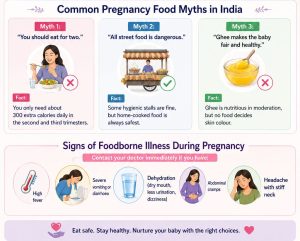
Infographic on foods to avoid during the first trimester of pregnancy, including raw meat, unpasteurised dairy, caffeine, alcohol, and pregnancy food myths in India, along with symptoms of foodborne illness and safe eating tips for pregnant women.

The first trimester is critical for the baby’s organ development. Be extra careful with raw/undercooked foods, unpasteurised dairy, and excessive caffeine. Morning sickness can make eating difficult — stick to small, frequent, bland meals.

Common Pregnancy Food Myths in India

Myth 1: “You should eat for two.” Fact: You only need about 300 extra calories daily in the second and third trimesters.

Myth 2: “All street food is dangerous.” Fact: Some hygienic stalls are fine, but home-cooked food is always safest.

Myth 3: “Ghee makes the baby fair and healthy.” Fact: Ghee is nutritious in moderation, but no food decides skin colour.

Signs of Foodborne Illness During Pregnancy

Contact your doctor immediately if you have:

  • High fever
  • Severe vomiting or diarrhoea
  • Dehydration
  • Abdominal cramps
  • Headache with stiff neck

When to Consult a Doctor

Always reach out to your gynaecologist if:

  • You accidentally ate something unsafe
  • You have persistent symptoms
  • You have existing health conditions like diabetes or thyroid issues

Tips for Safe Eating During Pregnancy

  • Wash fruits and vegetables thoroughly
  • Cook meat and eggs properly
  • Refrigerate leftovers and consume within 24 hours
  • Read labels for pasteurisation and expiry dates
  • Prefer home-cooked meals as much as possible

Key Takeaways

  • Prioritise food safety over fear
  • Avoid raw/undercooked items and unpasteurised products
  • Limit caffeine and avoid alcohol completely
  • Choose fresh, home-cooked, balanced meals
  • Listen to your body and consult your doctor for personalised advice

You’re doing an amazing job nourishing your baby. Small, consistent choices matter more than perfection.

📚 More Helpful Resources

💡 These are trusted external resources for more information.

Frequently Asked Questions (FAQs)

Can pregnant women eat pineapple?

Yes, ripe pineapple is safe and nutritious when eaten in moderation. It is rich in vitamins and helps with digestion. Avoid unripe (green) pineapple, especially in the first trimester.

Is coffee safe during pregnancy?

Yes, in limited amounts. You can safely have up to 200mg of caffeine per day — roughly 1–2 small cups of filter coffee. Too much caffeine may affect the baby’s growth.

Which fish should be avoided during pregnancy?

Avoid high-mercury fish such as shark, swordfish, king mackerel, and tilefish. Safer options include rohu, sardines, anchovies, and salmon (2–3 servings per week).

Can I eat spicy food while pregnant?

Moderate spicy food is usually fine if it doesn’t cause heartburn or discomfort. Listen to your body — if it doesn’t suit you, reduce the spice level.

Is papaya safe for pregnant women?

Ripe papaya is safe and provides good nutrition. Avoid large amounts of unripe (green) papaya, especially in the first trimester.

What foods can cause miscarriage?

Certain foods increase risk if consumed in large quantities or unsafe form — raw/undercooked meat, unpasteurised dairy, high alcohol, and excessive unripe papaya.

Implantation Bleeding: Signs, Symptoms, Timing & How to Tell If You’re Pregnant

Understanding implantation bleeding and pregnancy signs

Edited by: MomSaathi Editorial Team

Reviewed by: Pediatric Experts as per WHO 2006 Child Growth Standards & Indian Academy of Pediatrics (IAP) Guidelines

That little spot of blood on your underwear when you’re hoping for a baby can stop your heart for a second. “Is this my period starting… or could it be something more?” Many women trying to conceive know this exact feeling — a mix of hope and worry.

Implantation bleeding is one of those early pregnancy signs that often gets mistaken for a light period. Understanding it can bring so much reassurance during those anxious two-week waits.

Quick Summary

  • Implantation bleeding is light spotting when a fertilized egg attaches to the uterus lining.
  • It usually occurs 6–12 days after ovulation (often a few days before your expected period).
  • It’s typically pink or brown, very light, and lasts a few hours to 2–3 days.
  • Unlike a period, it doesn’t get heavier and rarely has clots.
  • Not every woman experiences it — and that’s completely okay.

What Is Implantation Bleeding?

Imagine a tiny fertilized egg gently nestling into the soft lining of your uterus. As it burrows in, it can disturb a few tiny blood vessels. The small amount of blood that comes out is called implantation bleeding.

It’s a normal part of early pregnancy for many women and happens in about 15–25% of pregnancies.

When Does Implantation Bleeding Occur?

Implantation bleeding typically happens 6 to 12 days after ovulation, most commonly around day 8–10. If you have a 28-day cycle, this is usually a few days before your expected period. This timing is exactly why it gets confused with an early period so often.

What Does Implantation Bleeding Look Like?

Most women describe it as:

  • Color: Light pink, rusty brown, or dark brown.
  • Flow: Very light spotting — just a smear or a few drops.
  • Texture: Watery or streaky, not thick.
  • Duration: A few hours to 2–3 days maximum.

Real story: Priya from Bengaluru said, “I saw brown spotting for one day and thought my period had come early. But it stopped suddenly. My pregnancy test two weeks later was positive!”

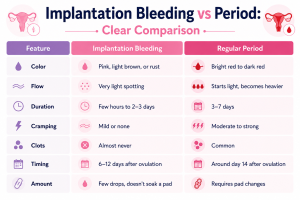
Implantation Bleeding vs Period: Clear Comparison

Implantation Bleeding vs Period: Clear Comparison Feature

Feature Implantation Bleeding Regular Period
Color Pink, light brown, or rust Bright red to dark red
Flow Very light spotting Starts light, becomes heavier
Duration Few hours to 2–3 days 3–7 days
Cramping Mild or none Moderate to strong
Clots Almost never Common
Timing 6–12 days after ovulation Around day 14 after ovulation
Amount Few drops, doesn’t soak a pad Requires pad changes

Common Symptoms of Implantation Bleeding

You may also notice:

  • Mild implantation bleeding cramps
  • Breast tenderness or tingling
  • Unusual fatigue
  • Mood changes
  • Light bloating

These implantation bleeding symptoms can feel very similar to PMS, which adds to the confusion.

How Long Does Implantation Bleeding Last?

It usually lasts 1 to 2 days, sometimes just a few hours. If spotting continues beyond 3 days or becomes heavier, it’s best to consult your doctor.

Can Implantation Bleeding Be Heavy?

True implantation bleeding is almost never heavy. If you’re soaking a pad or passing clots, it’s more likely your period or something that needs medical attention.

When Should You Take a Pregnancy Test?

Wait at least 2–3 days after the spotting stops, or until the day of your missed period for the most accurate result. Early morning urine gives the best chance of detection.

When Should You See a Doctor?

See your gynecologist if you experience:

  • Heavy bleeding
  • Bright red blood with clots
  • Severe pain or cramps
  • Dizziness or fever

Emotional Impact While Trying to Conceive

Seeing spotting when you’re trying can feel like an emotional rollercoaster. One moment you’re hopeful, the next you’re scared. Please remember — your feelings are valid. Be kind to yourself during this journey.

Tips to Track Early Pregnancy Symptoms

  • Use reliable apps like Flo, Clue, or Maya
  • Keep a simple symptom journal
  • Track ovulation if you’re actively trying
  • Connect with supportive communities

Myth vs Fact

Myth: Implantation bleeding always confirms pregnancy. Fact: It’s only a possible sign. A pregnancy test is needed.

Myth: Everyone gets implantation bleeding. Fact: Only about 1 in 4 women notice it.

Key Takeaways

  • Implantation bleeding is light, short, and usually pink or brown.
  • It happens earlier than your period and doesn’t get heavy.
  • Symptoms vary greatly from woman to woman.
  • Don’t panic if you see light spotting — take a test at the right time.
  • Always reach out to your doctor if anything feels concerning.

You’re doing an amazing job listening to your body and learning about these early signs. Whether this cycle brings good news or you continue your journey, remember you’re not alone. Many of us have been exactly where you are right now.

If you have any doubts, speak to your gynecologist — they’re there to support you with care and understanding.

Wishing you strength, patience, and lots of hope on your beautiful journey to motherhood.

Helpful External Resources

Always consult your gynecologist for personalized medical advice. These links are for educational purposes only.

Frequently Asked Questions (FAQs)

Can implantation bleeding be red?

Yes, it can sometimes be light pink or reddish, but bright red and heavy bleeding is more likely to be a period. Light pink spotting is common with implantation.

Does everyone get implantation bleeding?

No. Only about 15–25% of women experience it. Many perfectly healthy pregnancies happen without any spotting at all.

Can implantation bleeding have clots?

Usually not. Clots are much more common with a regular period. Implantation bleeding is typically very light without clots.

How many days does implantation bleeding last?

It usually lasts 1–2 days, sometimes just a few hours. Anything longer than 3 days should be discussed with your doctor.

Can implantation bleeding happen after a missed period?

It’s uncommon. Implantation bleeding typically occurs before your expected period. Spotting after a missed period needs medical evaluation.

Is brown spotting implantation bleeding?

Yes, brown spotting is very common with implantation bleeding. It’s usually older blood that takes time to leave the body.

Can implantation bleeding fill a pad?

No. Implantation bleeding is very light and rarely fills even a panty liner completely. If you need a full pad, it’s more likely your period.

Does implantation bleeding mean pregnancy is confirmed?

No, it doesn’t confirm pregnancy. It’s only a possible sign. You still need a pregnancy test for confirmation.

Can implantation bleeding happen with cramps?

Yes. Mild implantation bleeding cramps are common and usually feel like gentle period twinges. Severe pain is not normal and should be checked.

What are the first signs of pregnancy?

Early signs include missed period, implantation bleeding, breast tenderness, fatigue, nausea, frequent urination, and mood changes. Every woman’s experience is different.

First Trimester Symptoms: Complete Guide (Weeks 1-12) + Relief Tips

Pregnant woman in first trimester experiencing symptoms

Edited by: MomSaathi Editorial Team

Reviewed by: Based on evidence-based pregnancy and preconception care guidelines

The first trimester is an exciting yet often overwhelming time. From the moment you see that positive pregnancy test, your body begins a dramatic transformation to support your growing baby. For many women, first trimester symptoms can appear quickly and range from mild annoyances to challenges that disrupt daily life. Understanding these changes helps you feel more prepared, less anxious, and better equipped to care for yourself and your little one.

This guide covers everything you need to know about first trimester symptoms — what’s normal, why they happen, how long they last, and practical ways to find relief. Every pregnancy is unique, so what one person experiences intensely, another might barely notice. Let’s walk through this journey together.

What Is the First Trimester?

The first trimester spans from week 1 (the first day of your last menstrual period) through week 12 or 13 of pregnancy. During these early weeks, your baby develops from a tiny cluster of cells into a fetus with major organs, a beating heart, and tiny limbs forming.

Meanwhile, your body ramps up hormone production — primarily human chorionic gonadotropin (hCG), progesterone, and estrogen — to support this rapid growth. These hormonal shifts drive most first trimester symptoms. Blood volume increases, your metabolism changes, and your immune system adjusts. It’s intense work, which is why many women feel exhausted or queasy.

When Do First Trimester Symptoms Start?

First trimester symptoms often begin subtly around 4–6 weeks, though some women notice signs as early as a week or two after conception. A missed period is frequently the first clue. Nausea (morning sickness) commonly kicks in between weeks 4–9, while fatigue and breast tenderness can appear even earlier.

By weeks 8–12, many symptoms peak before starting to ease for most women as they enter the second trimester. However, some symptoms linger, and a small percentage of pregnancies involve symptoms throughout. If you have no first trimester symptoms at all, that can also be perfectly normal — plenty of healthy pregnancies progress quietly.

Common First Trimester Symptoms: What You Might Experience

Common First Trimester Symptoms: What You Might Experience

Here’s a clear breakdown of the most reported first trimester symptoms, why they occur, and how to manage them.

1. Missed Period and Early Bleeding/Spotting

A missed period is often the earliest sign. Light spotting (implantation bleeding) can occur around 6–12 days after conception. It’s usually lighter in colour and shorter than a normal period.

Relief/Tips: Confirm pregnancy with a home test or blood test. Any bleeding heavier than spotting or accompanied by pain warrants an immediate call to your doctor.

2. Nausea and Vomiting (Morning Sickness)

Up to 70–85% of pregnant women experience nausea, often with or without vomiting. It can strike at any time of day and typically starts around week 6.

Why it happens: Rising hCG and estrogen levels, heightened sense of smell, and slower digestion all play a role.

Practical Relief Strategies:

  • Eat small, frequent meals — never let your stomach get completely empty.
  • Try ginger tea, lemon water, or acupressure wristbands.
  • Stay hydrated with small sips throughout the day.
  • Severe cases (such as hyperemesis gravidarum) require medical help — don’t hesitate to reach out.

3. Extreme Fatigue

Progesterone acts like a natural sedative, and your body is working overtime to build the placenta and support the baby.

Tips for Coping:

  • Nap when you can and prioritise 7–9 hours of sleep at night.
  • Eat balanced snacks with protein and complex carbs.
  • Gentle movement like short walks can actually boost energy.

4. Breast Tenderness and Changes

Breasts may become sore, swollen, or tingly; nipples can darken and become more sensitive.

Management: Wear a supportive, soft bra (maternity or sleep bras work well) and use gentle moisturisers if skin feels tight or dry.

5. Frequent Urination

Increased blood flow and hormones make your kidneys work harder, leading to more bathroom trips — even at night.

Tips: Stay hydrated but reduce fluids close to bedtime. Practise Kegel exercises to strengthen your pelvic floor.

6. Mood Swings and Emotional Changes

Hormones, fatigue, and the emotional reality of pregnancy can trigger big feelings — from tears to irritability to sudden joy.

Support Strategies: Talk openly with loved ones, practise mindfulness or short meditations, and prioritise rest.

7. Food Cravings, Aversions, and Metallic Taste

Smells and tastes can change dramatically. Many women experience a metallic taste in the mouth.

Handling It: Eat whatever you can keep down and focus on staying hydrated and taking your prenatal vitamins.

8. Other Common First Trimester Symptoms

  • Constipation: Progesterone slows digestion — increase fibre, water, and gentle movement.
  • Headaches: Often caused by hormones or dehydration.
  • Mild cramping, heartburn, and bloating: Usually manageable with smaller meals and lifestyle adjustments.

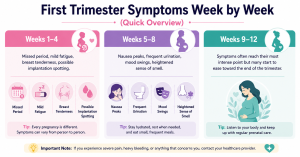
First Trimester Symptoms Week by Week (Quick Overview)

Common first trimester symptoms infographic

  • Weeks 1–4: Missed period, mild fatigue, breast tenderness, possible implantation spotting.
  • Weeks 5–8: Nausea peaks, frequent urination, mood swings, heightened sense of smell.
  • Weeks 9–12: Symptoms often reach their most intense point but many start to ease toward the end of the trimester.

When to Worry: Red Flags in the First Trimester

Contact your doctor immediately if you experience:

  • Severe abdominal pain or cramping
  • Heavy bleeding (soaking a pad in an hour)
  • Persistent vomiting that prevents keeping fluids down
  • Dizziness, fainting, or severe headaches
  • Signs of infection (fever, painful urination)

Trust your instincts — it’s always better to check than worry.

Managing First Trimester Symptoms: Lifestyle Tips

  • Eat small, nutrient-dense meals every 2–3 hours.
  • Stay active with gentle exercise (walking, prenatal yoga, swimming).
  • Rest when your body asks for it.
  • Build a strong support network and attend early prenatal care appointments.

The Emotional Side of Early Pregnancy

Many women feel a mix of joy, fear, excitement, and uncertainty. Be kind to yourself. This is a big life change, and it’s okay to feel overwhelmed. Reach out for emotional support when needed.

Looking Ahead: The Light at the End of the First Trimester

By weeks 12–14, most women start feeling significantly better. Nausea often fades, energy begins to return, and the constant exhaustion lifts. This challenging but temporary phase leads to the more comfortable second trimester and, eventually, meeting your baby.

FAQs About First Trimester Symptoms

What are the earliest first trimester symptoms?

The very first signs are often a missed period, mild fatigue, and breast tenderness. Some women notice implantation spotting or a metallic taste as early as 4 weeks. A positive pregnancy test is the best confirmation.

Is it normal to have no first trimester symptoms at all?

Yes, completely normal. Some women experience very few or no noticeable symptoms. As long as your prenatal check-ups and ultrasounds are normal, this is usually a positive sign.

How long do first trimester symptoms typically last?

Most symptoms peak between weeks 6–12 and improve by weeks 13–16. Nausea and fatigue are often the last to disappear.

Can first trimester symptoms tell me if I’m having twins or the baby’s gender?

More severe symptoms can sometimes be linked to higher hCG levels (possible with twins), but they are not reliable. Gender cannot be determined from symptoms.

What foods help with first trimester symptoms like nausea?

Bland, cold foods work best: crackers, toast, bananas, applesauce, rice, and plain pasta. Ginger, lemon, and peppermint are helpful natural remedies.

When should I call my doctor about first trimester symptoms?

Call right away for heavy bleeding, severe pain, dizziness, vomiting that keeps fluids down, or any concerns. Better safe than sorry.

Are there safe ways to relieve headaches or constipation?

Stay hydrated, eat high-fibre foods, move gently, and rest in a dark room for headaches. Always check with your doctor before taking any medication.

Do first trimester symptoms get better in the second trimester?

Yes, for most women. Many describe the second trimester as the “honeymoon phase” where nausea decreases and energy returns.

Can exercise help or worsen first trimester symptoms?

Gentle exercise usually helps reduce fatigue, improve mood, and ease constipation. Listen to your body and avoid high-intensity workouts.

How can my partner or family support me?

Ask for specific help — bringing snacks, handling chores, or simply listening. Clear communication makes a big difference.


Pregnant at 27: Why This Age May Be Perfect for Motherhood (And What No One Informs You of This Fact)

Edited by: MomSaathi Editorial Team

Reviewed by: Obstetricians & Gynecologists (OB-GYNs), Certified Nutritionists, and Maternal Health Experts based on evidence-based pregnancy and preconception care guidelines

As soon as I heard whispers about the optimal age to become pregnant, 27 kept cropping up in conversations with friends, doctors, and even random aunties at family events. “Pregnant at 27” seemed oddly specific — like it struck a balance between youth, energy, and readiness without either the early twenties rush or mid-thirties panic.

After doing research into my options and speaking to women who’ve already experienced motherhood while double-checking science’s claims on its practicality, 27 is certainly one of the least hyped yet most practical ages for starting or expanding families — not because everyone will benefit equally, but because it hits that sweet spot most women don’t ever hear about!

If you are 26, 27, or 28 and wondering whether now is the right time for you to have children, you aren’t alone. In India, especially, where discussions of pregnancy often oscillate between “get married early and have children by 22” and “build your career first”, 27 seems like an appropriate middle ground which works both biologically, emotionally, and practically. So let’s break this down without any unnecessary drama or panic-inducing rhetoric.

The Biology of Being Pregnant at 27

Fertility doesn’t suddenly fade with age 30 — according to data from the American Society for Reproductive Medicine and multiple studies, healthy women between 25-27 still have approximately a 20-25% chance of naturally conceiving within any cycle. If actively trying for pregnancy within 12 months (78-85% odds), chances are good.

Compare that to age 35+ when monthly chances drop to below 15% and miscarriage risks significantly rise. At 27, however, chromosomal issues like Down syndrome still fall below 0.3% while miscarriage rates average only 10-12% among confirmed pregnancies; gestational diabetes, hypertension, or preterm birth complications tend to be minimal at this age compared to later ones.

Indian Council of Medical Research has determined 21 to be an ideal biological age for many Indian women based on overall health metrics in their population, but for urban, educated women who juggle careers, higher education, and nuclear families, 27 is often more realistic; your body remains resilient, hormones remain balanced, and recovery from pregnancy usually goes smoothly. One European couple study noted fertility began a gradual decrease starting around 27, but wasn’t noticed until early thirties; getting pregnant at 27 means you’re still riding at the high end of this curve!

At this age, many mothers report conception without needing tracking apps or supplements — just their natural cycles doing their job! No IVF drama and no months of disappointment: that is the power of late 20s fertility!

Energy Levels and Physical Recovery

One thing pregnancy blogs rarely mention: toddlers can be exhausting. At 27, however, you still possess enough stamina to chase a crawling baby around at 2 a.m. or endure another round of “one more story” without feeling like your life has suddenly aged significantly overnight.

Your body also recovers more quickly when giving birth in your twenties than later on, with skin elasticity, muscle recovery, and overall healing occurring more quickly than if given birth later on in life. One mom I spoke to (who had her first at 27 and second at 30) reported being back to pre-pregnancy weight and energy levels within six months without extreme dieting or trainers. However, she gained 12-15 kg, her joints didn’t ache, her hair didn’t thin significantly, and postpartum depression felt manageable since she wasn’t fighting both fatigue and sleep deprivation at once!

Comparatively, friends who waited until 35+ shared stories of joint pain during gestation and prolonged recovery from C-sections, plus chronic fatigue that persists after giving birth. At 27, you’re not “old” per se, but past the reckless twenties when late nights and poor eating habits might have been commonplace; most likely, you have established basic self-care measures for sleep, nutrition, and movement, which make pregnancy and early motherhood sustainable rather than survival mode.

Career, Money, and Life Stability

At 27 you’ve reached an ideal point in your professional journey: beyond entry-level chaos yet not yet locked into senior leadership, where taking maternity leave feels irreparable. Most women at this age already have several years of work experience and savings behind them, giving them enough security in their field that taking time off or switching roles feels manageable without derailing everything they’ve achieved so far.

Financially, being 27 can often put one in an excellent place financially. Salaries should have started increasing, maybe you own or have purchased an EMI home or two-wheeler, and dual-income households are increasingly common across Indian metros like Bengaluru, Mumbai or Delhi, where hospital bills, nanny costs, and baby gear costs add up quickly. You should now know budgeting but your earning potential remains strong.

One working mom shared how her pregnancy at 27 gave her the “second innings” she needed. She took time away from mid-level corporate roles to evaluate what truly motivated her, then returned stronger by starting a side hustle that now supports her family. The time off didn’t feel like punishment; rather, it felt like strategic pausing.

Emotional Readiness and Relationship Glow-Up

By 27, most of us have lived some. We’ve experienced wild nights, questionable decisions, heartache, and quarter-life crises — an experience which should allow for genuine excitement about responsibility instead of any feelings of resentment or regret.

Your relationship can become richer with each passing year, from late-night feeds and first smiles, to those terrifying but hilarious parenting fails that bond you more deeply than date nights ever could. Respect grows; laughter becomes easier. By now, both partners are mature enough to deal with conflict without as much drama — yet still young enough to dream big together!

Indian families tend to view this age as the one where you have navigated some of the “log kya kahenge” pressure and can relax a bit about asking when my beta or shaadi is happening? Instead, they ask when is my wedding happening? — a weird yet welcome change.

The Long Game: When Your Kids Are Grown, You Aren’t “Old”

Imagine this: when your first child turns 18 when you are 45, you still feel energetic enough for college drop-offs, weddings and grandkids without missing your own life completely. Travel plans, career pivots or even that long-postponed MBA suddenly become viable again — life doesn’t end at 40; it opens up!

Moms who had children at 27 often say they feel as if they have “regained their youth” in their forties — this perspective shift can be profound.

But Pregnancy at 27 Isn’t All Rainbows

Let’s be real here — pregnancy at 27 can present real challenges. Society may treat you like you’re “too young,” especially if you don’t hold down a corporate job or carry debt. Postpartum body changes can be hard-hitting when comparing yourself with filtered Instagram lives, and joint families often provide unsolicited advice that flows like water down the Ganges River.

Fertility isn’t guaranteed for everyone; PCOS, stress, and lifestyle factors all can play a part no matter your age. Even women as old as 27 still face conception delays and need medical assistance — which is perfectly normal; what matters more than perfection is having the odds stacked more heavily in your favor now than later on.

Real Stories from Women Who Were Pregnant at 27

I have heard different versions of this across cities: from Bengaluru software engineers who conceived on their second cycle after marriage and now manage the workload associated with being pregnant at 27; to Mumbai content creators documenting their pregnancy journeys to become late-20s mom communities; and Delhi teachers citing how their energy levels allowed them to be the “fun moms” their kids still speak highly of.

One woman shared with me: “At 27, I was worried I was rushing life. However, looking back it gave me the best of both worlds — not being overwhelmed at 22 and exhausted at 35; 27 worked perfectly!”

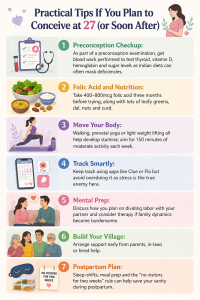
Practical Tips If You Plan to Conceive at 27 (or Soon After)

Pregnant at 27: Why This Age May Be Perfect for Motherhood (And What No One Informs You of This Fact)

  • Preconception Checkup: As part of a preconception examination, get blood work performed to test thyroid, vitamin D, hemoglobin and sugar levels as Indian diets can often mask deficiencies.
  • Folic Acid and Nutrition: Take 400-800mcg folic acid three months before trying, along with lots of leafy greens, dal, nuts and curd.
  • Move Your Body: Walking, prenatal yoga, or light weight lifting all help develop stamina; aim for 150 minutes of moderate activity each week.
  • Track Smartly: Keep track using apps like Clue or Flo, but avoid overdoing it as stress is the true enemy here.
  • Mental Prep: Discuss how you plan on dividing labor with your partner and consider therapy if family dynamics become burdensome.
  • Build Your Village: Arrange support early from parents, in-laws, or hired help.
  • Postpartum Plan: Sleep shifts, meal prep, and the “no visitors for two weeks” rule can help save your sanity during postpartum.

Final Thoughts: Your Body, Your Timeline

Pregnancies often happen at 27. While some women get pregnant as early as 22, others require medical support in their late 30s before going into gestation. But if you are in your late twenties and feeling ready to try for a baby — if biology and life are in sync — then science, real moms, and common sense point to yes!

Are You Late, Rushing or on Time for Motherhood? No one said anything like that — rather, there’s never been a better time or place to embrace motherhood that allows for you to remain present, energetic and fully yourself!

If this post strikes a chord with you, share your experiences in the comments. And if you’re actively trying or just considering it, visit a good gynecologist who listens carefully to you, not just age; as ultimately the ideal age is dependent upon personal choice.

🏛️

Official Government of India Resources

All links are official Government of India sources • Verified & trustworthy

Faq About Being Pregnant at 27

Is 27 really the best age to get pregnant?

It’s not “the best” for every woman, but it’s often one of the smartest. Biologically, fertility and egg quality are still at their peak while your body has the resilience of youth. Life-wise, you’re usually stable enough in your career and relationship to handle the changes without feeling completely overwhelmed. Doctors call it the “Goldilocks age” — not too young, not too old.

What are the risks of pregnancy at 27 compared to other ages?

Risks are actually very low. The miscarriage rate is around 10-12%, chromosomal abnormalities are under 0.3%, and complications like gestational diabetes or high blood pressure are far less common than after 35. The biggest “risk” is usually lifestyle-related (stress, poor diet) rather than age itself. Compared to 22, you’re more mature; compared to 35, your body recovers faster.

Will I have trouble conceiving if I wait until 27?

Most women don’t. Natural conception rates at 27 are excellent — about 78-85% within one year of trying. If you have conditions like PCOS, thyroid issues, or irregular cycles, you might need help regardless of age, but 27 gives you better odds than later. Start tracking cycles and see a gynecologist early if periods are irregular.

How does pregnancy at 27 affect my career?

It usually gives you more flexibility than later. You’ve had time to build some experience and savings, but you’re not yet in a senior role where maternity leave feels like a bigger setback. Many women return stronger — with better negotiation power or even a career pivot. In India, the Maternity Benefit Amendment Act gives you 26 weeks of paid leave, which feels more manageable when you’re still climbing the ladder.

What should I do before trying to get pregnant at 27?

Book a preconception check-up at least 3 months ahead. Get basic blood tests, start folic acid, eat balanced home-cooked meals, exercise regularly, cut down on caffeine and alcohol, and make sure your partner gets a basic semen analysis if needed. Mental health prep is just as important — talk openly with your partner and family.

Is it harder to lose baby weight after pregnancy at 27?

Not usually. Most women in their late twenties find it easier to get back in shape because metabolism is still high and hormones bounce back quicker. Combine breastfeeding, light walks, and realistic nutrition (not crash diets), and most moms are comfortable in their old clothes within 8-12 months. It’s more about consistency than age.


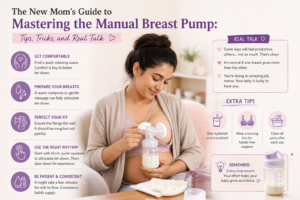
Mastering the Manual Breast Pump: Tips & Step-by-Step Guide

Edited by: MomSaathi Editorial Team

Reviewed by: Certified Lactation Consultants (IBCLC) and Maternal Health Specialists

You’re sitting on the edge of your bed, it’s 3:00 AM, and your little one is finally—finally—asleep. You’re feeling that familiar, heavy fullness in your chest, and you’ve got this small, plastic contraption in your hand that looks more like a high school science project than a life-saving tool.

If you’re staring at your manual breast pump wondering, “How on earth is this supposed to help me?” believe me, I have been there.

When I first brought my pump home, I thought it would be as simple as ‘press and go.’ Instead, I spent twenty minutes getting zero drops of milk and a very sore thumb. But here’s the secret: once you get the rhythm down, a manual pump can be your absolute best friend.

Whether you’re looking to build a small freezer stash, relieve engorgement, or just need a backup for when you’re on the move, mastering the manual breast pump is a skill that will save your sanity. Let’s dive into how to go from “zero milk” to “pro pumper.”

What Exactly is a Manual Breast Pump?

In a world of high-tech gadgets, the manual breast pump is refreshingly simple. It is a hand-operated device that uses a lever or a handle to create suction. Unlike electric pumps that require a wall outlet or batteries, this is powered entirely by you—specifically, your hand muscles.

Most manual pumps consist of a few basic parts:

  • The Flange (Shield): The funnel-shaped part that goes over your nipple.

  • The Handle: What you squeeze to create the vacuum.

  • The Valve and Diaphragm: The “engine” that creates the suction.

  • The Bottle: Where the liquid gold collects.

Moms often choose a manual pump because it’s incredibly portable, affordable, and—most importantly—silent. You can pump right next to a sleeping baby without that “hiss-whoosh” sound of an electric motor waking them up.

My First Experience: The “No Milk” Meltdown

I remember the first time I tried a manual breast pump for beginners. I had read the manual, watched a YouTube video, and felt ready. I sat down, squeezed the handle with all my might, and nothing. Not a single drop.

I felt like a failure. I assumed my milk had dried up or that the pump was broken. My hand started cramping after five minutes, and I was ready to throw the whole thing in the trash.

What I didn’t realize then was that pumping is 10% mechanics and 90% biology. I was stressed, cold, and my body wasn’t “letting down” the milk. If you are struggling right now, know that hand fatigue and initial confusion are part of the process. It gets easier, I promise.

How to Use a Manual Breast Pump (Step-by-Step)

If you want to see results, you have to follow the rhythm of how a baby actually nurses. Here is the foolproof method:

1. Clean and Assemble

Always start with clean hands. Make sure all the tiny white valves are pushed in tight. If there’s even a tiny air leak, you won’t get any suction.

2. Position the Flange

Center your nipple in the middle of the flange. It shouldn’t be rubbing against the sides. If it feels like it’s being pinched, you might need a different flange size.

3. Trigger the “Letdown”

This is the most common mistake. Don’t start with long, slow squeezes. Instead, mimic a hungry baby. Use short, fast, shallow pumps (about 2 per second). This tells your brain, “Hey, the baby is hungry! Release the milk!”

4. Transition to Rhythmic Pumping

Once you see milk starting to drip or spray (the letdown), switch to long, steady squeezes. Press the handle, hold for a second, and release. This pulls the milk out efficiently once the flow has started.

5 Pro-Tips for Manual Breast Pump Success

If you want to increase your output and decrease your frustration, try these manual breast pump tips used by seasoned moms:

  • Apply Warmth: Use a warm compress or a heated gel pack on your breast for 5 minutes before you start. Warmth expands the milk ducts and helps the milk flow much faster.

  • The “Milk Massage”: Gently massage your breast in a circular motion toward the nipple before and during pumping. This helps break up any “stuck” milk.

  • Relaxation is Key: Your milk won’t flow if you’re stressed. Look at photos or videos of your baby, listen to soothing music, or even eat a snack.

  • Don’t Watch the Bottle: Staring at the drips can cause “performance anxiety.” Cover the bottle with a baby sock and just focus on the feeling.

  • Consistency over Quantity: It’s better to pump for 10 minutes consistently every day than for an hour once a week.

Common Mistakes New Moms Make

  • Using the Wrong Flange Size: If your nipple is rubbing the sides or too much of your areola is being pulled in, it will be painful and ineffective.

  • Pumping Too Hard: More suction does not mean more milk. It only means more pain. If it hurts, you are squeezing too hard or the vacuum is too high.

  • Expecting Instant Results: Your body needs to learn how to respond to plastic and silicone instead of a warm baby. Give it 3–5 days of practice before you judge the results.

Manual vs. Electric Breast Pump: Which is Better?

Every mom’s journey is different. Here is the “Real Talk” breakdown:

Feature Manual Breast Pump Electric Breast Pump
Portability Fits in a handbag; no cords. Bulkier; needs power/batteries.
Cost Very budget-friendly. Can be quite expensive.
Effort Requires manual hand power. Hands-free or minimal effort.
Speed Takes longer to empty the breast. Much faster; can double-pump.
Noise Completely silent. Buzzing or humming motor sound.

The Verdict: If you are exclusively pumping, get an electric. If you are a stay-at-home mom who just needs to go out for a few hours or wants to relieve fullness, the manual pump is the winner.

Is a Manual Breast Pump Effective?

A common question is: Is manual breast pump effective enough to maintain a supply?

The answer is Yes, but with caveats. Manual pumps are highly effective for:

  • Relieving engorgement.

  • Occasional use (once or twice a day).

  • Travel or power outages.

  • Increasing supply by “power pumping” one side while baby nurses on the other.

However, if you are returning to a full-time office job and need to pump three times a day, your hand will likely get too tired, and an electric pump would be a better investment.

Real Talk: What No One Tells You

No one tells you that the first few times you use a manual pump, you might feel like a farm animal. It feels weird!

You might only get 5ml (half a teaspoon) your first time. That is normal. Your body is smart; it knows the difference between a pump and a baby. You have to “train” your breasts to trust the pump. Also, your mental state matters more than the brand of the pump. If you’re crying or stressed, your “Oxytocin” (the hormone that releases milk) stays low. Take a deep breath. You’re doing great.

Conclusion

The manual breast pump is a small tool that can provide a huge amount of freedom. It might take a few tries to find your rhythm, and your hand might feel a little like you’ve been at the gym for the first week, but don’t give up.

Once you master the short-fast/long-slow rhythm and learn to relax, you’ll find that this little plastic gadget is one of the most empowering tools in your parenting kit.

If you’re a new mom struggling with pumping, you’re not alone  

Pumping Resources & Guides

For more expert advice on breastfeeding and choosing the right equipment, explore these trusted sources:

FAQs About Manual Breast Pumps

Is using a manual breast pump painful?

It shouldn’t be! If you feel pinching or sharp pain, check your flange size or reduce the strength of your squeeze. It should feel like a strong “pull,” but never pain.

How long should I pump with a manual pump?

Usually, 10–15 minutes per side is enough. Pumping longer than 20 minutes can cause tissue soreness without necessarily getting more milk.

Can I increase my milk supply with a manual pump?

Yes. By pumping for 5-10 minutes after a nursing session, you send a signal to your body to produce more milk for the next time. Consistency is key!


6 Weeks From Today: Your Essential Guide

If you just looked at your calendar and realized that 6 weeks from today marks a massive change in your life, you probably felt a little flutter in your stomach. Maybe you just saw two pink lines on a pregnancy test, or perhaps you’re staring at a work deadline that suddenly feels very real.

Whether you are a new mom-to-be trying to wrap your head around “pregnancy math” or someone planning a big event, six weeks is a magical window of time. It’s long enough to see real physical changes, yet short enough to feel the urgency of preparation.

In this guide, we’re going to break down exactly what date is 6 weeks from today, how to calculate your pregnancy journey like a pro, and why this specific timeframe is the “sweet spot” for transformation.

What Does “6 Weeks from Today” Really Mean?

In our fast-paced lives, we usually think in days or months. But “weeks” are the secret language of growth. When you think about the span of 6 weeks from today, you are looking at a month and a half.

It is the amount of time it takes to form a new habit, for a tiny embryo to develop a heartbeat, or for a fitness challenge to actually show results in the mirror. It is a bridge between the “now” and a very different “then.”

How to Calculate the Date Easily

If you are sitting there with your phone or a paper planner, you might be wondering about the quickest way to find the exact date.

To find out what date is 6 weeks from today, you simply take today’s date and add 42 days.

  • Step 1: Look at today’s date.

  • Step 2: Count forward exactly six rows on a standard calendar (since each row is one week).

  • Step 3: That’s your target date!

For example, if today is April 26th, counting six weeks ahead lands you right in the first week of June. It sounds simple, but when life gets busy, having a clear “D-Day” helps keep the anxiety at bay.

Chart showing 6 weeks from today pregnancy timeline including months and trimesters

6 Weeks in Days, Months, and Pregnancy Terms

Let’s do some quick math to help you visualize this block of time.

How many days in 6 weeks?

There are exactly 42 days in 6 weeks.

  • 1,008 hours

  • 60,480 minutes

When you look at it in minutes, it feels like a lot! But in the world of pregnancy, those 42 days move at lightning speed.

Is 6 weeks equal to 1.5 months?

Almost, but not quite. Since most months are about 4.3 weeks long, 6 weeks is roughly one month and ten days. This is where many people get confused, especially when using a pregnancy timeline calculator.

Pregnancy Timeline Explained: Weeks vs. Months vs. Trimesters

If you’ve ever talked to a pregnant woman, you’ve probably noticed she never says “I’m three months pregnant.” She says “I’m 14 weeks.”

Why the obsession with weeks? Because in the womb, a single week can mean the difference between a tiny cluster of cells and a baby with developing fingers and toes.

📅 Quick Date Calculator

Calculate exactly 6 weeks (42 days) from any date!


The Trimester Calculation

The journey is divided into three main stages. Here is a simple pregnancy weeks and months chart to help you stay on track:

Trimester Week Range Month Range
First Trimester Week 1 – 13 Month 1 – 3
Second Trimester Week 14 – 27 Month 4 – 6
Third Trimester Week 28 – 40+ Month 7 – 9+

If you are currently 6 weeks from today in your pregnancy journey, you are firmly in the first trimester. Your baby is roughly the size of a sweet pea, and their heart is already beating!

Why Tracking Weeks is Important

Whether you are a “Type A” planner or a “go with the flow” soul, tracking by the week is a game-changer.

  1. Medical Accuracy: Doctors always use weeks. If you tell your OB-GYN you are “two months” pregnant, they will immediately ask for the week count to ensure baby’s milestones are being met.

  2. Mental Milestones: Telling yourself “I only have 6 weeks left” feels much more manageable than “I have a month and a half.”

  3. Hormonal Changes: For moms, your body changes week-by-week. Knowing what to expect 6 weeks from today helps you prepare for things like morning sickness or that second-trimester “glow.”

Real-Life Uses of “6 Weeks from Today”

It’s not just for babies! This timeframe is used by professionals and athletes everywhere.

1. Pregnancy Tracking

At the 6-week mark, many women have their first ultrasound. It’s an emotional moment where the pregnancy suddenly feels “real.” If you are planning a baby shower or a gender reveal, you’ll likely be looking at a date that is several sets of 6 weeks from today.

2. Project Planning

In the corporate world, a “6-week sprint” is a common way to get big tasks done. It’s enough time to design, build, and launch a small product without losing momentum.

3. Fitness Goals

Ever heard of a “6-week transformation”? That’s because it takes about six weeks for your friends and family to notice physical changes in your body. If you start today, think about how different you will feel 6 weeks from today.

Easy Ways to Calculate Future Dates

You don’t need to be a math genius to figure this out. Here are three easy ways to stay ahead:

  • The “Rule of 7”: Multiply the number of weeks by 7. ($6 \times 7 = 42$). Add that to your current date.

  • Digital Assistants: Ask your phone, “Hey, what is the date 6 weeks from now?”

  • Online Tools: Use a pregnancy timeline calculator if you are specifically looking for your due date or trimester shifts.

Tips to Stay Organized Over 6 Weeks

Six weeks can fly by if you aren’t careful. Here is how to make the most of those 42 days:

  • Set a “Mid-Way” Check-in: At the 3-week mark, see if you are halfway to your goal.

  • Use a Paper Calendar: There is something satisfying about crossing off days with a bright red pen.

  • Batch Your Tasks: If you are preparing for a baby, use the first two weeks for research, the next two for shopping, and the final two for setting up the nursery.

Common Mistakes People Make While Calculating Weeks

Believe it or not, people get this wrong all the time!

  • The “Month” Trap: Assuming 4 weeks always equals one month. Since months vary (28 to 31 days), assuming 4 weeks per month will leave you “short” about 2-3 days every single month.

  • Counting from the Wrong Day: In pregnancy, the clock starts from the first day of your last period, not the day you conceived. This usually adds 2 “bonus” weeks to your count!

  • Forgetting Leap Years: Every four years, February adds a day. If your 6 weeks from today calculation crosses into late February, don’t forget to add that extra day.

Conclusion

Whether you are counting down to meeting your little one or pushing toward a personal goal, remember that time is your best friend. Being exactly 6 weeks from today means you are in a season of growth and preparation.

Don’t let the days just slip by. Grab a planner, mark that date, and start making moves. You’ll be surprised at how much life can change in just 42 days!

What are you counting down to? Share your milestones in the comments below—I’d love to cheer you on!

📚 Expert Resources & References

For more detailed medical information on pregnancy milestones and date tracking, explore these trusted sources:

FAQs About 6 Weeks Pregnancy

Exactly what date is 6 weeks from today?

To find the exact date, add 42 days to today’s date. If today is Monday, your 6-week mark will also fall on a Monday.

How many months is 6 weeks in pregnancy?

In pregnancy terms, 6 weeks is roughly 1 month and 2 weeks. You are officially in your second month of pregnancy.

Is 6 weeks too early for an ultrasound?

Usually, no! By 6 weeks, a transvaginal ultrasound can often detect the fetal heartbeat and confirm that the pregnancy is in the right location.

How do I use a pregnancy timeline calculator?

You simply input the first day of your last menstrual period (LMP). The calculator does the “pregnancy math” for you, showing you your current week, trimester, and estimated due date.

Why do doctors count pregnancy in weeks instead of months?

Because fetal development is incredibly rapid. A baby changes more in one week of pregnancy than a toddler might change in three months! Weeks provide a more precise “medical yardstick.”

Can I start a 6-week fitness program if I’m pregnant?

Always consult your doctor first. Generally, if you were active before pregnancy, you can continue, but the 6-week mark is often when morning sickness and fatigue kick in, so listen to your body!