Baby Vaccines Schedule 2025-26: What Parents Should Know Around The World (Guides for New Moms)

Edited by: MomSaathi Editorial Team

Reviewed by: Based on pediatric immunization guidelines and IAP-recommended vaccination schedules

Hello, dear mother, it is very fun to take your baby for the first time. However, many questions arise as well. One of the questions that almost all new parents have is, “What vaccines does my baby need and when? ” This is particularly true since there have been recent changes in schedules in many countries.

This is the up-to-date baby vaccines schedule 2025-2026 guide that has been compiled by Momsaathi to give clear information on the first 12-24 months. This is because vaccines are a big part and protect your child from the deadly diseases that are avoidable, like whooping cough, measles, polio, and others. This article is dedicated to the core vaccines that are recommended worldwide, when and why they are important to child development, and some tips to help parents deal with the stress.

Every country has a different immunization protocol that is based on the disease risks and the country’s health. For this reason, you should take your child to a private doctor and obtain a health clearance to do this.

As a baby, a child has to develop some immunity to the child. This is done by the baby’s mother’s immune system. However, this immunity wanes quickly, and the child becomes susceptible to other infectious diseases. Vaccines are the help in this children. They teach children to react to and deal with problems that are harmful. This is done without exposing the children to sickness.

Leading health organizations, such as the World Health Organization (WHO), have reiterated that in the first year of life, a child’s first-line defense against illness is timely vaccinations.

The core vaccines contain antigens designed to elicit an immune response and provide long-lasting defense against a number of childhood illnesses that can have devastating effects, leading to permanent disability, prolonged hospital stay, or even death. There is a worldwide agreement to include vaccines against diphtheria, tetanus, and pertussis (whooping cough), Hib, pneumococcal disease, polio, measles, mumps, and rubella.

For further information about your baby’s health and early development, you can refer to our guide: Baby Milestones by Month: What to Expect 0-12 Months (With Red Flags).

Standard Baby Vaccines Schedule 0–24 Months (Global Overview)

Vaccination schedules may differ by country (e.g., the US, the UK, India, Australia, EU countries). Below is a global framework that is widely accepted based on the WHO recommendations and national programs in place for 2025-2026. Most countries have a similar framework with slight changes to the timing of the vaccinations or the use of combination vaccines.

Birth: Hepatitis B (HepB) – First dose (often within 24 hours)

2 Months: DTaP (Diphtheria, Tetanus, Pertussis) – 1st dose Hib (Haemophilus influenzae type b) – 1st dose Polio (IPV) – 1st dose Pneumococcal (PCV) – 1st dose Rotavirus – 1st dose (in many programs) Hepatitis B – 2nd dose (if not completed earlier)

4 Months: DTaP – 2nd dose Hib – 2nd dose Polio – 2nd dose Pneumococcal – 2nd dose Rotavirus – 2nd dose

6 Months: DTaP – 3rd dose, Hib – 3rd dose (depending on brand), Polio – 3rd dose (in some schedules), Pneumococcal – 3rd dose, Hepatitis B – 3rd dose (if needed), Rotavirus – 3rd dose (if using 3-dose vaccine), Influenza – Annual starts from 6 months in many countries

9–12 Months: Measles-containing vaccine (often MMR or MR) – First dose (usually at 9 or 12 months, depending on country), Yellow fever or other region-specific vaccines in endemic areas

12–18 Months: DTaP – 4th dose (booster) Hib – Final dose (if needed) Pneumococcal – Booster MMR – Second dose (in some schedules) Varicella (Chickenpox) – In countries that include it Hepatitis A – In many programs

18–24 Months: Boosters as needed (DTaP, polio, etc.) Annual influenza vaccine

Notes for 2025-2026: *Protection against RSV: Some countries recommend maternal RSV vaccination during pregnancy or use the monoclonal antibody (nirsevimab) for infants (particularly during the RSV season) *Combination vaccines: These are frequently used to minimize the number of vaccinations (for example, DTaP-Hib-IPV-HepB). *Catch-up: There are catch-up schedules for missed doses; ask your physician. *Schedules differ: Some countries administer BCG at birth (for TB) and perform oral polio vaccination in certain countries, as well as Japanese encephalitis in endemic regions. Recent 2026 updates for the US have shifted some routine recommendations (i.e. certain vaccines are now deemed risk-based or subject to shared decision-making), and the AAP advocates for broader protective schedules.

For information specific to your country, contact your health ministry, pediatrician, or the World Health Organization.

Vaccine Visit Tips and FAQs

Do vaccines overwhelm my baby’s immune system? No. Vaccines use small, safe parts of germs to build protection and target specific germs as babies encounter thousands of germs. What about side effects? These are common and usually resolve quickly. They include fussiness, a mild fever, or redness where the vaccine was received, and serious reactions are extremely rare. I heard the shots hurt! Your doctor may recommend an acetaminophen dose for pain relief. Your baby may be more comfortable with breastfeeding or skin-to-skin contact during the vaccine and afterward. Spacing or delaying? Following the recommended schedule provides the most protection for the most at-risk age groups.

These appointments are also excellent times to ask about growth assessments or parenting concerns. Combine them with the responsive caregiving from Gentle Parenting Techniques for Newborns and Toddlers (No Cry Methods).

For the most up-to-date worldwide recommendations, consult the World Health Organization’s immunization website or your country’s health department. For the most right-up-to-date recommendations in the US, consult the official CDC or AAP sites here: CDC Immunization Schedules.

Talking to the Pediatrician

Before each appointment, please discuss your baby’s specific health history and any concerns regarding travel and vaccinations. This is particularly important for babies who are premature, have a history of certain illnesses, or are allergic to certain things.

To stay on track, your baby’s vaccinations schedule 2025-2026 is also a valuable tool to keep the at-risk babies in your community safe.

We’re proud of you, Mama. This is important work. We trust the science, and we hope you will, too, along with your health professional. An enormous weight is off your shoulders with each milestone protected.

You can refer to this guide. You can do this! One well baby appointment at a time.

Feel free to share with us which vaccine visit was the easiest or the hardest for you by commenting below. Also, you can share a helpful strategy you used to keep your baby calm during the shots. Let’s support one another in the Momsaathi community!

Encourage new parents with concerns regarding vaccinations to read this article and aid us in providing useful information to new parents.

This article was reviewed by our in-house pediatric consultant. Last updated March 2026. Vaccine recommendations vary, consult your pediatrician or health authorities for advice specific to your location.

Baby Teething Symptoms and Natural Relief Remedies (No Medication – Complete 2026 Guide for Moms)

Edited by: MomSaathi Editorial Team

Reviewed by: Dr. Pooja Joshi – Dental Health Expert & Oral Care Reviewer

Hey there, wonderful mama! Does your baby have red gums, seem fussy, drool constantly, and seem to have lost sleep? You might be questioning if your baby is teething, and what you can do to help without medication.

This is one of the challenging phases new parents go through in the first two years, and we understand how overwhelming it can be at Momsaathi. That is why we have created a guide named Teething Relief that focuses on remedies without medication. You will also be informed on the description of symptoms, the timelines in which they appear, and the safest methods to soothe your baby.

This guide is also designed to be safe. That means no gels, no other medications, just safe, natural, and evidence-based methods designed to get through this phase with more smiles and fewer tears. Together, we can get through this! 🌟

When Does Teething Start? Typical Timeline (0–24 Months)

Most babies get their first tooth between 4 and 7 months, but it can start as early as 3 months or as late as 12 months. By the age of 2-3 years, we expect to see 20 primary teeth.

Common Age Ranges for First Teeth to Erupt Include:

  • 6-10 Months – Lower Central Incisors
  • 8-12 Months – Upper Central Incisors
  • 9-13 Months – Upper and Lower Lateral Incisors
  • 13-19 Months – First Molars
  • 16-23 Months – Canines
  • 23-33 Months – Second Molars

If a baby is 5 months old and suddenly becomes very upset, it could be related to teething. Prior to a tooth breaking through the gums, a baby can show signs of teething as early as a few weeks before it occurs.

If you want to stay on track for your baby’s development during this time, we recommend checking out this guide: Baby Milestones by Month: What to Expect 0-12 Months (With Red Flags).

Normal Teething Symptoms

  • Excessive drooling (may lead to chin rash)
  • Irritability and fussiness, particularly at night
  • Rubs ears and/or cheeks
  • Chews on anything and everything, which may lead to a loss of appetite (for breast milk, this is usually not the case)
  • Night waking
  • Increased fussiness (may lead to a loss of appetite)
  • Having a very mild fever (under 100.4°F / 38°C)
  • Rash caused by exposure to stools (may be a sign of insufficient sleep)
  • Sleep problems (may be caused by a rash caused by exposure to stools)
  • Chewing on hands, toys, and/or clothing

Please remember that babies do not typically show signs of teething with fever (greater than 101°F), vomiting, rash, or a severe reduction in appetite. Contact your child’s doctor if you believe that your child may have an infection.

If you’re noticing increased spit-up or changes in feeding frequency, it may be related to teething. You may want to refer to our guide: Why Does My Baby Spit Up After Every Feeding? Safe Remedies.

12 Safe Natural Teething Relief Remedies

These mom-created, pediatric-approved, teething baby relievers include:

  • Chilled Teething Rings — Teething silicone or rubber rings can be placed in the fridge for 15-20 minutes. They tend to numb the gums and become more comfortable.
  • Cold Washcloth — A clean, soft, cold washcloth is great for the baby to chew on. You can even add a little breast milk for added comfort.
  • Frozen Breast Milk Popsicles — You can pour your accumulated breast milk into a clean baby feeder or ice tray with a handle. Then, freeze it, and it can be great for older babies (6+ months).
  • Gentle Gum Massage — You’ll want to wash your hands, then wrap a clean finger in soft gauze, and then you can firmly rub the gums in a circular motion for 1-2 minutes.
  • Chilled Cucumber or Carrot Sticks (for 6+ months) — Cucumber or Carrot sticks may be given when your little one turns 6 months. You’ll want to supervise closely — and definitely don’t leave the baby alone.
  • Amber Teething Necklace? Only if… — The soothing effect Amber necklaces have is loved by many mothers; however, they should only be used under constant supervision, as there is a risk of choking. If you do choose to get an Amber necklace, use Baltic amber with an appropriate safety clasp.
  • Babywearing & Extra Cuddles — Staying close together, as with babywearing, causes the release of calming hormones and diverts attention from the discomfort.
  • White Noise + Dim Lights for Teething Discomfort Sleep — Disrupted sleep caused by teething is to be expected. Using a consistent sleep routine and white noise at bedtime is a good idea, as described in our Best Newborn Sleep Schedule 0-3 Months for First-Time Moms.
  • Breastfeeding on Demand — Extra nursing sessions provide comfort and closeness, help with hydration, and relieve pain.
  • Chilled Silicone Teething Toys — Safe brands with no detachable small parts.
  • Face & Chin Care — Wipe drool frequently and use coconut oil or lanolin to soothe raw skin.

Avoid Homeopathic Remedies — Some mothers use chamomile or calendula gels (which are natural and do not have benzocaine), but they should always check with a doctor before giving these remedies.

For the most up-to-date safe teething information provided by the American Academy of Pediatrics, please visit: Teething Pain Relief – American Academy of Pediatrics

Teething Nights & Fussy Days (Gentle Parenting Style)

Teething babies need a calm, predictable routine. An overtired baby will feel the discomfort much more and will be more cranky. Skin-to-skin with the baby is recommended, and babywearing is highly effective. Distraction with soft, calming songs and gentle play is recommended. Preferred toys are also recommended as good sources of distraction. You and your partner should alternate shifts so that you both have some time to rest.

These strategies combine wonderfully with our Gentle Parenting Techniques for Newborns and Toddlers (No Cry Methods).

Safe Practices & When to Call the Doctor

Always Safe:

  • The Teething Toy should be supervised
  • The Toys should be cleaned daily
  • Amber necklaces should not be used during sleep

You should Call Your Pediatrician If:

  • A fever that is over 100.4°F (38°C)
  • You have diarrhea lasting more than 24 hours
  • A refusal to be fed for long periods
  • Extreme lethargy or hours of inconsolable crying
  • Swelling or pus around the gum area
  • Any symptoms that trouble you

10 FAQs About Baby Teething Symptoms and Natural Relief

  • Can teething cause fever? Yes, it can cause mild low-grade fever, but high fever is usually something else.
  • How long does each tooth take to come in? Each tooth takes 3–7 days of noticeable symptoms, on average.
  • Is drooling always a sign of teething? Crying is a common result of infant behavior.
  • Should I use teething gels? Avoid any with benzocaine. Natural options are the way to go.
  • Do molars hurt more than front teeth? Yes, because of the larger surface area and because they are deeper in the gums.
  • Will my baby stop eating during teething? Baby might eat less solids, but typically will continue breastfeeding or formula well.
  • Can I give frozen fruit? Only soft options like banana or watermelon in a feeder bag after 6 months.
  • How do I prevent chin rash from drool? Wipe gently and apply a thin layer of coconut oil or barrier cream.
  • Is an amber teething necklace safe? Only with a proper breakaway clasp and constant supervision.
  • When should the first tooth appear? The average is 6 months, but anywhere from 3 to 12 months is normal.

You’re Doing an Amazing Job, Mama!

Teething can feel endless, but every tooth your baby gets gets them that little bit closer to that beautiful smile. With a little bit of extra patience, these natural teething relief remedies, and a few more cuddles, you’ll both get through the process that little bit stronger.

You’ve got natural tools, the community support, and more importantly, the love your baby needs. Save this guide and come back whenever a new tooth is on the way.

Which natural remedy was most effective for your teething baby? Which symptoms surprised you? The Momsaathi community is here for you!

If you know a mom whose baby is chewing everything, send her this no-medication teething guide. You’re helping more mamas than you know.

This article was medically reviewed by our in-house Dr. Pooja Joshi, pediatric consultant, and last updated March 2026. Always consult your pediatrician for personalized advice.

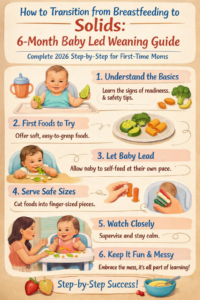
How to Transition from Breastfeeding to Solids: 6-Month Baby Led Weaning Guide (Complete 2026 Step-by-Step for First-Time Moms)

Hey mama! 👋If you’re watching your 6-month-old stare at your plate with those big curious eyes, you’re probably asking: “Is it time to start solids? How do I transition from breastfeeding without losing my milk supply or stressing my baby?”

You’re in the perfect place. At Momsaathi, we know this transition can feel exciting yet overwhelming. This complete 6-month baby led weaning guide walks you through everything — from the right signs to start, safe first foods, feeding schedules, common mistakes, and how to keep breastfeeding strong while introducing solids.

Baby-led weaning (BLW) puts your baby in charge — they self-feed soft finger foods instead of purees. It encourages independence, better oral motor skills, and a healthy relationship with food. Ready? Let’s make this transition smooth, joyful, and mess-free(ish)! 🍓

When to Start Solids: Signs Your 6-Month-Old Is Ready

The World Health Organization and AAP recommend exclusive breastfeeding for the first 6 months, then introducing solids while continuing breast milk as the main nutrition.

Your baby is ready for solids when they show most of these signs:

  • Can sit with minimal support (or in a high chair)
  • Has good head and neck control
  • Shows interest in food (reaches for your plate, watches you eat)
  • Lost the tongue-thrust reflex (no longer automatically pushes food out with tongue)
  • Can bring objects to mouth and chew on them

Most babies hit these milestones around 6 months, but some may be ready a little earlier or later. Never start before 4 months.

For tracking overall development, see our guide: Baby Milestones by Month: What to Expect 0-12 Months (With Red Flags).

Why Baby-Led Weaning? Benefits for Breastfed Babies

Baby-led weaning offers many advantages over traditional spoon-feeding:

  • Develops fine motor skills and hand-eye coordination
  • Reduces risk of picky eating later by letting baby explore textures and tastes
  • Helps with self-regulation of appetite (babies stop when full)
  • Encourages family mealtimes and confident eaters

Studies show BLW babies often accept a wider variety of foods and have better chewing skills.

How to Transition from Breastfeeding to Solids: Step-by-Step 6-Month Plan

Week 1–2: First Tastes (Exploration Phase)

  • Offer solids after breastfeeding (so baby isn’t overly hungry or frustrated).
  • Start with 1 meal per day, 10–15 minutes long.
  • Begin with soft, stick-shaped foods that baby can easily grasp (about the size of your pinky finger).
  • Let baby self-feed. Expect more playing than eating at first — that’s normal!

Week 3–4: Building Confidence

  • Increase to 2 meals per day.
  • Introduce new single-ingredient foods every 2–3 days to watch for allergies.
  • Continue breastfeeding on demand (usually 6–8 times in 24 hours).

Month 2 (Around 7–8 Months)

  • Move to 3 meals per day + 1–2 snacks.
  • Add more textures: mashed foods, soft lumps.
  • Breast milk still provides most calories and nutrition.

Month 3–6 (8–12 Months)

  • 3 meals + 2 snacks.
  • Offer family foods (modified for safety).
  • By 12 months, solids become the main source of nutrition, with breast milk or formula as a supplement.

Sample Daily Schedule at 6–7 Months (Breastfeeding + BLW)

  • 7:00 AM – Breastfeed
  • 8:00 AM – Breakfast solids (e.g., avocado strips)
  • 10:30 AM – Breastfeed
  • 12:30 PM – Lunch solids
  • 3:00 PM – Breastfeed + snack
  • 5:30 PM – Breastfeed
  • 7:00 PM – Breastfeed before bed

Adjust based on your baby’s cues. For sleep support during this transition, read: Best Newborn Sleep Schedule 0-3 Months for First-Time Moms (many tips still apply at 6 months).

Best First Foods for Baby-Led Weaning (Safe & Nutritious)

Focus on iron-rich foods since breast milk iron stores start dropping around 6 months.

Top 10 Safe Starter Foods:

  1. Avocado slices (soft, healthy fats)
  2. Banana strips (ripe, mashable)
  3. Steamed broccoli florets or carrot sticks (soft enough to squish)
  4. Sweet potato wedges (roasted soft)
  5. Apple slices (steamed or grated)
  6. Iron-fortified baby oatmeal (mixed thick)
  7. Scrambled egg yolks (well-cooked)
  8. Soft pear pieces
  9. Well-cooked chicken or salmon flakes
  10. Full-fat plain yogurt (if no dairy allergy)

Foods to Avoid at 6 Months:

  • Honey (botulism risk)
  • Whole nuts, grapes, raw carrots (choking hazards)
  • Added salt or sugar
  • Cow’s milk as a drink (wait until 12 months)

External Resource: For the latest choking prevention guidelines, see the American Academy of Pediatrics safe feeding advice: https://www.healthychildren.org/English/ages-stages/baby/feeding-nutrition/Pages/Starting-Solid-Foods.aspx

Safe Feeding Practices & Choking Prevention in Baby-Led Weaning

  • Always supervise meals 100% — never leave baby alone while eating.
  • Offer foods in safe shapes: long strips or soft sticks that baby can hold and gnaw on.
  • Cut round foods (like grapes or cherry tomatoes) lengthwise into quarters.
  • Learn infant CPR — every parent should know it.
  • Sit baby upright in a high chair with good support.

If you notice frequent spit-up during this transition, our guide Why Does My Baby Spit Up After Every Feeding? Safe Remedies can help.

How to Protect Your Breast Milk Supply During Weaning

Many moms worry about supply dropping. Here’s how to keep it strong:

  • Continue breastfeeding before every solid meal.
  • Offer breastfeeds on demand, especially at night and during growth spurts.
  • Pump or hand-express if baby skips a feed.
  • Stay hydrated and eat calorie-rich foods (oats, fenugreek, lactation cookies if needed).

Most moms successfully continue breastfeeding until 12 months or longer while introducing solids.

For postpartum support while juggling feeding changes, check: Postpartum Recovery Tips Week by Week for New Moms.

Common Challenges & Gentle Solutions in Baby-Led Weaning

  • Baby refuses solids or gags a lot → Normal at first. Gagging is different from choking (baby will make noise). Keep offering calmly.
  • Messy eating → Embrace it! Put a mat under the high chair. It’s how they learn.
  • Constipation → Increase water intake and offer high-fiber fruits/veggies.
  • Allergic reactions → Introduce one new food at a time. Watch for rash, vomiting, or swelling — seek medical help if severe.

Use gentle parenting approaches during mealtimes: Gentle Parenting Techniques for Newborns and Toddlers (No Cry Methods).

External Resource: Detailed baby-led weaning safety and recipes from Solid Starts (highly recommended by many pediatric feeding experts): https://solidstarts.com/

12 FAQs About Transitioning from Breastfeeding to Solids at 6 Months

  1. Can I start baby-led weaning before 6 months? Not recommended. Wait for developmental readiness and pediatrician’s green light.
  2. How much solids should my 6-month-old eat? Start with 1–2 tablespoons per meal. Breast milk remains the main nutrition.
  3. Will starting solids reduce my milk supply? Usually not if you continue breastfeeding on demand before solids.
  4. What if my baby only plays with food and doesn’t eat? Totally normal in the first weeks. Exploration is learning!
  5. Is pureeing better than baby-led weaning? Both work. Many families do a mix (BLW + some spoon-feeding).
  6. How do I know if my baby is allergic to a food? Introduce one new food every 2–3 days and watch for symptoms.
  7. When can my baby have water or juice? Offer small sips of water with meals after 6 months. No juice until 12 months.
  8. My baby gags a lot — is that choking? Gagging is loud and baby can cough. Choking is silent — learn the difference and act fast.
  9. Should I use baby rice cereal? It’s optional. Many BLW parents skip it and go straight to whole foods.
  10. When do babies usually self-feed well? Most improve dramatically between 7–9 months.
  11. Can I combine baby-led weaning with purees? Yes — a blended approach works great for many families.
  12. What if my baby has low iron levels? Prioritize iron-rich foods and discuss supplements with your pediatrician.

You’ve Got This, Mama — Enjoy the Journey!

Transitioning from breastfeeding to solids at 6 months with baby-led weaning is a beautiful milestone. It’s messy, fun, and full of firsts. Trust your baby’s cues, keep breastfeeding strong, and celebrate every new taste they try.

Save this 6-month baby led weaning guide and come back as your little one grows. The meals will get easier, the giggles louder, and the memories sweeter.

Drop your biggest question or your baby’s favorite first food in the comments below — our Momsaathi community loves sharing tips and cheering each other on!

Share this guide with any breastfeeding mama who’s about to start solids. You’re doing an incredible job nourishing your baby. 💕

This article was medically reviewed by our in-house pediatric consultant and last updated March 2026. Always consult your pediatrician for personalized advice.

Why Does My Baby Spit Up After Every Feeding? Safe Remedies Every New Mom Needs to Know

Edited by: MomSaathi Editorial Team

Reviewed by: Based on pediatric reflux guidelines and infant feeding research

Hey, exhausted but amazing mama!  If you’re wiping curdled milk off your shoulder for the fifth time today while wondering “Why does my baby spit up after every feeding?”, take a deep breath — you are not failing at this.

Spitting up is one of the most common (and messy!) experiences in the newborn phase. Up to 50% of babies do it regularly in the first 3–6 months. At Momsaathi, we hear this question from first-time moms every single day, and we’re here to give you real, evidence-based answers plus gentle, safe remedies that actually work.

This complete guide explains exactly why your baby spits up after every feeding, how to tell normal spit-up from something more serious, and the best doctor-approved ways to reduce it — without harsh medications or stress. By the end, you’ll feel confident, less overwhelmed, and ready to enjoy feeding time again. Let’s turn that laundry mountain into a manageable molehill!

Is It Normal for My Baby to Spit Up After Every Feeding?

Yes — completely normal for most healthy babies!

Spit-up (also called gastroesophageal reflux or GER) is the easy, effortless flow of a small amount of milk back up from the stomach and out of the mouth. It usually happens right after feeding or during burping. It often looks like a tablespoon or two of curdled milk and doesn’t bother your baby.

This peaks between 1–4 months and almost always improves dramatically by 6–12 months as your baby’s digestive system matures.

For more on newborn feeding and routines, check our popular guide: Best Newborn Sleep Schedule 0-3 Months for First-Time Moms.

Why Does My Baby Spit Up After Every Feeding? The Real Causes

Your baby’s tiny tummy and developing body are the main culprits:

  1. Immature Lower Esophageal Sphincter (LES) The muscle valve between the esophagus and stomach is still weak and relaxes too easily. Milk + air easily flows back up.
  2. Small Stomach Size: A newborn’s stomach is only the size of a cherry at birth and grows to the size of a walnut by one month. It fills up fast!
  3. Swallowing Air During Feeding Fast let-down, poor latch, or gulping from a bottle introduces air that pushes milk back out.
  4. Overfeeding or Fast Feeding: Too much milk too quickly overwhelms the small stomach.
  5. Position Changes Right After Feeding. Lying baby flat or active play (bouncing, car rides) right after feeds increases pressure.
  6. Other Common Triggers
    • Forceful let-down or oversupply in breastfeeding moms
    • Cow’s milk protein sensitivity (in mom’s diet or formula)
    • A tight diaper or clothing pressing on the tummy

Understanding these reasons is the first step to fixing the mess without worry.

Spit-Up vs. Vomiting: How to Tell the Difference (Important!)

Many moms panic because spit-up can look dramatic. Here’s the clear difference:

Feature Normal Spit-Up (GER) Vomiting (Concerning)
Force Effortless, oozes or dribbles Forceful, projectile (shoots out)
Amount 1–2 tablespoons Larger amounts, repeated
Baby’s Reaction Happy, no pain, continues playing Cries, arches back, seems in discomfort
Timing During/after feeds or burps Can happen anytime
Color/Consistency Milky or curdled Yellow/green bile, blood, or coffee-like
If your baby is vomiting forcefully, has green/yellow spit-up, blood, fewer wet diapers, or isn’t gaining weight well, contact your pediatrician right away.

For full details on red flags, see the American Academy of Pediatrics resource: Why Babies Spit Up.

12 Safe, Proven Remedies to Reduce Baby Spit-Up

These gentle changes work for the vast majority of babies and are recommended by Mayo Clinic, AAP, and pediatric experts.

  1. Feed Smaller Amounts More Frequently. Instead of big feeds every 3–4 hours, offer smaller volumes every 2–2.5 hours. This prevents overfilling the stomach.
  2. Burp often and properly. Burp midway (after every 1–2 oz or one breast) and again at the end. Hold the baby upright over your shoulder and gently pat/rub for 2–3 minutes.
  3. Keep Baby Upright During and After Feeds. Feed in a semi-upright position. Hold baby upright for 20–30 minutes after every feeding (on your shoulder or lap — not in a car seat, as it can worsen reflux).
  4. Improve Latch and Feeding Technique for breastfeeding: Ensure a deep latch. If oversupply/forceful let-down, try laid-back nursing or block feeding (one breast per session). For bottle-feeding: Use slow-flow nipples and paced bottle feeding.
  5. Avoid Tight Pressure on the tummy. Keep diapers loose after feeds. Dress in loose clothing. No tight swaddles around the belly.
  6. Elevate During Sleep Safely. Always place the baby on their back to sleep (AAP safe sleep rule). Do not elevate the mattress or use pillows. Gravity helps during the day, but safe sleep comes first.
  7. Try Frequent Smaller Feeds + Longer Intervals Between. Wait a bit longer between feeds once the baby is comfortable so the stomach can empty.
  8. If breastfeeding, check Mom’s Diet. Temporarily eliminate dairy, caffeine, or spicy foods for 1–2 weeks to rule out sensitivity. Many moms see improvement.
  9. Thickened Feeds (Only if Doctor Approves) For formula-fed babies, some pediatricians suggest adding a tiny amount of rice cereal (1 tsp per oz) or using anti-reflux formula. Never do this without advice.
  10. Pacifier Use in Moderation. Excessive sucking can introduce more air. Use only when needed.
  11. Gentle Tummy Time and Movement. Do tummy time when the baby is awake and not right after feeds.
  12. White Noise and Calm Environment Reduce crying (which increases pressure) with soothing techniques from our Gentle Parenting Techniques for Newborns.

When to Call the Doctor — Red Flags for GERD or Other Issues

Most spit-up is harmless, but see your pediatrician if your baby:

  • Isn’t gaining weight or has poor weight gain
  • Spits up forcefully (projectile)
  • Has blood or green/yellow bile in spit-up
  • Cries excessively during or after feeds, arches back, or seems in pain (possible GERD)
  • Has fewer than 6 wet diapers a day
  • Refuses feeds or seems hungry but spits up constantly
  • Starts after 6 months or suddenly worsens

True GERD (gastroesophageal reflux disease) is less common and may need medical evaluation.

Real Mom Stories & When It Finally Gets Better

“I was changing outfits 8 times a day until I started burping every ounce and keeping him upright for 30 minutes. Life-changing!” — Priya, mom of 2-month-old.

Most babies outgrow frequent spit-up by 6–7 months when they start sitting up, and the LES strengthens. Hang in there!

For related newborn concerns, read: Baby Hiccups After Feeding: Causes, When to Worry, and Quick Fixes.

FAQs About Baby Spit-Up After Feeding

  1. How much spit-up is normal? Usually 1–2 tablespoons, a few times a day. It often looks like more because it spreads!
  2. Does spit-up mean my baby is not getting enough milk? No — babies usually keep down most of what they need.
  3. Can I continue breastfeeding if my baby spits up a lot? Absolutely! Breast milk is still best.
  4. Will switching formula help? Sometimes (especially hypoallergenic), but try feeding techniques first.
  5. Is it okay to use anti-reflux pillows or wedges? No — unsafe for sleep. Only upright holding during the day.
  6. How long does spit-up last? Usually improves after 4–6 months, gone by 12 months for most.
  7. Should I give medication? Rarely needed. Lifestyle changes work for 90%+ of cases.
  8. Does a pacifier cause more spit-up? It can if overused. Limit wisely.
  9. Can teething cause more spit-up? Not directly, but increased drooling + swallowing can mimic it. See our Baby Teething Symptoms and Natural Relief Remedies.
  10. Is spit-up worse with breastmilk or formula? Can happen with both; technique matters more than type.

You’re Doing Great, Mama — This Phase Won’t Last Forever!

Spitting up after every feeding can feel endless, but with these simple, safe remedies, you’ll see improvement in days to weeks. Focus on responsive feeding, good burping, and keeping baby upright — and don’t forget to take care of yourself too (check our Postpartum Recovery Tips Week by Week).

You’ve got this. The laundry will get lighter, the cuddles will get sweeter, and one day you’ll look back and laugh at the milk stains.

Drop your biggest spit-up struggle or success story in the comments below — our Momsaathi community is here to support you every step of the way!

Best Newborn Sleep Schedule 0-3 Months for First-Time Moms: Your Complete 2026 Guide with Expert Tips, Sample Routines & Printable Chart

Edited by: MomSaathi Editorial Team

Reviewed by: Based on newborn sleep guidelines and pediatric sleep research

Hey there, beautiful new mama!  If you’re reading this at 3 a.m. with one hand rocking the bassinet and the other scrolling for answers, I see you. Those first few months with your newborn can feel like a beautiful, exhausting whirlwind. One minute, your little one is peacefully snoozing, the next, they’re wide awake every 90 minutes. You’re not alone — and you’re doing an incredible job.

At Momsaathi, we know how much first-time moms worry about getting sleep “right.” That’s why we created this ultimate guide to the best newborn sleep schedule 0-3 months. Backed by the latest American Academy of Pediatrics (AAP) guidelines and real-mom-tested tips, you’ll learn exactly what to expect, how to build gentle routines, and how to protect your own sanity. No strict “cry it out” nonsense here — just practical, evidence-based advice that fits your unique family.

By the end of this post (yes, it’s long because you deserve every detail), you’ll have a flexible newborn sleep schedule you can actually use, plus a free printable chart to stick on your fridge. Let’s dive in and help your baby (and you!) get the rest you both deserve.

Why Newborn Sleep Is a Game-Changer for First-Time Moms

Newborns sleep a lot — 14 to 17 hours in 24 hours is completely normal (sometimes even up to 19 hours in the earliest weeks). But here’s the catch: their sleep comes in tiny, unpredictable bursts. Understanding this newborn sleep schedule 0-3 months isn’t just nice-to-know info. It directly impacts your baby’s brain development, growth, and emotional regulation.

Poor sleep in these early months can lead to fussiness, feeding struggles, and even more postpartum fatigue for you. On the flip side, when you gently guide your baby’s sleep schedule, you’ll notice longer stretches of calm, better feeding sessions, and (eventually) those magical longer night sleeps.

Pro tip: If you’re also navigating postpartum recovery, pairing good sleep habits with our Postpartum Recovery Tips Week by Week for New Moms will make the fourth trimester so much smoother.

Understanding Newborn Sleep Patterns (The Science Every First-Time Mom Needs)

Unlike adults, newborns don’t have a mature circadian rhythm. Their internal “day-night” clock is still developing. In the first 4–6 weeks:

  • Sleep cycles last only 40–60 minutes (vs. 90 minutes for adults).
  • They spend more time in active (REM-like) sleep, which is why you’ll see twitching, grunting, and eye fluttering.
  • Wake windows (time awake between sleeps) are super short: 30–90 minutes for 0–4 weeks, stretching to 60–120 minutes by 12 weeks.

Total daily sleep target for a newborn sleep schedule 0-3 months:

  • 0–4 weeks: 16–19 hours
  • 1–2 months: 15–17 hours
  • 2–3 months: 14–17 hours

Most babies wake every 2–4 hours to feed (cluster feeding is super common around 2–3 weeks and 6–8 weeks). “Sleeping through the night” at this age usually means 5–6 hours straight — and that’s a win!

For a deeper look at development, check our Baby Milestones by Month: What to Expect 0-12 Months (With Red Flags).

Sample Newborn Sleep Schedules 0-3 Months (Flexible, Not Rigid!)

There is no one-size-fits-all newborn sleep schedule, but these examples give first-time moms a gentle framework. Adjust based on your baby’s hunger cues and your family’s needs.

Weeks 0–4: The “Feed on Demand” Phase

  • Total sleep: 16–19 hours
  • Wake windows: 30–60 minutes
  • Night feeds: Every 2–3 hours
  • Sample day:
    • 7:00 AM – Wake, feed, 30-min play
    • 8:00 AM – Nap (1–2 hours)
    • Repeat every 2–3 hours all day
    • Night: 10 PM – 6 AM with 3–4 feeds

Weeks 4–8: Building Day-Night Difference

  • Total sleep: 15–17 hours
  • Wake windows: 45–90 minutes
  • Naps: 4–6 short naps
  • Sample day:
    • 7:30 AM – Feed + tummy time
    • 8:30 AM – Nap
    • Evening wind-down by 7:30 PM
    • Longest night stretch: 4–5 hours possible

Weeks 8–12: Emerging Routine

  • Total sleep: 14–17 hours
  • Wake windows: 60–120 minutes
  • Naps: 3–4 naps (longer daytime ones)
  • Sample day:
    • 7:00 AM – Morning feed
    • Bedtime routine: 7:30–8:00 PM
    • Possible 5–6 hour night stretch

Printable Newborn Sleep Schedule Chart (0-3 Months) (You can copy this table into a doc or screenshot it!)

Age Total Sleep Wake Window Typical Naps Suggested Bedtime
0–4 weeks 16–19 hrs 30–60 min 5–8 short naps 8–10 PM
4–8 weeks 15–17 hrs 45–90 min 4–6 naps 7:30–8:30 PM
8–12 weeks 14–17 hrs 60–120 min 3–4 naps 7–8 PM

How to Create Your Own Newborn Sleep Schedule (Step-by-Step for First-Time Moms)

  1. Track for 3 days — Use a simple app or notebook to note wake, feed, and sleep times.
  2. Set a consistent bedtime routine — Bath, feed, swaddle, white noise, lullaby. Takes just 10 minutes but signals “sleep time.”
  3. Exposure to natural light during the day, and dim lights at night, helps the circadian rhythm.
  4. Follow wake windows — Put baby down drowsy but awake when they start yawning.
  5. Cluster feeds in the evening to encourage longer night stretches.

Struggling with feeding? Our How to Transition from Breastfeeding to Solids: 6-Month Baby Led Weaning Guide has early tips too.

Safe Sleep Practices Every Mom Must Know (AAP 2025–2026 Guidelines)

Safety first — always! The AAP’s latest safe sleep rules:

  • Back to sleep for every nap and night.
  • Alone in a crib, bassinet, or play yard (no blankets, pillows, or bumpers).
  • Room-share (not bed-share) for at least 6 months.
  • Firm, flat mattress with fitted sheet only.

Read the full AAP guide here: A Parent’s Guide to Safe Sleep.

Magic Tools That Actually Work: Swaddling, White Noise & More

  • Swaddling: Mimics the womb and prevents the startle reflex. Stop when the baby shows signs of rolling (usually 2 months). Try our favorite safe swaddles in the Momsaathi shop.
  • White noise: Blocks household sounds and mimics womb whooshing. Keep volume under 50 dB and machine at least 7 feet away (AAP recommendation). External source: Sleep Foundation on White Noise for Babies.
  • Dark room + blackout curtains during naps.
  • Pacifier (after breastfeeding is established) for soothing.

Common Sleep Struggles & Quick Fixes for 0-3 Months

  • Frequent night wakings? Normal! Check for hunger, wet diaper, or overtiredness.
  • Short naps? Extend with white noise and a consistent nap routine.
  • Day-night confusion? Bright days, nights + lots of outdoor time.
  • Spitting up after feeds? Try our guide: Why Does My Baby Spit Up After Every Feeding? Safe Remedies.

If your baby suddenly seems inconsolable or sleeps way less than 14 hours, chat with your pediatrician.

When Will My Newborn Sleep Through the Night?

Most babies start stretching to 5–6 hours by 2–3 months, but true 8-hour stretches often arrive closer to 4–6 months. Every baby is different — and that’s okay! Focus on progress, not perfection.

For more myths busted, see our article on Gentle Parenting Techniques for Newborns and Toddlers.

10 FAQs About Newborn Sleep Schedule 0-3 Months

  1. How many naps does a newborn take? 5–8 in the first month, dropping to 3–4 by 3 months.
  2. Is it okay to let my newborn cry? Short periods of fussing are normal, but respond to cries promptly in the newborn phase.
  3. Should I wake my baby to feed? Yes, every 3–4 hours until they regain birth weight, then as needed.
  4. Can I use a sleep sack? Absolutely — they’re safer than blankets.
  5. What if my baby won’t sleep in the crib? Start with contact naps, then transfer once deeply asleep.
  6. Is white noise safe long-term? Yes, when used correctly (low volume, distance).
  7. How do I know if my baby is overtired? Rubbing eyes, yawning, fussiness — catch it within the wake window!
  8. Should I follow a strict schedule? No — flexible routines work best for 0-3 months.
  9. When do babies start teething and affect sleep? Usually after 4 months, but check Baby Teething Symptoms and Natural Relief Remedies for early signs.
  10. How can dads help with newborn sleep? Take one night feed so mom can rest!

Final Thoughts: You’ve Got This, Mama!

Creating the best newborn sleep schedule 0-3 months isn’t about perfection — it’s about finding a rhythm that works for your baby and your family. Some nights will be rough, but with these tips, safe sleep practices, and a little patience, you’ll start seeing longer stretches sooner than you think.

Download your free printable newborn sleep tracker from the Momsaathi resources library (link in the sidebar) and start tracking today. You’re building healthy sleep habits that will last a lifetime.

If this guide helped even a little, share it with another first-time mom who needs it! And drop your biggest newborn sleep question in the comments below — our community of Momsaathi mamas (and pediatric experts) is here to support you.

Sweet dreams to you and your little one!

Why Does My Baby Cry in Sleep But Not Wake Up? Safe Tips for Indian-American Moms in 2026

Calm Indian newborn sleeping peacefully in traditional cradle bassinet – baby sleep cries without waking explained

Peaceful Indian newborn baby sleeping in safe crib bassinet – why does my baby cry in sleep but not wake up gentle tips for Indian moms in USA 2026As an Indian mom raising a little one in the USA, those 3 a.m. moments hit differently. You hear your baby let out a sudden cry, whimper, or even a sharp gasp—your heart races, but when you peek into the crib, they’re still fast asleep, eyes closed, breathing steady. No full wake-up, no need for feeding or rocking… yet the sound keeps you wide awake wondering:


Why does my baby cry in sleep but not wake up?

You’re not alone. This is one of the most common nighttime worries for new parents in the US (and yes, it spikes in Google searches every year!). The good news? In most cases, it’s completely normal—and often a sign your baby’s brain and body are doing exactly what they’re supposed to. Let’s break it down gently, with trusted AAP (American Academy of Pediatrics) guidelines mixed with practical Desi wisdom that many Indian-American families swear by.

Common Reasons Why Babies Cry, Grunt, or Gasp in Sleep (Without Fully Waking)

Babies’ sleep is very different from adults’. Newborns and infants spend up to 50% of sleep in active REM (light sleep), with short cycles of 40–60 minutes. During transitions between cycles—or even within them—strange noises happen. For more on understanding newborn sleep patterns, check our Complete Baby Care Guide for Indian Parents (0–12 Months).

Here are the top normal causes:

  1. Sleep Cycle Transitions (The #1 Reason) Your baby drifts from deep sleep to lighter REM sleep. Their developing nervous system isn’t fully smooth yet, so they may fuss, whimper, cry out briefly, or grunt without ever opening their eyes. Many babies self-soothe and slide back into deeper sleep within seconds or minutes. This is super common in the first 6–12 months and peaks during growth spurts or developmental leaps (like the famous 4-month sleep regression). For more on sleep regressions, check our guide: Newborn Sleep Regression Tips.
  2. Digestive Sounds & Gas (Grunting Baby Alert!) Why does my baby grunt in sleep? Newborn tummies are immature. They process milk, pass gas, or have tiny bowel movements even while sleeping. Grunting helps them push air out or coordinate breathing with digestion. You might hear low throaty grunts, sighs, or even a “pig-like” sound—totally normal unless it’s constant and labored. Cleveland Clinic explains baby grunting in sleep as a common, harmless noise from small nasal passages and active sleep.
  3. Breathing Adjustments & Noisy Respiration Why does my baby gasp for air while sleeping or breathe fast? Small nasal passages, learning to breathe through the nose, or brief pauses (5–10 seconds) in newborns can cause gasping, snorting, or fast breathing. In light sleep, they might moan or cry out as airways adjust. AAP notes irregular breathing is normal in young infants.
  4. Moro Reflex or Startle

    That sudden arm-flail cry? The Moro reflex (startle) can trigger a brief cry even in sleep, especially if not swaddled. It fades by 4–6 months. For more on early reflexes and soothing techniques, see our First 30 Days with a Newborn: Realistic Survival Guide.

  5. Teething, Overtiredness, or Mild Discomfort Emerging teeth, being overtired from a busy day, or minor stuffiness can cause fussing without full waking. During leaps (e.g., rolling, babbling milestones), the brain processes so much that nighttime cries increase. Explore our Gentle Parenting Tips for Developmental Leaps.
  6. When It’s Not Normal (Red Flags to Watch) Most sleep cries are harmless, but call your pediatrician or seek help if:
    • Grunting after every breath or constant labored breathing
    • Pauses longer than 10 seconds + color change (blue lips)
    • Fever, excessive crying when awake, or poor feeding
    • Noisy breathing persists past 3–4 months without improvement

Always trust your mama instinct—better safe than sorry! If concerned, refer to CDC’s guidance on sudden infant death and safe sleep.

Newborn baby sleeping soundly in crib with gentle white noise – common reasons for crying in sleep without waking

AAP Safe Sleep Guidelines 2026: What Every NRI Mom Needs to Know

The American Academy of Pediatrics’ latest safe sleep recommendations (updated 2022, still current in 2026) focus on reducing SIDS and sleep-related risks. Follow these for peace of mind:

  • Back to Sleep Always: Place baby on their back for every nap and night (even if they roll later).
  • Firm, Flat Surface: Use a crib, bassinet, or play yard with a firm mattress and fitted sheet—no pillows, blankets, bumpers, or toys.
  • Room-Sharing, Not Bed-Sharing: Share the room (not bed) for at least 6 months, ideally 1 year.
  • No Soft Items: Keep loose blankets, stuffed animals, or inclined sleepers out.
  • Avoid Couch/Armchair Sleeping: Never let baby sleep on sofas or in car seats outside travel.

Many Indian families traditionally co-sleep or use gentle swaddling—AAP allows safe swaddling (arms in or out based on rolling ability) but stresses no overheating or loose fabric. Adapt with lightweight muslin wraps and monitor temperature. See the full AAP policy here: Sleep-Related Infant Deaths: Updated 2022 Recommendations.

Indian mom giving gentle oil massage to sleeping newborn – Desi remedies for better baby sleep in USA

Gentle Desi Remedies & Tips to Help Your Baby Sleep Better

Blend US science with Indian home wisdom for calmer nights:

  • Burp Thoroughly After Feeds: Reduces gas-related grunts. Hold upright 10–15 minutes post-feed.
  • Warm Oil Massage Before Bed: A light til (sesame) or coconut oil massage with gentle tummy circles can ease digestion and promote relaxation—many Desi moms find it magical for fussy sleepers. Try our Newborn Massage Guide.
  • Warm Bath Routine: Evening bath + feed + lullaby mimics traditional Indian routines and signals sleep time.
  • White Noise or Soft Lullabies: Use a fan or gentle rain sounds to mask household noise—great for apartment living in the US.
  • Consistent Schedule: Aim for age-appropriate wake windows to avoid overtired cries.
  • Bilingual Lullabies: Sing Hindi rhymes or “Soja beta” along with English ones—comforts cultural roots while soothing.

If cries persist, track patterns (time, after feed?) and discuss with your pediatrician—they can rule out reflux or allergies.

FAQs: Quick Answers for Tired Moms

Why does my baby hit head on crib or pinch while sleeping?

Often self-soothing behaviors or Moro reflex remnants—normal up to 9–12 months.

Is baby sleep sounds like pig normal?

Yes! Grunting/snorting from breathing + digestion is common and fades with age.

When do babies stop crying in sleep?

Most reduce significantly after 6–12 months as sleep matures and cycles lengthen. More on transitioning to toddler sleep in our Toddler Sleep Routine Guide.

Should I wake my baby if they cry in sleep?

Usually no—let them self-settle if brief. Comfort gently if it escalates.

Breastfed vs formula: Does it affect sleep cries?

Both can have gas cries, but burping helps equally.

As an Indian mom navigating US parenting, these phases feel intense—but they pass. Your baby is growing, learning, and trusting you every night. Hang in there, mama—you’re doing an amazing job.

Have you experienced this with your little one? Share in the comments below—we’re all in this together! Subscribe to Momsaathi for more gentle, NRI-friendly parenting tips, baby name ideas, and postpartum care.

Newborn Essentials: Complete Checklist & Must-Haves for New Parents

Newborn essentials help prepare for your baby’s arrival without overwhelm — focusing on safety, comfort, and practicality for the first few months. In 2025–2026, trends lean toward minimalist setups (fewer items, multi-use gear), safe sleep priorities (firm mattress, no loose bedding), breathable/natural fabrics for skin, and smart tech (monitors, white noise machines).

This checklist covers must-haves, nice-to-haves, and what to skip — based on expert advice from parents, pediatricians, and recent guides. Prioritize a safe car seat, sleep space, diapers, and feeding basics first. Budget: ₹15,000–40,000 (India) or $500–1,500 (USA) for essentials.

Newborn Essentials Checklist by Category

Category Must-Haves (Essentials) Nice-to-Haves (Optional) What to Skip (Save Money) Approx. Cost Range (India/USA)
Sleep Firm crib/bassinet + breathable mattress; fitted sheets (2–3); swaddles/sleep sacks (4–6); baby monitor (audio/video) White noise machine; blackout curtains; bedside bassinet Fancy bedding sets; pillows/blankets (unsafe); wipe warmers ₹5,000–15,000 / $200–600
Car Seat & Travel Rear-facing infant car seat (approved); diaper bag; baby carrier (ergonomic) Stroller travel system; portable changing pad Jogging stroller early on; multiple car seats ₹8,000–20,000 / $200–500
Diapering Newborn diapers (200–300 pack); wipes (unscented); diaper rash cream; changing pad/mat; diaper pail Cloth diapers (reusable); wipe warmer Diaper genie (regular trash works); too many fancy creams ₹3,000–8,000 / $100–300
Clothing Onesies/footie pajamas (8–12); mittens/booties (4–6 pairs); hats (2–3); swaddle blankets (muslin/cotton, 4–6) Socks; bibs (for drool) Too many outfits (babies grow fast); newborn shoes ₹2,000–6,000 / $100–300
Feeding Bottles (4–6, slow-flow); burp cloths (8–10); nursing pillow; breast pump (if breastfeeding); formula (if needed) Bottle sterilizer; warmer; milk storage bags Fancy bottle sets; unnecessary gadgets early ₹3,000–10,000 / $150–400
Bathing & Hygiene Baby bathtub; gentle soap/shampoo; hooded towels (2–3); washcloths; nail clippers; nasal aspirator Bath thermometer; lotion (fragrance-free) Bubble bath; fancy bath toys early ₹1,500–5,000 / $50–200
Health & Safety Digital thermometer; bulb syringe; first aid kit basics; baby-safe laundry detergent Humidifier; baby gates (later) Fancy gadgets (e.g., video monitors if budget tight) ₹1,000–4,000 / $50–150
Other Pacifiers (if using); blackout shades; sound machine Play mat; bouncer Wipe warmers; too many toys early ₹2,000–6,000 / $100–300
Total Essentials Budget Tip: Start minimal (₹15,000–25,000 / $500–800) — focus on safety (car seat, sleep space) and daily needs (diapers, clothing, feeding).

Key Trends for Newborn Essentials in 2025–2026

  • Minimalism: Parents skip clutter — multi-use items (e.g., convertible cribs, all-in-one carriers) win.
  • Safe Sleep: Firm, breathable mattress; no loose items in crib (AAP guidelines).
  • Eco & Natural: Breathable cotton/muslin; fragrance-free products; reusable diapers.
  • Smart Gear: Monitors with app alerts; white noise for better sleep.
  • Budget Hacks: Buy second-hand (car seat only new); registry sales; focus on hospital gifts.

Common Mistakes & What to Skip

  • Overbuying outfits (babies grow fast — buy 0–3 months size sparingly).
  • Fancy non-essentials (wipe warmers, bottle sterilizers if boiling works).
  • Ignoring safety (always rear-facing car seat; no co-sleeping pillows).
  • Buying too early (wait for baby shower gifts).

Newborn essentials make the early weeks smoother — focus on safety, comfort, and bonding.

Explore more on MomSaathi:

What’s on your newborn essentials list? Share in the comments or follow @momsaathi for more prep tips!

Food for Kids: Healthy & Nutritious Indian Meal Ideas for Growth & Picky Eaters

Food for kids in India should be tasty, balanced, and easy to prepare — fueling growth, brain development, immunity, and energy for school/play. With busy parents and often picky eaters, focus on homemade meals using everyday ingredients like dal, rice, veggies, fruits, dairy, nuts, and whole grains.

This guide covers essential nutrients, age-wise meal ideas (weaning to school age), quick recipes, tips for fussy eaters, and a sample daily chart. Prioritize variety, portion control, and fun presentation — always consult a pediatrician for allergies or special needs.

(SEO tip: Add hero image – colorful Indian thali with kid-friendly foods like khichdi, idli, fruits, and paneer. Alt: “Healthy food for kids India – nutritious Indian meals for growth”)

Key Nutrients Kids Need & Best Indian Food Sources

Kids require balanced macros (carbs, protein, fats) and micros (iron, calcium, vitamin D, zinc, omega-3s) for height, brain, bones, and immunity.

Nutrient Why Important Top Indian Sources (Kid-Friendly) Daily Tip
Protein Muscle, tissue growth, immunity Dal, paneer, curd, eggs, chicken (non-veg), nuts Add to every meal (dal-rice, paneer paratha)
Calcium & Vit D Strong bones/teeth Milk, curd, ragi, sesame seeds, fortified foods 2–3 dairy servings; sunlight exposure
Iron Brain development, energy Spinach (palak), beetroot, lentils, raisins Pair with vitamin C (lemon) for absorption
Omega-3s Brain & eye health Walnuts, flaxseeds (alsi), fish (non-veg), ghee Sprinkle flax in khichdi or ladoos
Fiber & Vitamins Digestion, immunity Fruits (banana, papaya), veggies (carrot, lauki), whole grains (ragi, oats) Colorful plate: 2 fruits + 2 veggies daily

Age-Wise Food for Kids: Indian Meal Ideas

Tailor portions and textures to age.

6–12 Months (Weaning)

  • Smooth purees/mashes: Ragi porridge, moong dal khichdi, mashed banana/apple, carrot puree.
  • Start 1–2 tsp solids; continue breastfeeding/formula.

1–3 Years (Toddlers)

  • Soft foods: Idli, dosa pieces, khichdi with veggies, curd rice, paneer bhurji.
  • Finger foods: Steamed carrot sticks, soft roti pieces.

3–6 Years (Preschoolers)

  • Balanced meals: Dal-chawal, roti-sabzi, upma, poha, fruit curd.
  • Snacks: Ragi laddoo, nuts, homemade cookies.

6+ Years (School Age)

  • Full family meals with mild spices: Vegetable paratha, rajma-chawal, paneer curry, salads.
  • Tiffin ideas: Idli-sambhar, mini sandwiches, fruit chaat.

Quick & Healthy Recipes for Kids (Indian Favorites)

  1. Ragi Porridge (Iron-Rich Breakfast)
    • Mix 2 tbsp ragi flour in water; cook 5–7 mins; add milk/jaggery.
    • Top with banana slices.
  2. Moong Dal Khichdi (Comfort Lunch)
    • Pressure cook moong dal + rice + veggies (carrot, peas); temper with ghee.
    • Mild, digestible, protein-packed.
  3. Paneer Paratha (Protein Snack)
    • Stuff whole-wheat paratha with grated paneer + mild spices.
    • Serve with curd.
  4. Vegetable Upma (Quick Dinner)
    • Roast rava; add veggies (beans, carrot); cook with water.
    • Nutritious one-pot.
  5. Jaggery Laddoo (Energy Sweet)
    • Roast oats/flour; mix with ghee + jaggery + nuts.
    • Healthy treat for picky eaters.

Tips for Picky Eaters & Healthy Eating Habits

  • Involve kids in cooking (let them stir or choose veggies).
  • Make food fun: Shapes with idli cutter, colorful plates.
  • Hide veggies: Blend in khichdi or paratha.
  • Offer variety but no pressure — repeated exposure helps.
  • Limit junk (packaged snacks, sugary drinks); prefer homemade.
  • Set family meal times — eat together without screens.

Food for kids should be enjoyable and nourishing — small changes like adding ragi or paneer build lifelong habits.

Explore more on MomSaathi:

What’s your child’s favorite healthy food? Share recipes or tips in the comments!

Birth Flowers: Meaning & Symbolism by Month – Your Personal Bloom Guide

Birth flowers are a beautiful tradition that assigns a special flower (or two) to each month of the year, much like birthstones or zodiac signs. These blooms represent the personality traits, emotions, or qualities linked to people born in that month. The custom has roots in ancient times, often tied to the flowers blooming naturally during those seasons in the Northern Hemisphere.

Many parents love incorporating birth flowers into baby announcements, nursery decor, first birthday gifts, or even naming inspirations. In India, where flowers hold deep cultural and symbolic value (think marigold for joy or jasmine for purity), birth flowers make thoughtful, personalized presents or meaningful additions to celebrations.

Discover your birth flower below — including primary and secondary options, their symbolism, and fun ways to celebrate them.

Birth Flowers by Month – Chart & Meanings

Birth Month Flowers set line art. Outline birth month flowers isolated on white. Hand painted line art botanical illustration

Month Primary Birth Flower Secondary Birth Flower Symbolism & Key Traits Fun India-Inspired Ideas
January Carnation Snowdrop Love, devotion, fascination (carnation); hope, renewal, resilience (snowdrop) Pink carnations for new moms; snowdrop motifs in winter baby photos.
February Violet Primrose Faithfulness, modesty, virtue (violet); youth, renewal, eternal love (primrose) Violet bouquets for Valentine’s babies; primrose in spring pujas.
March Daffodil Jonquil New beginnings, joy, rebirth, hope Daffodil yellow for Holi babies; fresh blooms in spring decor.
April Daisy Sweet Pea Innocence, purity, cheerfulness (daisy); pleasure, goodbye, thank you (sweet pea) Daisy chains for summer babies; sweet pea scents in baby gifts.
May Lily of the Valley Hawthorn Humility, sweetness, return of happiness (lily of the valley); love, protection (hawthorn) Delicate lily arrangements for May weddings/births; hawthorn as protective charm.
June Rose Honeysuckle Love, passion, beauty (rose); devotion, bonds of love (honeysuckle) Red roses for June brides/babies; honeysuckle in monsoon garlands.
July Larkspur Water Lily Positivity, love, strong bonds (larkspur); enlightenment, purity (water lily) Larkspur colors for Rakhi babies; lotus/water lily for spiritual symbolism.
August Gladiolus Poppy Strength, integrity, honor (gladiolus); remembrance, peace (poppy) Gladiolus spikes in Independence Day themes; poppy for remembrance days.
September Aster Morning Glory Wisdom, love, faith (aster); affection, mortality, rebirth (morning glory) Aster in Ganesh Chaturthi decor; morning glory vines for home blessings.
October Marigold Cosmos Creativity, passion, joy (marigold); harmony, order, peace (cosmos) Marigold garlands for Diwali babies; cosmos in festive rangoli.
November Chrysanthemum Peony Loyalty, friendship, cheerfulness (chrysanthemum); prosperity, honor, romance (peony) Chrysanthemum for Diwali/Christmas; peony luxury gifts for November births.
December Narcissus (Paperwhite) Holly Hope, renewal, self-esteem (narcissus); protection, domestic happiness (holly) Paperwhites for Christmas babies; holly accents in winter decor.

Why Birth Flowers Matter & How to Celebrate

Birth flowers add a personal touch to milestones:

  • Gifts: Bouquets, jewelry, nursery prints, or custom name art with the bloom.
  • Traditions: In India, pair with rangoli, garlands, or puja offerings (e.g., marigold for October babies during Diwali).
  • Modern Twists: Birth flower tattoos, baby shower themes, or monthly photo series.
  • Symbolism Boost: Many believe your birth flower reflects core traits — e.g., a rose baby might be passionate and loving, while a daffodil child brings joy and optimism.

These floral symbols remind us of nature’s beauty tied to our birth month — perfect for welcoming a new baby or honoring loved ones.

Explore more on MomSaathi:

What’s your birth flower? Does its meaning resonate with you or your baby? Share in the comments below!

Baby Massage Oil India: Best Options & Benefits for Newborns

Baby massage oil India is a cherished tradition (tel malish) that helps newborns thrive. Daily gentle massage with the right oil improves circulation, strengthens muscles/bones, promotes better sleep, aids digestion, and deepens parent-baby bonding. In India, parents often choose natural oils like coconut, sesame, or almond — rooted in Ayurveda for their nourishing properties.

This guide covers the best oil for baby massage India (safe, cold-pressed, dermatologist-recommended options), benefits for newborns, seasonal choices (summer/monsoon vs winter), step-by-step routine, and top brands. Always do a patch test, use lukewarm oil, and consult your pediatrician (especially for premature or sensitive-skin babies).

Benefits of Baby Massage Oil for Newborns

Regular massage (10–15 minutes daily) offers proven advantages:

  • Improves circulation & muscle tone — Gentle strokes help blood flow and strengthen limbs (Ayurvedic view: balances Vata dosha).
  • Better sleep & relaxation — Soothes fussy babies, reduces crying.
  • Skin nourishment & barrier protection — Locks in moisture, prevents dryness/rashes (especially in dry winters or humid monsoon).
  • Digestion & colic relief — Clockwise tummy massage eases gas.
  • Bonding & emotional development — Eye contact, touch releases oxytocin for both parent and baby.
  • Immune & bone support — Oils rich in vitamin E, fatty acids (almond, coconut) aid growth.

Coconut oil for newborn massage is popular in South India for its cooling, antibacterial properties; sesame warms in North winters.

Seasonal Choices: Best Oil for Baby Massage India

India’s climate varies — adapt oil to season:

  • Summer/Monsoon (Hot & Humid): Light, cooling oils like virgin coconut oil (hydrates without clogging, prevents heat rashes). Or jojoba (mimics skin’s sebum).
  • Winter (Dry & Cold): Warming, nourishing oils like sesame (deep penetration, anti-inflammatory) or sweet almond (vitamin E-rich, moisturizing).
  • All-Season: Blends (coconut + almond) or branded options with natural additives.

Avoid heavy mustard oil for newborns (too pungent/irritating); use only if diluted and doctor-approved.

Top Baby Massage Oils in India (Safe & Popular Picks)

Here are highly rated, parent-trusted options (cold-pressed/natural focus, available on Amazon/FirstCry/Flipkart).

Rank Product/Oil Name Key Ingredients Best For Price Range (Approx.) Why Recommended (India Context)
1 Parachute Advansed Baby Massage Oil 100% virgin coconut oil + natural extracts All seasons, newborns ₹200–400 (200ml) Mom-trusted; lightweight, absorbs fast; gentle for daily tel malish.
2 Himalaya Baby Massage Oil Olive oil, Winter cherry (Ashwagandha) Strength & warmth, winter ₹200–350 (200ml) Ayurvedic-inspired; nourishes deeply; popular for Indian families.
3 Mamaearth Soothing Massage Oil Coconut oil, sesame, almond, vitamin E Natural/toxin-free, sensitive skin ₹300–500 (200ml) MadeSafe certified; paraben-free; great for eco-conscious parents.
4 Cold-Pressed Virgin Coconut Oil (Parachute/any edible brand) Pure coconut Summer/monsoon, cooling ₹150–300 (200ml) Affordable, natural; antibacterial; traditional South Indian favorite.
5 Kama Ayurveda Baby Massage Oil Sesame, almond, herbs Premium Ayurvedic, winter ₹800–1,200 (100ml) Organic, wood-pressed; deep nourishment.
6 Mother Sparsh Baby Massage Oil Coconut, almond, natural herbs Gentle daily use ₹300–400 (200ml) 100% Ayurvedic; non-toxic; good absorption.
7 Sesame Oil (cold-pressed edible) Pure sesame Winter, warming ₹200–400 (500ml) Traditional North Indian; detoxifies, strengthens.
Budget Tip: Start with Parachute coconut or Himalaya (under ₹400) — effective and widely available. Patch test on arm; stop if rash appears.

Step-by-Step Baby Massage Routine for Newborns

  1. Prepare: Warm oil (rub in hands or place bottle in warm water). Dim room, soft music.
  2. Timing: 10–15 mins before bath (morning/evening); after feed when baby is calm.
  3. Position: Lay baby on towel/mat on firm surface.
  4. Technique (gentle, clockwise strokes):
    • Legs/feet: Ankle to thigh.
    • Tummy: Clockwise circles (for digestion).
    • Chest/arms: Shoulder to hands.
    • Back: Soft strokes.
    • Head: Light circular (avoid fontanelle pressure).
  5. Finish: Wrap in towel; bath after 10–15 mins.
  6. Frequency: Daily or every alternate day.

Use moderate pressure — baby should enjoy, not cry.

Precautions & When to Avoid

  • Patch test 24 hours before first use.
  • No oil on face/eyes.
  • Avoid if baby has open wounds, fever, or skin infection.
  • No mustard oil for newborns (too strong).
  • Consult doctor for premature/low-birth-weight babies.

Baby massage oil India is a beautiful ritual — choose natural, safe options for healthy, glowing skin and strong bonding.

Explore more on MomSaathi:

What’s your favorite oil for baby massage? Share in the comments or follow @momsaathi for daily tips!