Gentle Parenting in Joint Families: How to Make It Work with Grandparents

Momsaathi.com provides content for informational and educational purposes only. It is not intended to serve as a substitute for professional medical advice, diagnosis, or treatment. Always consult a qualified pediatrician, child psychologist, or family counselor for personalized parenting guidance.

Living in a joint family is beautiful — grandparents’ love, shared chores, festival celebrations, and built-in support are priceless. However, gentle parenting in joint families in India often feels challenging when grandparents follow traditional, stricter styles (“children should obey instantly,” “no tantrums allowed,” “don’t pamper too much”). In 2026, more young Indian parents want to raise emotionally intelligent kids with empathy and firm boundaries — without constant conflict.

This guide shows how to make gentle parenting work smoothly in joint families — practical, respectful tips that honor elders while protecting your parenting values.

Why Gentle Parenting Feels Hard in Joint Families

Gentle parenting focuses on connection, validating feelings, and kind limits. Traditional Indian joint family styles often emphasize obedience, quick discipline, and “tough love.” These differences can lead to:

  • Mixed messages for kids
  • Tension between parents and grandparents
  • Mom guilt (“Am I disrespecting elders?”)
  • Kids are getting confused about the rules

The goal: blend both worlds respectfully — keep family harmony while raising emotionally strong children.

Start with Respectful Communication – Set the Tone Early

Talk openly but kindly before the baby arrives or early on.

How to start the conversation:

  • Choose a calm moment (not during a disagreement).
  • Use “we” language: “We want to raise our child with love and clear boundaries — how can we work together?”
  • Acknowledge grandparents’ experience: “You raised us so well — we value your wisdom and want to include it.”
  • Share one gentle parenting book/article (e.g., “The Whole-Brain Child” or Indian blogs) — read together.

Desi tip: Many Karnataka families use “family meetings” during evening chai time — make it a monthly habit.

[fc-calories-calculator]

Find Common Ground – Blend Traditions with Gentle Principles

Most grandparents want the same outcome: happy, respectful, successful kids. Highlight shared values.

Examples of blending:

  • Respect for elders → Teach kids to say “Namaste” and listen, but allow polite expression of feelings.
  • Discipline → Use natural consequences (“If toys aren’t picked up, they rest tomorrow”) instead of scolding.
  • Food & routines → Keep traditional foods and bedtime stories, but explain gently why screen limits help focus.

Tip: Frame gentle parenting as “modern love with old values” — grandparents often warm up when they see it works.

Set Clear, Kind Boundaries – Without Disrespect

Boundaries protect your parenting style — deliver them calmly.

Practical scripts:

  • “We really appreciate your help. For tantrums, we’re trying to stay calm and name feelings — it’s working well for us.”
  • “Thank you for the advice! We’ve decided to follow our pediatrician’s sleep routine — it’s helping baby a lot.”
  • “We love how much you care. Let’s agree on one house rule together so the baby isn’t confused.”

Desi tip: Involve grandparents in small decisions (“Should we read Ramayana or Panchatantra tonight?”) — makes them feel included.

Involve Grandparents Positively – Turn Them into Allies

Grandparents can be gentle parenting superheroes when guided.

Ideas that work:

  • Ask them to tell stories or sing lullabies — it builds emotional connection.
  • Teach simple emotion words (“You look happy/sad/angry”) during play.
  • Let them handle outdoor play or park time — screen-free bonding.
  • Praise their efforts: “Baby calms so fast when you sing — thank you!”

Handle Conflicts Calmly – Protect Your Peace

Disagreements will happen — handle them without escalation.

Quick strategies:

  • Step away briefly if tension rises (“I need a minute to think”).
  • Use “I feel” statements: “I feel worried when the baby is scolded — it makes him scared.”
  • Reconnect later: “Let’s find a way that works for all of us.”
  • If needed: Seek neutral support (family elder, counselor).

Tip: Many Karnataka moms join online gentle parenting groups — great for support and scripts.

Benefits You’ll See in Joint Families Using Gentle Parenting

  • Kids feel safe expressing feelings → fewer tantrums long-term
  • Stronger family bonds — grandparents feel valued, not criticized
  • Less yelling, more cooperation
  • Emotionally resilient children who respect elders naturally

Final Words for Indian Moms in Joint Families

Gentle parenting in joint families in India is possible — it just takes patience, clear communication, and respect for everyone’s role. You’re not choosing between tradition and modern parenting — you’re creating a beautiful blend.

How do you balance gentle parenting with grandparents in your home? Share one tip that worked for you in the comments — let’s help each other, Karnataka moms!

Related Articles on Momsaathi.com:

External Resources:

5 Gentle Parenting Tips Every Mom Should Know in 2026 (Practical & Easy Guide)

parenting tips 2026 gentle parenting guide

Edited by: MomSaathi Editorial Team

Reviewed by: Based on modern parenting trends, social behavior insights, and family lifestyle research

Parenting tips 2026 are evolving as more parents focus on emotional connection, empathy, and positive discipline. Modern parenting is no longer about strict rules alone — it’s about guiding children with patience and understanding. If you are looking for practical parenting tips 2026, gentle parenting strategies can help you raise confident, emotionally strong, and happy children.

Gentle parenting is not about letting children do whatever they want. Instead, it focuses on understanding children, setting respectful boundaries, and guiding them with patience and empathy. When practiced consistently, this parenting style can help children grow into confident, emotionally intelligent individuals.

If you are looking for simple yet effective parenting tips in 2026, these gentle parenting strategies can help make everyday parenting easier and more meaningful.

What Is Gentle Parenting?

Gentle parenting is a respectful parenting approach that focuses on communication, empathy, and positive discipline. Instead of punishment or fear-based control, parents guide children by helping them understand their emotions and actions.

The main goal of gentle parenting is to raise children who feel safe, respected, and emotionally secure.

Parents practicing gentle parenting usually focus on:

  • Understanding the child’s feelings

  • Setting clear and calm boundaries

  • Teaching emotional awareness

  • Building trust and connection

This approach encourages cooperation rather than conflict.

[fc-bmi-cal]

Why Gentle Parenting Is Becoming Popular in 2026

Parents today are increasingly aware that emotional well-being plays a huge role in a child’s development. Gentle parenting supports healthy emotional growth while strengthening the parent-child relationship.

Some reasons why more families are adopting gentle parenting include:

  • Greater focus on children’s mental health

  • Increased awareness of emotional intelligence

  • Research supporting positive parenting methods

  • Parents want stronger communication with their kids

This shift reflects a broader move toward mindful and supportive parenting.

If you’re planning for a baby, you may also find our pregnancy diet chart guide helpful.

You can also explore our collection of baby boy names and baby girl names.

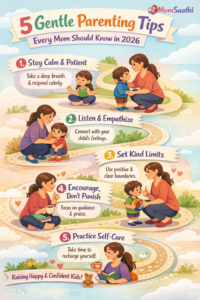
5 Gentle Parenting Tips Every Mom Should Know

gentle parenting tips 2026 infographic for modern parents

1. Listen to Your Child With Patience

Children often act out when they feel unheard or misunderstood. One of the most effective parenting tips is to listen carefully to what your child is trying to express.

Instead of immediately correcting them, pause and try to understand their perspective. A simple response like “I understand you’re upset” can help children feel validated and calm down more quickly.

Active listening builds trust and encourages open communication between parents and children.

2. Set Clear but Kind Boundaries

Gentle parenting does not mean avoiding rules. In fact, children need boundaries to feel secure and understand acceptable behavior.

The key difference is how boundaries are communicated.

Rather than raising your voice or using punishment, calmly explain the rule and the reason behind it. For example, instead of saying “Stop that now!”, you might say “We need to be gentle because hitting can hurt others.”

Children respond better when boundaries are explained with respect.

3. Teach Kids How to Handle Their Emotions

Children are still learning how to manage strong feelings like anger, frustration, or disappointment. Parents can play a big role in helping them understand these emotions.

When your child becomes upset, help them label their feelings by saying things like:

  • “It seems like you’re feeling frustrated.”

  • “Are you feeling sad about what happened?”

Helping children recognize emotions teaches them valuable emotional skills that will benefit them throughout life.

4. Be the Role Model Your Child Needs

Children learn a great deal by observing their parents. The way parents respond to stress, conflict, and emotions often becomes the behavior children copy.

If parents demonstrate patience, kindness, and calm communication, children naturally begin to adopt these qualities.

Simple habits like apologizing when you make a mistake or speaking respectfully to others can teach powerful life lessons.

5. Encourage Independence and Confidence

One important goal of parenting is helping children become confident and capable individuals. Encouraging independence allows kids to develop problem-solving skills and self-belief.

Instead of doing everything for your child, guide them to try things on their own. Whether it’s dressing themselves, completing a small task, or solving a problem, these experiences help build resilience and confidence.

Supporting independence also strengthens a child’s sense of responsibility.

Common Parenting Mistakes to Avoid

Even with the best intentions, parents sometimes fall into habits that can create unnecessary conflict. Recognizing these mistakes can help improve the overall parenting experience.

Some common parenting challenges include:

  • Comparing children with others

  • Ignoring a child’s emotional needs

  • Reacting with anger instead of patience

  • Inconsistent rules and expectations

Gentle parenting encourages parents to pause, reflect, and respond thoughtfully instead of reacting emotionally.

Gentle Parenting Tips for Toddlers

Toddlers are naturally curious and energetic, which can make parenting this stage both exciting and challenging. Gentle parenting can be particularly helpful during toddler years.

Helpful strategies include:

  • Keeping daily routines consistent

  • Offering simple choices (for example, choosing between two outfits)

  • Redirecting behavior instead of punishing

  • Staying calm during tantrums

Toddlers often need guidance and reassurance as they learn about the world around them.

Research on child development highlights the importance of responsive parenting : Read more

Parenting Trends to Watch in 2026

Parenting continues to evolve as new research highlights the importance of emotional well-being and healthy family relationships.

Some key parenting trends gaining attention in 2026 include:

  • Mindful parenting practices

  • Emotional intelligence education

  • Balanced screen time for children

  • Positive discipline strategies

  • Focus on mental and emotional health

These trends reflect a growing understanding that parenting is about guiding children, not controlling them.

Benefits of Gentle Parenting

Parents who adopt gentle parenting often notice several long-term benefits. Children raised with this approach tend to develop strong emotional awareness and healthy social skills.

Some key benefits include:

  • Improved communication between parents and children

  • Stronger emotional intelligence

  • Greater self-confidence in children

  • Healthier parent-child relationships

  • Better problem-solving skills

Gentle parenting creates a supportive environment where children feel comfortable expressing themselves and learning from their experiences.

These parenting tips 2026 focus on building strong emotional bonds between parents and children.

According to the American Academy of Pediatrics, positive parenting improves emotional development in children : Read more

Final Thoughts

Parenting is one of the most rewarding yet challenging journeys in life. As parenting approaches continue to evolve, many families are embracing more compassionate and understanding methods.

By focusing on empathy, communication, and positive guidance, gentle parenting offers a practical way to raise emotionally healthy children.

These gentle parenting tips for 2026 can help parents build stronger relationships with their children while creating a supportive and loving home environment.

FAQs

What are the best parenting tips for modern parents?

The best parenting tips include listening to children, setting respectful boundaries, teaching emotional awareness, and encouraging independence.

Yes, gentle parenting has been shown to help children develop emotional intelligence, confidence, and stronger social skills.

Yes, gentle parenting works very well for toddlers because it focuses on understanding emotions and guiding behavior rather than punishment.

Busy parents can practice gentle parenting by spending quality time with their children, communicating calmly, and being mindful of their child’s emotional needs.

The best parenting tips include listening to children, setting respectful boundaries, teaching emotional awareness, and encouraging independence.

Yes, gentle parenting has been shown to help children develop emotional intelligence, confidence, and stronger social skills.

Yes, gentle parenting works very well for toddlers because it focuses on understanding emotions and guiding behavior rather than punishment.

Busy parents can practice gentle parenting by spending quality time with their children, communicating calmly, and being mindful of their child’s emotional needs.

External Resources & Further Reading

Want to dive deeper into gentle parenting? These trusted external websites, experts, and books perfectly support the 5 practical tips in this guide — patient listening, kind boundaries, emotional coaching, role modeling, and building independence.

Official & Science-Backed Organizations

Top Gentle Parenting Experts & Blogs

Must-Read Books (2025–2026 Recommendations)

  • The Whole-Brain Child by Daniel J. Siegel & Tina Payne Bryson – Master emotional intelligence and connection.
  • Good Inside by Dr. Becky Kennedy – A fresh, practical guide for today’s moms.
  • Peaceful Parent, Happy Kids by Dr. Laura Markham – Stop yelling and build strong bonds.
  • Raising Good Humans by Hunter Clarke-Fields – Mindful parenting for busy moms.

These external resources align perfectly with the 2026 gentle parenting approach shared in the article. Bookmark them for ongoing support!