

Edited by: MomSaathi Editorial Team
Reviewed by: Pediatric Experts as per WHO 2006 Child Growth Standards & Indian Academy of Pediatrics (IAP) Guidelines
That little spot of blood on your underwear when you’re hoping for a baby can stop your heart for a second. “Is this my period starting… or could it be something more?” Many women trying to conceive know this exact feeling — a mix of hope and worry.
Implantation bleeding is one of those early pregnancy signs that often gets mistaken for a light period. Understanding it can bring so much reassurance during those anxious two-week waits.
Quick Summary
- Implantation bleeding is light spotting when a fertilized egg attaches to the uterus lining.
- It usually occurs 6–12 days after ovulation (often a few days before your expected period).
- It’s typically pink or brown, very light, and lasts a few hours to 2–3 days.
- Unlike a period, it doesn’t get heavier and rarely has clots.
- Not every woman experiences it — and that’s completely okay.
What Is Implantation Bleeding?
Imagine a tiny fertilized egg gently nestling into the soft lining of your uterus. As it burrows in, it can disturb a few tiny blood vessels. The small amount of blood that comes out is called implantation bleeding.
It’s a normal part of early pregnancy for many women and happens in about 15–25% of pregnancies.
When Does Implantation Bleeding Occur?
Implantation bleeding typically happens 6 to 12 days after ovulation, most commonly around day 8–10. If you have a 28-day cycle, this is usually a few days before your expected period. This timing is exactly why it gets confused with an early period so often.
What Does Implantation Bleeding Look Like?
Most women describe it as:
- Color: Light pink, rusty brown, or dark brown.
- Flow: Very light spotting — just a smear or a few drops.
- Texture: Watery or streaky, not thick.
- Duration: A few hours to 2–3 days maximum.
Real story: Priya from Bengaluru said, “I saw brown spotting for one day and thought my period had come early. But it stopped suddenly. My pregnancy test two weeks later was positive!”
Implantation Bleeding vs Period: Clear Comparison
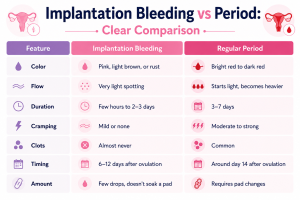
| Feature | Implantation Bleeding | Regular Period |
|---|---|---|
| Color | Pink, light brown, or rust | Bright red to dark red |
| Flow | Very light spotting | Starts light, becomes heavier |
| Duration | Few hours to 2–3 days | 3–7 days |
| Cramping | Mild or none | Moderate to strong |
| Clots | Almost never | Common |
| Timing | 6–12 days after ovulation | Around day 14 after ovulation |
| Amount | Few drops, doesn’t soak a pad | Requires pad changes |
Common Symptoms of Implantation Bleeding
You may also notice:
- Mild implantation bleeding cramps
- Breast tenderness or tingling
- Unusual fatigue
- Mood changes
- Light bloating
These implantation bleeding symptoms can feel very similar to PMS, which adds to the confusion.
How Long Does Implantation Bleeding Last?
It usually lasts 1 to 2 days, sometimes just a few hours. If spotting continues beyond 3 days or becomes heavier, it’s best to consult your doctor.
Can Implantation Bleeding Be Heavy?
True implantation bleeding is almost never heavy. If you’re soaking a pad or passing clots, it’s more likely your period or something that needs medical attention.
When Should You Take a Pregnancy Test?
Wait at least 2–3 days after the spotting stops, or until the day of your missed period for the most accurate result. Early morning urine gives the best chance of detection.
When Should You See a Doctor?
See your gynecologist if you experience:
- Heavy bleeding
- Bright red blood with clots
- Severe pain or cramps
- Dizziness or fever
Emotional Impact While Trying to Conceive
Seeing spotting when you’re trying can feel like an emotional rollercoaster. One moment you’re hopeful, the next you’re scared. Please remember — your feelings are valid. Be kind to yourself during this journey.
Tips to Track Early Pregnancy Symptoms
- Use reliable apps like Flo, Clue, or Maya
- Keep a simple symptom journal
- Track ovulation if you’re actively trying
- Connect with supportive communities
Myth vs Fact
Myth: Implantation bleeding always confirms pregnancy. Fact: It’s only a possible sign. A pregnancy test is needed.
Myth: Everyone gets implantation bleeding. Fact: Only about 1 in 4 women notice it.
Key Takeaways
- Implantation bleeding is light, short, and usually pink or brown.
- It happens earlier than your period and doesn’t get heavy.
- Symptoms vary greatly from woman to woman.
- Don’t panic if you see light spotting — take a test at the right time.
- Always reach out to your doctor if anything feels concerning.
You’re doing an amazing job listening to your body and learning about these early signs. Whether this cycle brings good news or you continue your journey, remember you’re not alone. Many of us have been exactly where you are right now.
If you have any doubts, speak to your gynecologist — they’re there to support you with care and understanding.
Wishing you strength, patience, and lots of hope on your beautiful journey to motherhood.
Helpful External Resources
- Mayo Clinic – Implantation Bleeding & Early Pregnancy Signs
Read Full Article → - American College of Obstetricians and Gynecologists (ACOG) – Early Pregnancy Bleeding
Read Full Article → - Cleveland Clinic – Implantation Bleeding vs Period
Read Full Article → - NHS (UK) – Vaginal Bleeding in Early Pregnancy
Read Full Article → - WebMD – Understanding Implantation Bleeding
Read Full Article →
Always consult your gynecologist for personalized medical advice. These links are for educational purposes only.
Frequently Asked Questions (FAQs)
Can implantation bleeding be red?
Yes, it can sometimes be light pink or reddish, but bright red and heavy bleeding is more likely to be a period. Light pink spotting is common with implantation.
Does everyone get implantation bleeding?
No. Only about 15–25% of women experience it. Many perfectly healthy pregnancies happen without any spotting at all.
Can implantation bleeding have clots?
Usually not. Clots are much more common with a regular period. Implantation bleeding is typically very light without clots.
How many days does implantation bleeding last?
It usually lasts 1–2 days, sometimes just a few hours. Anything longer than 3 days should be discussed with your doctor.
Can implantation bleeding happen after a missed period?
It’s uncommon. Implantation bleeding typically occurs before your expected period. Spotting after a missed period needs medical evaluation.
Is brown spotting implantation bleeding?
Yes, brown spotting is very common with implantation bleeding. It’s usually older blood that takes time to leave the body.
Can implantation bleeding fill a pad?
No. Implantation bleeding is very light and rarely fills even a panty liner completely. If you need a full pad, it’s more likely your period.
Does implantation bleeding mean pregnancy is confirmed?
No, it doesn’t confirm pregnancy. It’s only a possible sign. You still need a pregnancy test for confirmation.
Can implantation bleeding happen with cramps?
Yes. Mild implantation bleeding cramps are common and usually feel like gentle period twinges. Severe pain is not normal and should be checked.
What are the first signs of pregnancy?
Early signs include missed period, implantation bleeding, breast tenderness, fatigue, nausea, frequent urination, and mood changes. Every woman’s experience is different.