
Baby Teething Symptoms and Natural Relief Remedies (No Medication – Complete 2026 Guide for Moms)

Edited by: MomSaathi Editorial Team

Reviewed by: Dr. Pooja Joshi – Dental Health Expert & Oral Care Reviewer

Hey there, wonderful mama! Does your baby have red gums, seem fussy, drool constantly, and seem to have lost sleep? You might be questioning if your baby is teething, and what you can do to help without medication.

This is one of the challenging phases new parents go through in the first two years, and we understand how overwhelming it can be at Momsaathi. That is why we have created a guide named Teething Relief that focuses on remedies without medication. You will also be informed on the description of symptoms, the timelines in which they appear, and the safest methods to soothe your baby.

This guide is also designed to be safe. That means no gels, no other medications, just safe, natural, and evidence-based methods designed to get through this phase with more smiles and fewer tears. Together, we can get through this! 🌟

When Does Teething Start? Typical Timeline (0–24 Months)

Most babies get their first tooth between 4 and 7 months, but it can start as early as 3 months or as late as 12 months. By the age of 2-3 years, we expect to see 20 primary teeth.

Common Age Ranges for First Teeth to Erupt Include:

  • 6-10 Months – Lower Central Incisors
  • 8-12 Months – Upper Central Incisors
  • 9-13 Months – Upper and Lower Lateral Incisors
  • 13-19 Months – First Molars
  • 16-23 Months – Canines
  • 23-33 Months – Second Molars

If a baby is 5 months old and suddenly becomes very upset, it could be related to teething. Prior to a tooth breaking through the gums, a baby can show signs of teething as early as a few weeks before it occurs.

If you want to stay on track for your baby’s development during this time, we recommend checking out this guide: Baby Milestones by Month: What to Expect 0-12 Months (With Red Flags).

Normal Teething Symptoms

  • Excessive drooling (may lead to chin rash)
  • Irritability and fussiness, particularly at night
  • Rubs ears and/or cheeks
  • Chews on anything and everything, which may lead to a loss of appetite (for breast milk, this is usually not the case)
  • Night waking
  • Increased fussiness (may lead to a loss of appetite)
  • Having a very mild fever (under 100.4°F / 38°C)
  • Rash caused by exposure to stools (may be a sign of insufficient sleep)
  • Sleep problems (may be caused by a rash caused by exposure to stools)
  • Chewing on hands, toys, and/or clothing

Please remember that babies do not typically show signs of teething with fever (greater than 101°F), vomiting, rash, or a severe reduction in appetite. Contact your child’s doctor if you believe that your child may have an infection.

If you’re noticing increased spit-up or changes in feeding frequency, it may be related to teething. You may want to refer to our guide: Why Does My Baby Spit Up After Every Feeding? Safe Remedies.

12 Safe Natural Teething Relief Remedies

These mom-created, pediatric-approved, teething baby relievers include:

  • Chilled Teething Rings — Teething silicone or rubber rings can be placed in the fridge for 15-20 minutes. They tend to numb the gums and become more comfortable.
  • Cold Washcloth — A clean, soft, cold washcloth is great for the baby to chew on. You can even add a little breast milk for added comfort.
  • Frozen Breast Milk Popsicles — You can pour your accumulated breast milk into a clean baby feeder or ice tray with a handle. Then, freeze it, and it can be great for older babies (6+ months).
  • Gentle Gum Massage — You’ll want to wash your hands, then wrap a clean finger in soft gauze, and then you can firmly rub the gums in a circular motion for 1-2 minutes.
  • Chilled Cucumber or Carrot Sticks (for 6+ months) — Cucumber or Carrot sticks may be given when your little one turns 6 months. You’ll want to supervise closely — and definitely don’t leave the baby alone.
  • Amber Teething Necklace? Only if… — The soothing effect Amber necklaces have is loved by many mothers; however, they should only be used under constant supervision, as there is a risk of choking. If you do choose to get an Amber necklace, use Baltic amber with an appropriate safety clasp.
  • Babywearing & Extra Cuddles — Staying close together, as with babywearing, causes the release of calming hormones and diverts attention from the discomfort.
  • White Noise + Dim Lights for Teething Discomfort Sleep — Disrupted sleep caused by teething is to be expected. Using a consistent sleep routine and white noise at bedtime is a good idea, as described in our Best Newborn Sleep Schedule 0-3 Months for First-Time Moms.
  • Breastfeeding on Demand — Extra nursing sessions provide comfort and closeness, help with hydration, and relieve pain.
  • Chilled Silicone Teething Toys — Safe brands with no detachable small parts.
  • Face & Chin Care — Wipe drool frequently and use coconut oil or lanolin to soothe raw skin.

Avoid Homeopathic Remedies — Some mothers use chamomile or calendula gels (which are natural and do not have benzocaine), but they should always check with a doctor before giving these remedies.

For the most up-to-date safe teething information provided by the American Academy of Pediatrics, please visit: Teething Pain Relief – American Academy of Pediatrics

Teething Nights & Fussy Days (Gentle Parenting Style)

Teething babies need a calm, predictable routine. An overtired baby will feel the discomfort much more and will be more cranky. Skin-to-skin with the baby is recommended, and babywearing is highly effective. Distraction with soft, calming songs and gentle play is recommended. Preferred toys are also recommended as good sources of distraction. You and your partner should alternate shifts so that you both have some time to rest.

These strategies combine wonderfully with our Gentle Parenting Techniques for Newborns and Toddlers (No Cry Methods).

Safe Practices & When to Call the Doctor

Always Safe:

  • The Teething Toy should be supervised
  • The Toys should be cleaned daily
  • Amber necklaces should not be used during sleep

You should Call Your Pediatrician If:

  • A fever that is over 100.4°F (38°C)
  • You have diarrhea lasting more than 24 hours
  • A refusal to be fed for long periods
  • Extreme lethargy or hours of inconsolable crying
  • Swelling or pus around the gum area
  • Any symptoms that trouble you

10 FAQs About Baby Teething Symptoms and Natural Relief

  • Can teething cause fever? Yes, it can cause mild low-grade fever, but high fever is usually something else.
  • How long does each tooth take to come in? Each tooth takes 3–7 days of noticeable symptoms, on average.
  • Is drooling always a sign of teething? Crying is a common result of infant behavior.
  • Should I use teething gels? Avoid any with benzocaine. Natural options are the way to go.
  • Do molars hurt more than front teeth? Yes, because of the larger surface area and because they are deeper in the gums.
  • Will my baby stop eating during teething? Baby might eat less solids, but typically will continue breastfeeding or formula well.
  • Can I give frozen fruit? Only soft options like banana or watermelon in a feeder bag after 6 months.
  • How do I prevent chin rash from drool? Wipe gently and apply a thin layer of coconut oil or barrier cream.
  • Is an amber teething necklace safe? Only with a proper breakaway clasp and constant supervision.
  • When should the first tooth appear? The average is 6 months, but anywhere from 3 to 12 months is normal.

You’re Doing an Amazing Job, Mama!

Teething can feel endless, but every tooth your baby gets gets them that little bit closer to that beautiful smile. With a little bit of extra patience, these natural teething relief remedies, and a few more cuddles, you’ll both get through the process that little bit stronger.

You’ve got natural tools, the community support, and more importantly, the love your baby needs. Save this guide and come back whenever a new tooth is on the way.

Which natural remedy was most effective for your teething baby? Which symptoms surprised you? The Momsaathi community is here for you!

If you know a mom whose baby is chewing everything, send her this no-medication teething guide. You’re helping more mamas than you know.

This article was medically reviewed by our in-house Dr. Pooja Joshi, pediatric consultant, and last updated March 2026. Always consult your pediatrician for personalized advice.

Postpartum Recovery Tips Week by Week for New Moms (Body + Mental Health – Complete 2026 Guide)

Edited by: MomSaathi Editorial Team

Reviewed by: Based on medical postpartum care guidelines and week-by-week recovery research

Hey, beautiful new mama

You just brought a tiny human into the world — and now your body and mind are going through one of the biggest recoveries of your life. Whether you had a vaginal birth, C-section, or anything in between, the fourth trimester can feel overwhelming, exhausting, and surprisingly emotional.

At Momsaathi, we believe every new mom deserves honest, gentle, and practical support. This postpartum recovery tips week by week guide covers physical healing, emotional ups and downs, nutrition, gentle movement, and mental health — all in one place. No pressure to “bounce back.” Just realistic, evidence-based advice to help you heal at your own pace.

You’ve got this, mama. Let’s walk through the weeks together so you feel informed, supported, and a little less alone.

Week 1: The Golden Hour & First Days at Home (Focus: Rest + Bleeding)

Your body is doing heavy healing work right now.

Physical Recovery Tips:

  • Expect heavy bleeding (lochia) — bright red at first, like a heavy period. Use hospital-grade pads or adult diapers. Change often.
  • If you had stitches (vaginal or C-section), keep the area clean and dry. Use a peri bottle with warm water after every bathroom visit.
  • For C-section moms: Support your incision when coughing, sneezing, or laughing. Avoid heavy lifting.
  • Rest as much as possible. Accept help with cooking, cleaning, and baby care.
  • Stay hydrated (aim for 3–4 liters of water daily) and eat nutrient-rich meals.

Mental Health Tips:

  • Baby blues are very common in the first 2 weeks — crying, mood swings, anxiety. This usually passes on its own.
  • Skin-to-skin with your baby helps release oxytocin (the love hormone) and stabilizes mood.
  • Talk openly with your partner or a trusted person about how you’re feeling.

Pro Tip: Pair this week with responsive newborn care from our Best Newborn Sleep Schedule 0-3 Months for First-Time Moms.

Week 2: Healing & Establishing Routines

Bleeding starts to lighten (pink/brown). Your uterus is shrinking back.

Physical Recovery:

  • Gentle walking around the house is encouraged. No strenuous exercise yet.
  • Continue peri care and sitz baths (warm water with Epsom salt) 2–3 times a day for soothing.
  • For C-section: Incision should look less red and swollen. Watch for signs of infection (increasing redness, pus, fever).
  • Breastfeeding or pumping may feel more comfortable now, but engorgement or cracked nipples can still happen.

Mental Health:

  • If baby blues haven’t improved or you feel overwhelmed, reach out to your doctor.
  • Try short mindfulness moments: 5 minutes of deep breathing while feeding baby.
  • Remember: It’s okay if bonding feels slow — it grows with time and responsiveness.

Internal Link: If feeding feels challenging, read How to Transition from Breastfeeding to Solids: 6-Month Baby Led Weaning Guide for future planning (many tips apply early too).

Week 3–4: Energy Returns Slowly + Hormonal Shifts

Many moms notice a bit more energy, but fatigue is still high.

Physical Recovery Tips:

  • Lochia becomes lighter (yellow/white). If it suddenly gets heavier or smells bad, call your doctor.
  • Start very gentle pelvic floor exercises (Kegels) — only if it feels comfortable. Consult a pelvic floor physiotherapist if you had tears or episiotomy.
  • For C-section moms: Light scar massage with vitamin E or recommended oil can help (after incision is fully closed).
  • Eat iron-rich foods (leafy greens, lentils, red meat or supplements if prescribed) to rebuild blood levels.

Mental Health Tips:

  • Watch for signs of postpartum depression or anxiety: persistent sadness, loss of interest, panic attacks, or intrusive thoughts.
  • Schedule a follow-up visit with your OB/GYN or midwife around 4–6 weeks.
  • Connect with other new moms — online or in-person support groups make a huge difference.

External Resource: For official postpartum mental health screening tools and support, visit the American College of Obstetricians and Gynecologists (ACOG) resource: https://www.acog.org/womens-health/faqs/postpartum-depression

Week 5–6: The “I’m Healing But Still Tired” Phase

You’re likely cleared for light activity at your 6-week check-up.

Physical Recovery:

  • Most moms can slowly resume driving and short walks outside.
  • Introduce gentle core activation (not full crunches yet). Focus on diaphragmatic breathing and pelvic tilts.
  • Continue breastfeeding or pumping. Many moms notice supply stabilizes around now.
  • Sleep when baby sleeps — even 20-minute naps help.

Mental Health:

  • If you’re feeling better emotionally, celebrate it! If not, ask for help — therapy, medication, or both can be life-changing and safe while breastfeeding.
  • Practice self-compassion: Your body created life. Healing takes time.

Internal Link: For safe sleep support during this exhausting phase, revisit Best Newborn Sleep Schedule 0-3 Months for First-Time Moms.

Week 7–12: Building Strength & Adjusting to Motherhood

You’re entering the “fourth trimester” endgame, but full recovery can take 6–12 months or longer.

Physical Recovery Tips:

  • Gradually increase walks and add postpartum-friendly exercises (yoga, Pilates for new moms).
  • Wear a supportive bra and consider belly binding only if it feels good (not too tight).
  • Address any lingering issues: diastasis recti, incontinence, or back pain with a specialist.

Mental Health Tips:

  • Reconnect with your partner — date nights at home count!
  • Set small, realistic goals each day (shower + one meal = win).
  • If anxiety or low mood persists beyond 6–8 weeks, seek professional support early.

External Resource: Mayo Clinic’s comprehensive postpartum recovery timeline and red flags: https://www.mayoclinic.org/healthy-lifestyle/labor-and-delivery/in-depth/postpartum-care/art-20047233

Nutrition, Movement & Self-Care Tips That Help All Weeks

  • Eat: Warm, nourishing meals — soups, dals, oats, nuts, fruits. Include galactagogues like fenugreek or oats if breastfeeding.
  • Hydrate & Rest: Keep water and snacks near your feeding station.
  • Gentle Movement: Start with breathing exercises and progress slowly. Never push through pain.
  • Mental Health Toolkit: Journaling, short meditations, asking for help without guilt, and limiting social media comparisons.

Internal Link: Combine physical healing with responsive parenting using Gentle Parenting Techniques for Newborns and Toddlers (No Cry Methods).

Red Flags — When to Call Your Doctor Immediately

  • Heavy bleeding that soaks a pad in under an hour
  • Severe headache, vision changes, or chest pain
  • Fever over 100.4°F (38°C)
  • Foul-smelling discharge or increasing pain at incision/stitch site
  • Thoughts of harming yourself or the baby (emergency — call helpline or go to ER)
  • Severe sadness or inability to care for yourself/baby for days

FAQs About Postpartum Recovery Week by Week

  1. How long does postpartum bleeding last? Usually 4–6 weeks, but can vary. It should gradually lighten.
  2. When can I exercise again after birth? Light walking from week 1–2. Full exercise only after 6-week clearance and when it feels right.
  3. Is it normal to cry a lot in the first weeks? Yes — baby blues affect up to 80% of new moms and usually resolve by week 2.
  4. How do I know if I have postpartum depression? If sadness, anxiety, or hopelessness lasts more than 2 weeks or interferes with daily life.
  5. Can I do Kegels right away? Gentle ones yes, but stop if painful and consult a pelvic floor therapist.
  6. Will my belly ever go back to normal? It takes time — skin, muscles, and organs need months to adjust.
  7. Is it okay to feel disconnected from my baby? Many moms do at first. Responsive care and time usually strengthen the bond.
  8. When does milk supply regulate? Around 4–6 weeks for most breastfeeding moms.
  9. Can I take pain medication while breastfeeding? Most common ones (ibuprofen, paracetamol) are safe — confirm with your doctor.
  10. How long until I feel like “myself” again? Physical healing: 6–12 weeks. Full emotional recovery: 6–18 months for many.
  11. Should I bind my belly? Only if it provides comfort — not for weight loss or tight shaping.
  12. What if recovery feels slower than other moms? Every birth and body is different. Compare only to your own progress.

You Are Healing Beautifully, Mama — One Week at a Time

Postpartum recovery is not a race. Some days you’ll feel strong, others you’ll need extra rest. Be kind to your body and mind — you just did something extraordinary.

Bookmark this postpartum recovery tips week-by-week guide and check back as the weeks unfold. Celebrate every small win: a shower, a walk outside, a moment of calm.

You are not alone. Reach out to your support system, your doctor, or our Momsaathi community anytime.

Drop a comment below: Which week are you in right now, and what’s helping you the most? Or share one tip you wish someone had told you earlier. Let’s support each other!

Share this guide with any new mom who needs gentle, realistic encouragement. You’re doing an amazing job — healing, nurturing, and growing into motherhood.

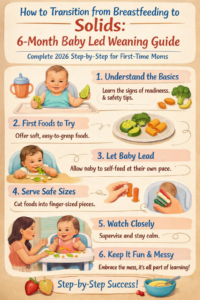
How to Transition from Breastfeeding to Solids: 6-Month Baby Led Weaning Guide (Complete 2026 Step-by-Step for First-Time Moms)

Hey mama! 👋If you’re watching your 6-month-old stare at your plate with those big curious eyes, you’re probably asking: “Is it time to start solids? How do I transition from breastfeeding without losing my milk supply or stressing my baby?”

You’re in the perfect place. At Momsaathi, we know this transition can feel exciting yet overwhelming. This complete 6-month baby led weaning guide walks you through everything — from the right signs to start, safe first foods, feeding schedules, common mistakes, and how to keep breastfeeding strong while introducing solids.

Baby-led weaning (BLW) puts your baby in charge — they self-feed soft finger foods instead of purees. It encourages independence, better oral motor skills, and a healthy relationship with food. Ready? Let’s make this transition smooth, joyful, and mess-free(ish)! 🍓

When to Start Solids: Signs Your 6-Month-Old Is Ready

The World Health Organization and AAP recommend exclusive breastfeeding for the first 6 months, then introducing solids while continuing breast milk as the main nutrition.

Your baby is ready for solids when they show most of these signs:

  • Can sit with minimal support (or in a high chair)
  • Has good head and neck control
  • Shows interest in food (reaches for your plate, watches you eat)
  • Lost the tongue-thrust reflex (no longer automatically pushes food out with tongue)
  • Can bring objects to mouth and chew on them

Most babies hit these milestones around 6 months, but some may be ready a little earlier or later. Never start before 4 months.

For tracking overall development, see our guide: Baby Milestones by Month: What to Expect 0-12 Months (With Red Flags).

Why Baby-Led Weaning? Benefits for Breastfed Babies

Baby-led weaning offers many advantages over traditional spoon-feeding:

  • Develops fine motor skills and hand-eye coordination
  • Reduces risk of picky eating later by letting baby explore textures and tastes
  • Helps with self-regulation of appetite (babies stop when full)
  • Encourages family mealtimes and confident eaters

Studies show BLW babies often accept a wider variety of foods and have better chewing skills.

How to Transition from Breastfeeding to Solids: Step-by-Step 6-Month Plan

Week 1–2: First Tastes (Exploration Phase)

  • Offer solids after breastfeeding (so baby isn’t overly hungry or frustrated).
  • Start with 1 meal per day, 10–15 minutes long.
  • Begin with soft, stick-shaped foods that baby can easily grasp (about the size of your pinky finger).
  • Let baby self-feed. Expect more playing than eating at first — that’s normal!

Week 3–4: Building Confidence

  • Increase to 2 meals per day.
  • Introduce new single-ingredient foods every 2–3 days to watch for allergies.
  • Continue breastfeeding on demand (usually 6–8 times in 24 hours).

Month 2 (Around 7–8 Months)

  • Move to 3 meals per day + 1–2 snacks.
  • Add more textures: mashed foods, soft lumps.
  • Breast milk still provides most calories and nutrition.

Month 3–6 (8–12 Months)

  • 3 meals + 2 snacks.
  • Offer family foods (modified for safety).
  • By 12 months, solids become the main source of nutrition, with breast milk or formula as a supplement.

Sample Daily Schedule at 6–7 Months (Breastfeeding + BLW)

  • 7:00 AM – Breastfeed
  • 8:00 AM – Breakfast solids (e.g., avocado strips)
  • 10:30 AM – Breastfeed
  • 12:30 PM – Lunch solids
  • 3:00 PM – Breastfeed + snack
  • 5:30 PM – Breastfeed
  • 7:00 PM – Breastfeed before bed

Adjust based on your baby’s cues. For sleep support during this transition, read: Best Newborn Sleep Schedule 0-3 Months for First-Time Moms (many tips still apply at 6 months).

Best First Foods for Baby-Led Weaning (Safe & Nutritious)

Focus on iron-rich foods since breast milk iron stores start dropping around 6 months.

Top 10 Safe Starter Foods:

  1. Avocado slices (soft, healthy fats)
  2. Banana strips (ripe, mashable)
  3. Steamed broccoli florets or carrot sticks (soft enough to squish)
  4. Sweet potato wedges (roasted soft)
  5. Apple slices (steamed or grated)
  6. Iron-fortified baby oatmeal (mixed thick)
  7. Scrambled egg yolks (well-cooked)
  8. Soft pear pieces
  9. Well-cooked chicken or salmon flakes
  10. Full-fat plain yogurt (if no dairy allergy)

Foods to Avoid at 6 Months:

  • Honey (botulism risk)
  • Whole nuts, grapes, raw carrots (choking hazards)
  • Added salt or sugar
  • Cow’s milk as a drink (wait until 12 months)

External Resource: For the latest choking prevention guidelines, see the American Academy of Pediatrics safe feeding advice: https://www.healthychildren.org/English/ages-stages/baby/feeding-nutrition/Pages/Starting-Solid-Foods.aspx

Safe Feeding Practices & Choking Prevention in Baby-Led Weaning

  • Always supervise meals 100% — never leave baby alone while eating.
  • Offer foods in safe shapes: long strips or soft sticks that baby can hold and gnaw on.
  • Cut round foods (like grapes or cherry tomatoes) lengthwise into quarters.
  • Learn infant CPR — every parent should know it.
  • Sit baby upright in a high chair with good support.

If you notice frequent spit-up during this transition, our guide Why Does My Baby Spit Up After Every Feeding? Safe Remedies can help.

How to Protect Your Breast Milk Supply During Weaning

Many moms worry about supply dropping. Here’s how to keep it strong:

  • Continue breastfeeding before every solid meal.
  • Offer breastfeeds on demand, especially at night and during growth spurts.
  • Pump or hand-express if baby skips a feed.
  • Stay hydrated and eat calorie-rich foods (oats, fenugreek, lactation cookies if needed).

Most moms successfully continue breastfeeding until 12 months or longer while introducing solids.

For postpartum support while juggling feeding changes, check: Postpartum Recovery Tips Week by Week for New Moms.

Common Challenges & Gentle Solutions in Baby-Led Weaning

  • Baby refuses solids or gags a lot → Normal at first. Gagging is different from choking (baby will make noise). Keep offering calmly.
  • Messy eating → Embrace it! Put a mat under the high chair. It’s how they learn.
  • Constipation → Increase water intake and offer high-fiber fruits/veggies.
  • Allergic reactions → Introduce one new food at a time. Watch for rash, vomiting, or swelling — seek medical help if severe.

Use gentle parenting approaches during mealtimes: Gentle Parenting Techniques for Newborns and Toddlers (No Cry Methods).

External Resource: Detailed baby-led weaning safety and recipes from Solid Starts (highly recommended by many pediatric feeding experts): https://solidstarts.com/

12 FAQs About Transitioning from Breastfeeding to Solids at 6 Months

  1. Can I start baby-led weaning before 6 months? Not recommended. Wait for developmental readiness and pediatrician’s green light.
  2. How much solids should my 6-month-old eat? Start with 1–2 tablespoons per meal. Breast milk remains the main nutrition.
  3. Will starting solids reduce my milk supply? Usually not if you continue breastfeeding on demand before solids.
  4. What if my baby only plays with food and doesn’t eat? Totally normal in the first weeks. Exploration is learning!
  5. Is pureeing better than baby-led weaning? Both work. Many families do a mix (BLW + some spoon-feeding).
  6. How do I know if my baby is allergic to a food? Introduce one new food every 2–3 days and watch for symptoms.
  7. When can my baby have water or juice? Offer small sips of water with meals after 6 months. No juice until 12 months.
  8. My baby gags a lot — is that choking? Gagging is loud and baby can cough. Choking is silent — learn the difference and act fast.
  9. Should I use baby rice cereal? It’s optional. Many BLW parents skip it and go straight to whole foods.
  10. When do babies usually self-feed well? Most improve dramatically between 7–9 months.
  11. Can I combine baby-led weaning with purees? Yes — a blended approach works great for many families.
  12. What if my baby has low iron levels? Prioritize iron-rich foods and discuss supplements with your pediatrician.

You’ve Got This, Mama — Enjoy the Journey!

Transitioning from breastfeeding to solids at 6 months with baby-led weaning is a beautiful milestone. It’s messy, fun, and full of firsts. Trust your baby’s cues, keep breastfeeding strong, and celebrate every new taste they try.

Save this 6-month baby led weaning guide and come back as your little one grows. The meals will get easier, the giggles louder, and the memories sweeter.

Drop your biggest question or your baby’s favorite first food in the comments below — our Momsaathi community loves sharing tips and cheering each other on!

Share this guide with any breastfeeding mama who’s about to start solids. You’re doing an incredible job nourishing your baby. 💕

This article was medically reviewed by our in-house pediatric consultant and last updated March 2026. Always consult your pediatrician for personalized advice.
Gentle Parenting Techniques for Newborns and Toddlers (No Cry Methods That Actually Work – 2026 Guide)

Edited by: MomSaathi Editorial Team

Reviewed by: Based on gentle parenting principles and child development research

Hey sweet mama! If the idea of letting your baby or toddler “cry it out” makes your heart ache, you’re in the right place. Gentle parenting focuses on building a strong, trusting bond through empathy, respect, and responsiveness — without tears or harsh methods.

At Momsaathi, we believe the early years are about connection, not control. This comprehensive guide shares gentle parenting techniques for newborns and toddlers that are proven, compassionate, and completely no-cry (or very low-cry). You’ll learn practical ways to handle sleep, tantrums, feeding, and daily routines while raising confident, emotionally secure children.

Whether your baby is 2 weeks old or your toddler is 2 years old, these methods honor your child’s needs and protect your peace of mind. Let’s dive in and make parenting feel lighter and more joyful.

What Is Gentle Parenting? (And Why It Works So Well)

Gentle parenting is rooted in responsive caregiving and attachment theory. It means meeting your child’s emotional and physical needs promptly, using empathy instead of punishment, and guiding behavior with respect rather than fear.

Research from the American Academy of Pediatrics (AAP) and child development experts shows that responsive, sensitive parenting leads to better emotional regulation, stronger parent-child bonds, and healthier brain development.

No cry methods don’t mean zero fussing ever — babies and toddlers express big feelings. But they do mean you respond with love and presence instead of leaving them to cry alone.

For a strong foundation in the newborn phase, pair these techniques with our Best Newborn Sleep Schedule 0-3 Months for First-Time Moms.

Gentle Parenting Techniques for Newborns (0–6 Months)

Newborns need constant closeness. Their brains are wired for connection, and responsive care helps them feel safe.

  1. Responsive Feeding (On-Demand, No Schedule Pressure) Feed whenever your baby shows hunger cues (rooting, hand-to-mouth, fussing). This builds trust and prevents over-tiredness or overwhelm. Breastfeeding or paced bottle feeding works beautifully here.
  2. Babywearing and Skin-to-Skin Contact: Carry your newborn in a soft sling or wrap during the day. Skin-to-skin regulates heart rate, temperature, and hormones. It’s one of the easiest ways to soothe without any crying.
  3. The “No Cry” Soothing Toolkit
    • Shushing + swaying
    • White noise (keep under 50 dB)
    • Swaddling (until rolling starts)
    • Pacifier (after breastfeeding is established). Respond to every cry promptly — it teaches your baby the world is safe.
  4. Floor Time and Tummy Time with Connection Lie down with your baby for tummy time and talk or sing gently. This supports motor skills without stress.

If spit-up is making feeding stressful, see our guide: Why Does My Baby Spit Up After Every Feeding? Safe Remedies.

Gentle No-Cry Sleep Techniques for Newborns and Young Infants

Sleep is often the biggest worry. Here are proven no-cry (or minimal-cry) methods:

  • Pick-Up/Put-Down Method: Place your drowsy-but-awake baby in the crib. If they fuss, pick them up, soothe until calm (shushing, patting), then put them back down. Repeat as needed until they fall asleep. This gradually teaches self-soothing while keeping you close.
  • Fading / Chair Method (Camping Out) Sit in a chair next to the crib and offer gentle reassurance (soft voice, hand on chest). Each night, move the chair a little farther away until you’re out of the room. Perfect for babies 4–8 months.
  • Bedtime Fading Note the time your baby naturally falls asleep, then gradually shift bedtime 15 minutes earlier each night while keeping a calm routine (bath, feed, lullaby).

These methods respect your baby’s need for comfort and work beautifully with our Newborn Baby Care Routine 0-3 Months.

External Resource: Learn more about no-cry sleep approaches from BabyCenter’s trusted guide on gentle sleep training: https://www.babycenter.com/baby/sleep/baby-sleep-training-no-tears-methods_1497581

Gentle Parenting Techniques for Toddlers (12–36 Months)

Toddlers test boundaries as they explore independence. Gentle parenting turns these moments into opportunities for growth.

  1. Emotion Coaching Instead of Time-Outs When your toddler has a meltdown, get down to their level and name the feeling: “You’re so angry because the toy broke. It’s okay to feel mad. I’m here.” Help them calm down with hugs or deep breaths. This builds emotional intelligence.
  2. Positive Redirection and Natural Consequences Instead of “No! Don’t touch!”, say “Let’s play with this soft ball instead.” Use simple choices: “Do you want the red cup or the blue cup?”
  3. Responsive Discipline with Connection
    • Use “time-in” — sit together quietly until calm.
    • Model the behavior you want (“We use gentle hands”).
    • Praise effort: “I love how you shared your toy!”
  4. Gentle Sleep Support for Toddlers: Keep a consistent, calming bedtime routine. If night wakings happen, offer brief reassurance without full playtime. The fading method works well here, too.

For tracking development alongside these techniques, check our Baby Milestones by Month: What to Expect 0-12 Months (With Red Flags).

External Resource: Discover CDC’s positive parenting tips for toddlers, full of gentle, responsive strategies: https://www.cdc.gov/child-development/positive-parenting-tips/toddlers-1-2-years.html

Daily Gentle Parenting Practices That Make a Big Difference

  • Speak Respectfully — Use the same tone you’d use with a friend.
  • Set Clear, Kind Boundaries — “We don’t hit because it hurts. Let’s hug instead.”
  • Prioritize Play and Connection — 10–15 minutes of child-led play daily strengthens your bond more than any reward chart.
  • Practice Self-Compassion — Gentle parenting includes being gentle with yourself. Take breaks when you need them.

Common Challenges and How Gentle Parenting Helps

  • Frequent Night Wakings → Responsive comforting builds security so independent sleep comes naturally later.
  • Tantrums → Emotion coaching reduces intensity over time.
  • Feeding Battles → Responsive feeding prevents picky eating by keeping mealtimes positive.

If you’re also navigating postpartum emotions, our Postpartum Recovery Tips Week by Week for New Moms offers extra support.

10 FAQs About Gentle Parenting for Newborns and Toddlers

  1. Does gentle parenting mean no discipline? No — it means positive, respectful guidance instead of punishment.
  2. Will my baby become spoiled if I respond to every cry? No. Responding builds secure attachment and actually leads to more independent children later.
  3. How do I handle toddler tantrums without time-outs? Use time-in, name feelings, and offer comfort until they’re regulated.
  4. Is the pick-up/put-down method really no-cry? It minimizes crying and keeps you responsive. Some fussing is normal, but tears are short and comforted.
  5. Can gentle parenting work with both parents? Absolutely — consistency and teamwork make it even stronger.
  6. What if my toddler won’t sleep without me? Use fading gradually. It takes patience but preserves trust.
  7. Is gentle parenting too permissive? No — it sets loving limits while respecting feelings.
  8. When can I start gentle sleep techniques? From 4–6 months onward, once feeding and weight gain are established.
  9. How does gentle parenting affect long-term behavior? Children raised this way tend to have better emotional regulation and stronger relationships.
  10. What books support these methods? Look into works by Dr. William Sears or Elizabeth Pantley’s No-Cry series for more inspiration.

[fc-calories-calculator]

You’re Already a Gentle Parent at Heart, Mama!

Gentle parenting isn’t about being perfect — it’s about showing up with love, even on the hard days. These no-cry techniques for newborns and toddlers will help you build a deep bond while teaching your child that their feelings matter.

Start small: pick one or two techniques this week and notice how your connection grows. You’re raising kind, confident humans, and that’s beautiful work.

Share your experience in the comments — which gentle technique are you trying first? Or tell us a sweet moment when responsiveness made all the difference. Our Momsaathi community is here to cheer you on!

Pin or share this guide with other moms who want a kinder way to parent. You’ve got this.

This article was reviewed by our in-house pediatric consultant and last updated in March 2026. Always consult your child’s doctor for personalized advice.

Baby Milestones by Month: What to Expect 0-12 Months (With Red Flags Every Mom Should Know)

Edited by: MomSaathi Editorial Team

Reviewed by: Based on child development milestones and early intervention guidelines

Hey, wonderful mama! If you’re staring at your baby, wondering, “Is my little one developing normally?” or “Should they be doing this by now?”, you’re not alone. Every first-time mom (and even experienced ones) checks baby milestones constantly. Those monthly well-baby visits can feel both exciting and nerve-wracking.

At Momsaathi, we’ve created this ultimate baby milestones by month guide covering 0–12 months. You’ll get clear, realistic expectations for gross motor, fine motor, language, social, and cognitive skills — plus important red flags that mean it’s time to talk to your pediatrician.

This isn’t about comparing your baby to others. Every child develops at their own pace. Think of this as your supportive roadmap, not a strict checklist. Let’s walk through what to expect month by month so you can celebrate the wins and catch any concerns early.

Why Tracking Baby Milestones Matters (But Don’t Stress!)

Baby milestones are skills most children achieve within a certain age range. They help doctors and parents monitor development in four main areas:

  • Gross motor (big movements)
  • Fine motor (small hand skills)
  • Language & communication
  • Social & emotional

Tracking milestones helps spot delays early, when intervention works best. But remember: the ranges are wide. Some babies walk at 9 months, others at 15 — both can be perfectly normal.

For a deeper dive into newborn routines that support development, read our guide: Best Newborn Sleep Schedule 0-3 Months for First-Time Moms.

Baby Milestones by Month: 0–12 Months (With Red Flags)

0–1 Month (Newborn Stage)

What to Expect:

  • Gross motor: Lifts head briefly when on tummy, turns head side to side
  • Fine motor: Grasp reflex (holds finger), fists mostly closed
  • Language: Cries, makes throaty sounds
  • Social: Looks at faces, startles to loud sounds, calms when held

Red Flags (Talk to Doctor If):

  • No response to loud sounds
  • Doesn’t briefly lift head when on tummy
  • Constantly stiff or floppy body
  • No eye contact or tracking moving objects by the end of the month

1–2 Months

What to Expect:

  • Gross motor: Lifts head 45° on tummy, smoother movements
  • Fine motor: Holds hands open more, follows objects with eyes
  • Language: Coos, makes vowel sounds (“ahh”, “ooh”)
  • Social: Social smiles, recognizes parents’ voices

Red Flags:

  • No social smile by 8 weeks
  • Doesn’t follow objects with eyes
  • Arms and legs remain stiff or don’t move equally

2–3 Months

What to Expect:

  • Gross motor: Pushes up on forearms when on tummy, holds head steady when supported
  • Fine motor: Opens and shuts hands, swipes at toys
  • Language: Chuckles, gurgles, begins to “talk back.”
  • Social: Enjoys looking at faces, recognizes familiar people

Red Flags:

  • Still no head control when pulled to sit
  • No smiling or cooing
  • Doesn’t bring hands to mouth

3–4 Months

What to Expect:

  • Gross motor: Rolls from tummy to back, pushes up on hands
  • Fine motor: Holds and shakes toys, brings hands together
  • Language: Babbles with consonant sounds (“ba”, “da”)
  • Social: Laughs out loud, enjoys playtime

Red Flags:

  • Doesn’t reach for objects
  • No rolling or pushing up on arms
  • No babbling or laughing

4–6 Months

What to Expect:

  • Gross motor: Rolls both ways, sits with support, bears weight on legs when held
  • Fine motor: Transfers objects hand to hand, rakes small items
  • Language: Babbles more (“bababa”), responds to name
  • Social: Stranger anxiety may begin, and enjoys mirror play

Red Flags:

  • Doesn’t roll in either direction by 6 months
  • No weight bearing on legs
  • No babbling or responding to sounds

6–9 Months

What to Expect:

  • Gross motor: Sits without support, crawls or scoots, pulls to stand
  • Fine motor: Pincer grasp (thumb + finger), bangs objects together
  • Language: Says “mama”/“dada” (not always specific), understands “no.”
  • Social: Waves bye-bye, plays peek-a-boo, shows preferences

Red Flags:

  • Cannot sit unsupported for 9 months
  • No crawling or attempts to move
  • No babbling with different sounds

9–12 Months

What to Expect:

  • Gross motor: Cruises along furniture, may take first steps, stands alone briefly
  • Fine motor: Points with index finger, puts objects in and out of containers
  • Language: Says 2–3 words with meaning, follows simple commands
  • Social: Separation anxiety peaks, shows affection, plays simple games

Red Flags (Very Important at 12 Months):

  • Not crawling or bearing weight on legs
  • No pointing or gestures
  • Says no words at all
  • Doesn’t respond to name or simple requests

Free Printable Baby Milestones Tracker 0–12 Months (You can screenshot or download the table below)

Age Gross Motor Fine Motor Language Social/Emotional Red Flag Checklist
0-1 mo Lifts head briefly on tummy Grasp reflex Cries, throaty sounds Looks at faces No response to sound
2-3 mo Pushes up on forearms Bring hands to mouth Coos, gurgles Social smile No smiling by 8 weeks
4-6 mo Rolls both ways, sits with support Transfers toys hand-to-hand Babbles (ba, da) Laughs out loud No rolling by 6 months
6-9 mo Sits unsupported, crawls Pincer grasp “Mama/dada” sounds Waves bye-bye Cannot sit for 9 months
9-12 mo Pulls to stand, cruises Points with a finger 2–3 real words Plays peek-a-boo No words or pointing by 12 months

How to Support Your Baby’s Development Every Month

  • Tummy time daily from day one (start with 1–2 minutes, build up)
  • Talk, read, and sing to your baby constantly — language develops through interaction
  • Provide safe toys that encourage reaching, grasping, and exploring
  • Responsive caregiving — answer cries promptly to build secure attachment
  • Limit screen time — zero recommended under 18 months (AAP guideline)

Need help building a daily routine? See our Newborn Baby Care Routine 0-3 Months.

When to Seek Help — Don’t Wait!

If your baby misses several milestones or you notice any red flags, speak with your pediatrician right away. Early intervention services (speech, physical, or occupational therapy) can make a huge difference and are often free or low-cost.

Trust your gut. You know your baby best.

For more on gentle approaches, read: Gentle Parenting Techniques for Newborns and Toddlers.

FAQs About Baby Milestones 0–12 Months

What if my baby is premature?

Use corrected age (subtract weeks born early) until 2 years old for milestone checks.

Is it normal for babies to develop at different speeds?

Yes! Some skip crawling and go straight to walking.

Should I compare my baby to others?

Avoid it — comparison steals joy and creates unnecessary worry.

When do babies usually say their first word?

Between 8–14 months, with “mama” or “dada” often first.

My 10-month-old isn’t crawling yet — should I worry?

Some babies bottom-shuffle or commando crawl. As long as they’re trying to move, it’s usually fine. Check with the doctor if there is no movement by 12 months.

Does early rolling mean my baby will walk sooner?

Not necessarily — each skill develops somewhat independently.

How much tummy time is enough?

Aim for 15–30 minutes total per day by 3–4 months, spread throughout the day.

Can too much screen time delay milestones?

Yes — screens can delay language and social skills. Keep it zero for babies.

What if my baby had a difficult birth?

Some delays are more common; regular check-ups help catch them early.

Are there apps to track milestones?

Yes, but always confirm with your pediatrician. The CDC Milestone Tracker app is reliable.

When should my baby have their first dental visit?

By 12 months or when the first tooth appears.

How do vaccines relate to milestones?

Vaccines protect health but don’t cause developmental delays.

See ourBaby Vaccines Schedule 2025-2026.

You’re Doing an Amazing Job, Mama!

Watching your baby hit milestones is one of the greatest joys of parenthood. Some months will feel like huge leaps, others slower — and that’s perfectly okay. Celebrate every small victory: the first smile, the first roll, the first “mama.”

Keep this baby milestones by month guide bookmarked. Use the table as your quick reference, and never hesitate to reach out to your pediatrician with any concerns.

You’re raising a unique little human with their own perfect timeline. Trust the process, trust yourself, and enjoy every stage — they grow so fast!

Drop a comment below: Which milestone is your baby working on right now? Or share your biggest “wow” moment so far. Our Momsaathi community loves celebrating together!

Why Does My Baby Spit Up After Every Feeding? Safe Remedies Every New Mom Needs to Know

Edited by: MomSaathi Editorial Team

Reviewed by: Based on pediatric reflux guidelines and infant feeding research

Hey, exhausted but amazing mama!  If you’re wiping curdled milk off your shoulder for the fifth time today while wondering “Why does my baby spit up after every feeding?”, take a deep breath — you are not failing at this.

Spitting up is one of the most common (and messy!) experiences in the newborn phase. Up to 50% of babies do it regularly in the first 3–6 months. At Momsaathi, we hear this question from first-time moms every single day, and we’re here to give you real, evidence-based answers plus gentle, safe remedies that actually work.

This complete guide explains exactly why your baby spits up after every feeding, how to tell normal spit-up from something more serious, and the best doctor-approved ways to reduce it — without harsh medications or stress. By the end, you’ll feel confident, less overwhelmed, and ready to enjoy feeding time again. Let’s turn that laundry mountain into a manageable molehill!

Is It Normal for My Baby to Spit Up After Every Feeding?

Yes — completely normal for most healthy babies!

Spit-up (also called gastroesophageal reflux or GER) is the easy, effortless flow of a small amount of milk back up from the stomach and out of the mouth. It usually happens right after feeding or during burping. It often looks like a tablespoon or two of curdled milk and doesn’t bother your baby.

This peaks between 1–4 months and almost always improves dramatically by 6–12 months as your baby’s digestive system matures.

For more on newborn feeding and routines, check our popular guide: Best Newborn Sleep Schedule 0-3 Months for First-Time Moms.

Why Does My Baby Spit Up After Every Feeding? The Real Causes

Your baby’s tiny tummy and developing body are the main culprits:

  1. Immature Lower Esophageal Sphincter (LES) The muscle valve between the esophagus and stomach is still weak and relaxes too easily. Milk + air easily flows back up.
  2. Small Stomach Size: A newborn’s stomach is only the size of a cherry at birth and grows to the size of a walnut by one month. It fills up fast!
  3. Swallowing Air During Feeding Fast let-down, poor latch, or gulping from a bottle introduces air that pushes milk back out.
  4. Overfeeding or Fast Feeding: Too much milk too quickly overwhelms the small stomach.
  5. Position Changes Right After Feeding. Lying baby flat or active play (bouncing, car rides) right after feeds increases pressure.
  6. Other Common Triggers
    • Forceful let-down or oversupply in breastfeeding moms
    • Cow’s milk protein sensitivity (in mom’s diet or formula)
    • A tight diaper or clothing pressing on the tummy

Understanding these reasons is the first step to fixing the mess without worry.

Spit-Up vs. Vomiting: How to Tell the Difference (Important!)

Many moms panic because spit-up can look dramatic. Here’s the clear difference:

Feature Normal Spit-Up (GER) Vomiting (Concerning)
Force Effortless, oozes or dribbles Forceful, projectile (shoots out)
Amount 1–2 tablespoons Larger amounts, repeated
Baby’s Reaction Happy, no pain, continues playing Cries, arches back, seems in discomfort
Timing During/after feeds or burps Can happen anytime
Color/Consistency Milky or curdled Yellow/green bile, blood, or coffee-like
If your baby is vomiting forcefully, has green/yellow spit-up, blood, fewer wet diapers, or isn’t gaining weight well, contact your pediatrician right away.

For full details on red flags, see the American Academy of Pediatrics resource: Why Babies Spit Up.

12 Safe, Proven Remedies to Reduce Baby Spit-Up

These gentle changes work for the vast majority of babies and are recommended by Mayo Clinic, AAP, and pediatric experts.

  1. Feed Smaller Amounts More Frequently. Instead of big feeds every 3–4 hours, offer smaller volumes every 2–2.5 hours. This prevents overfilling the stomach.
  2. Burp often and properly. Burp midway (after every 1–2 oz or one breast) and again at the end. Hold the baby upright over your shoulder and gently pat/rub for 2–3 minutes.
  3. Keep Baby Upright During and After Feeds. Feed in a semi-upright position. Hold baby upright for 20–30 minutes after every feeding (on your shoulder or lap — not in a car seat, as it can worsen reflux).
  4. Improve Latch and Feeding Technique for breastfeeding: Ensure a deep latch. If oversupply/forceful let-down, try laid-back nursing or block feeding (one breast per session). For bottle-feeding: Use slow-flow nipples and paced bottle feeding.
  5. Avoid Tight Pressure on the tummy. Keep diapers loose after feeds. Dress in loose clothing. No tight swaddles around the belly.
  6. Elevate During Sleep Safely. Always place the baby on their back to sleep (AAP safe sleep rule). Do not elevate the mattress or use pillows. Gravity helps during the day, but safe sleep comes first.
  7. Try Frequent Smaller Feeds + Longer Intervals Between. Wait a bit longer between feeds once the baby is comfortable so the stomach can empty.
  8. If breastfeeding, check Mom’s Diet. Temporarily eliminate dairy, caffeine, or spicy foods for 1–2 weeks to rule out sensitivity. Many moms see improvement.
  9. Thickened Feeds (Only if Doctor Approves) For formula-fed babies, some pediatricians suggest adding a tiny amount of rice cereal (1 tsp per oz) or using anti-reflux formula. Never do this without advice.
  10. Pacifier Use in Moderation. Excessive sucking can introduce more air. Use only when needed.
  11. Gentle Tummy Time and Movement. Do tummy time when the baby is awake and not right after feeds.
  12. White Noise and Calm Environment Reduce crying (which increases pressure) with soothing techniques from our Gentle Parenting Techniques for Newborns.

When to Call the Doctor — Red Flags for GERD or Other Issues

Most spit-up is harmless, but see your pediatrician if your baby:

  • Isn’t gaining weight or has poor weight gain
  • Spits up forcefully (projectile)
  • Has blood or green/yellow bile in spit-up
  • Cries excessively during or after feeds, arches back, or seems in pain (possible GERD)
  • Has fewer than 6 wet diapers a day
  • Refuses feeds or seems hungry but spits up constantly
  • Starts after 6 months or suddenly worsens

True GERD (gastroesophageal reflux disease) is less common and may need medical evaluation.

Real Mom Stories & When It Finally Gets Better

“I was changing outfits 8 times a day until I started burping every ounce and keeping him upright for 30 minutes. Life-changing!” — Priya, mom of 2-month-old.

Most babies outgrow frequent spit-up by 6–7 months when they start sitting up, and the LES strengthens. Hang in there!

For related newborn concerns, read: Baby Hiccups After Feeding: Causes, When to Worry, and Quick Fixes.

FAQs About Baby Spit-Up After Feeding

  1. How much spit-up is normal? Usually 1–2 tablespoons, a few times a day. It often looks like more because it spreads!
  2. Does spit-up mean my baby is not getting enough milk? No — babies usually keep down most of what they need.
  3. Can I continue breastfeeding if my baby spits up a lot? Absolutely! Breast milk is still best.
  4. Will switching formula help? Sometimes (especially hypoallergenic), but try feeding techniques first.
  5. Is it okay to use anti-reflux pillows or wedges? No — unsafe for sleep. Only upright holding during the day.
  6. How long does spit-up last? Usually improves after 4–6 months, gone by 12 months for most.
  7. Should I give medication? Rarely needed. Lifestyle changes work for 90%+ of cases.
  8. Does a pacifier cause more spit-up? It can if overused. Limit wisely.
  9. Can teething cause more spit-up? Not directly, but increased drooling + swallowing can mimic it. See our Baby Teething Symptoms and Natural Relief Remedies.
  10. Is spit-up worse with breastmilk or formula? Can happen with both; technique matters more than type.

You’re Doing Great, Mama — This Phase Won’t Last Forever!

Spitting up after every feeding can feel endless, but with these simple, safe remedies, you’ll see improvement in days to weeks. Focus on responsive feeding, good burping, and keeping baby upright — and don’t forget to take care of yourself too (check our Postpartum Recovery Tips Week by Week).

You’ve got this. The laundry will get lighter, the cuddles will get sweeter, and one day you’ll look back and laugh at the milk stains.

Drop your biggest spit-up struggle or success story in the comments below — our Momsaathi community is here to support you every step of the way!

Best Newborn Sleep Schedule 0-3 Months for First-Time Moms: Your Complete 2026 Guide with Expert Tips, Sample Routines & Printable Chart

Edited by: MomSaathi Editorial Team

Reviewed by: Based on newborn sleep guidelines and pediatric sleep research

Hey there, beautiful new mama!  If you’re reading this at 3 a.m. with one hand rocking the bassinet and the other scrolling for answers, I see you. Those first few months with your newborn can feel like a beautiful, exhausting whirlwind. One minute, your little one is peacefully snoozing, the next, they’re wide awake every 90 minutes. You’re not alone — and you’re doing an incredible job.

At Momsaathi, we know how much first-time moms worry about getting sleep “right.” That’s why we created this ultimate guide to the best newborn sleep schedule 0-3 months. Backed by the latest American Academy of Pediatrics (AAP) guidelines and real-mom-tested tips, you’ll learn exactly what to expect, how to build gentle routines, and how to protect your own sanity. No strict “cry it out” nonsense here — just practical, evidence-based advice that fits your unique family.

By the end of this post (yes, it’s long because you deserve every detail), you’ll have a flexible newborn sleep schedule you can actually use, plus a free printable chart to stick on your fridge. Let’s dive in and help your baby (and you!) get the rest you both deserve.

Why Newborn Sleep Is a Game-Changer for First-Time Moms

Newborns sleep a lot — 14 to 17 hours in 24 hours is completely normal (sometimes even up to 19 hours in the earliest weeks). But here’s the catch: their sleep comes in tiny, unpredictable bursts. Understanding this newborn sleep schedule 0-3 months isn’t just nice-to-know info. It directly impacts your baby’s brain development, growth, and emotional regulation.

Poor sleep in these early months can lead to fussiness, feeding struggles, and even more postpartum fatigue for you. On the flip side, when you gently guide your baby’s sleep schedule, you’ll notice longer stretches of calm, better feeding sessions, and (eventually) those magical longer night sleeps.

Pro tip: If you’re also navigating postpartum recovery, pairing good sleep habits with our Postpartum Recovery Tips Week by Week for New Moms will make the fourth trimester so much smoother.

Understanding Newborn Sleep Patterns (The Science Every First-Time Mom Needs)

Unlike adults, newborns don’t have a mature circadian rhythm. Their internal “day-night” clock is still developing. In the first 4–6 weeks:

  • Sleep cycles last only 40–60 minutes (vs. 90 minutes for adults).
  • They spend more time in active (REM-like) sleep, which is why you’ll see twitching, grunting, and eye fluttering.
  • Wake windows (time awake between sleeps) are super short: 30–90 minutes for 0–4 weeks, stretching to 60–120 minutes by 12 weeks.

Total daily sleep target for a newborn sleep schedule 0-3 months:

  • 0–4 weeks: 16–19 hours
  • 1–2 months: 15–17 hours
  • 2–3 months: 14–17 hours

Most babies wake every 2–4 hours to feed (cluster feeding is super common around 2–3 weeks and 6–8 weeks). “Sleeping through the night” at this age usually means 5–6 hours straight — and that’s a win!

For a deeper look at development, check our Baby Milestones by Month: What to Expect 0-12 Months (With Red Flags).

Sample Newborn Sleep Schedules 0-3 Months (Flexible, Not Rigid!)

There is no one-size-fits-all newborn sleep schedule, but these examples give first-time moms a gentle framework. Adjust based on your baby’s hunger cues and your family’s needs.

Weeks 0–4: The “Feed on Demand” Phase

  • Total sleep: 16–19 hours
  • Wake windows: 30–60 minutes
  • Night feeds: Every 2–3 hours
  • Sample day:
    • 7:00 AM – Wake, feed, 30-min play
    • 8:00 AM – Nap (1–2 hours)
    • Repeat every 2–3 hours all day
    • Night: 10 PM – 6 AM with 3–4 feeds

Weeks 4–8: Building Day-Night Difference

  • Total sleep: 15–17 hours
  • Wake windows: 45–90 minutes
  • Naps: 4–6 short naps
  • Sample day:
    • 7:30 AM – Feed + tummy time
    • 8:30 AM – Nap
    • Evening wind-down by 7:30 PM
    • Longest night stretch: 4–5 hours possible

Weeks 8–12: Emerging Routine

  • Total sleep: 14–17 hours
  • Wake windows: 60–120 minutes
  • Naps: 3–4 naps (longer daytime ones)
  • Sample day:
    • 7:00 AM – Morning feed
    • Bedtime routine: 7:30–8:00 PM
    • Possible 5–6 hour night stretch

Printable Newborn Sleep Schedule Chart (0-3 Months) (You can copy this table into a doc or screenshot it!)

Age Total Sleep Wake Window Typical Naps Suggested Bedtime
0–4 weeks 16–19 hrs 30–60 min 5–8 short naps 8–10 PM
4–8 weeks 15–17 hrs 45–90 min 4–6 naps 7:30–8:30 PM
8–12 weeks 14–17 hrs 60–120 min 3–4 naps 7–8 PM

How to Create Your Own Newborn Sleep Schedule (Step-by-Step for First-Time Moms)

  1. Track for 3 days — Use a simple app or notebook to note wake, feed, and sleep times.
  2. Set a consistent bedtime routine — Bath, feed, swaddle, white noise, lullaby. Takes just 10 minutes but signals “sleep time.”
  3. Exposure to natural light during the day, and dim lights at night, helps the circadian rhythm.
  4. Follow wake windows — Put baby down drowsy but awake when they start yawning.
  5. Cluster feeds in the evening to encourage longer night stretches.

Struggling with feeding? Our How to Transition from Breastfeeding to Solids: 6-Month Baby Led Weaning Guide has early tips too.

Safe Sleep Practices Every Mom Must Know (AAP 2025–2026 Guidelines)

Safety first — always! The AAP’s latest safe sleep rules:

  • Back to sleep for every nap and night.
  • Alone in a crib, bassinet, or play yard (no blankets, pillows, or bumpers).
  • Room-share (not bed-share) for at least 6 months.
  • Firm, flat mattress with fitted sheet only.

Read the full AAP guide here: A Parent’s Guide to Safe Sleep.

Magic Tools That Actually Work: Swaddling, White Noise & More

  • Swaddling: Mimics the womb and prevents the startle reflex. Stop when the baby shows signs of rolling (usually 2 months). Try our favorite safe swaddles in the Momsaathi shop.
  • White noise: Blocks household sounds and mimics womb whooshing. Keep volume under 50 dB and machine at least 7 feet away (AAP recommendation). External source: Sleep Foundation on White Noise for Babies.
  • Dark room + blackout curtains during naps.
  • Pacifier (after breastfeeding is established) for soothing.

Common Sleep Struggles & Quick Fixes for 0-3 Months

  • Frequent night wakings? Normal! Check for hunger, wet diaper, or overtiredness.
  • Short naps? Extend with white noise and a consistent nap routine.
  • Day-night confusion? Bright days, nights + lots of outdoor time.
  • Spitting up after feeds? Try our guide: Why Does My Baby Spit Up After Every Feeding? Safe Remedies.

If your baby suddenly seems inconsolable or sleeps way less than 14 hours, chat with your pediatrician.

When Will My Newborn Sleep Through the Night?

Most babies start stretching to 5–6 hours by 2–3 months, but true 8-hour stretches often arrive closer to 4–6 months. Every baby is different — and that’s okay! Focus on progress, not perfection.

For more myths busted, see our article on Gentle Parenting Techniques for Newborns and Toddlers.

10 FAQs About Newborn Sleep Schedule 0-3 Months

  1. How many naps does a newborn take? 5–8 in the first month, dropping to 3–4 by 3 months.
  2. Is it okay to let my newborn cry? Short periods of fussing are normal, but respond to cries promptly in the newborn phase.
  3. Should I wake my baby to feed? Yes, every 3–4 hours until they regain birth weight, then as needed.
  4. Can I use a sleep sack? Absolutely — they’re safer than blankets.
  5. What if my baby won’t sleep in the crib? Start with contact naps, then transfer once deeply asleep.
  6. Is white noise safe long-term? Yes, when used correctly (low volume, distance).
  7. How do I know if my baby is overtired? Rubbing eyes, yawning, fussiness — catch it within the wake window!
  8. Should I follow a strict schedule? No — flexible routines work best for 0-3 months.
  9. When do babies start teething and affect sleep? Usually after 4 months, but check Baby Teething Symptoms and Natural Relief Remedies for early signs.
  10. How can dads help with newborn sleep? Take one night feed so mom can rest!

Final Thoughts: You’ve Got This, Mama!

Creating the best newborn sleep schedule 0-3 months isn’t about perfection — it’s about finding a rhythm that works for your baby and your family. Some nights will be rough, but with these tips, safe sleep practices, and a little patience, you’ll start seeing longer stretches sooner than you think.

Download your free printable newborn sleep tracker from the Momsaathi resources library (link in the sidebar) and start tracking today. You’re building healthy sleep habits that will last a lifetime.

If this guide helped even a little, share it with another first-time mom who needs it! And drop your biggest newborn sleep question in the comments below — our community of Momsaathi mamas (and pediatric experts) is here to support you.

Sweet dreams to you and your little one!

Family Traditions Ideas 2026: Screen-Free Ways to Build Memories for Desi Families in America

Happy desi family enjoying screen-free time together playing board games at home, representing family traditions and bonding in 2026

Edited by: MomSaathi Editorial Team

Reviewed by: Based on family bonding research and screen-free activity insights

As a Desi mom raising kids in the USA, you know the challenge: blending vibrant Indian cultural roots with the fast-paced American life, all while screens compete for attention. In 2026, parents are pushing back — creating screen-free family traditions that foster connection, nostalgia, and joy. According to Pinterest’s Parenting Trend Report 2026, searches for family tradition ideas surged +200% year-over-year, alongside screen-free activities (+200%), no phone summer (+340%), and digital detox aesthetic (+95%). Families want analog childhood activities and intentional family routines in 2026 that create lasting memories, not endless scrolling.

This trend toward offline family bonding ideas is perfect for Desi family traditions in the USA — think storytelling from mythology, festival rituals, kitchen togetherness, and simple home games that pass down values like respect, gratitude, and togetherness. These traditions strengthen cultural identity, reduce screen reliance, and build emotional security for kids navigating bilingual homes, school pressures, and peer influences.

Here are 25+ screen-free family traditions ideas (easy to start, low-cost) tailored for Indian-American families. Pick one or two to make your own!

Why Screen-Free Family Traditions Matter in 2026

  • Creates “experience-rich” childhoods parents crave.
  • Boosts emotional connection and resilience.
  • Reinforces Desi values (family unity, gratitude, creativity) in a US context.
  • Reduces overstimulation — kids remember stories and laughter more than videos.

Start small: Choose one weekly ritual. Consistency turns it into a cherished memory.

Daily & Weekly Intentional Family Routines 2026

  1. Evening Storytelling Circle — Gather after dinner for Panchatantra, Akbar-Birbal, or family stories. The alternative who tells — builds listening and imagination.
  2. Gratitude Sharing at Dinner — Everyone shares one thankful thing (no phones on the table). Desi twist: End with “Shukriya” or a simple prayer.
  3. Weekly Family Walk — Neighborhood stroll with no devices — talk, notice nature, hold hands.
  4. Sunday Morning Chai Ritual — Brew chai together, share plans — cozy, screen-free start.
  5. Bedtime Lullaby Rotation — Sing Hindi/English lullabies or “Soja beta” — emotional bonding.

Festival & Seasonal Desi Family Traditions USA

  1. Diwali Memory Jar — Write notes of family highlights on diyas; read at next festival.
  2. Holi Color Play at Home — Safe, indoor water colors or flower petals — joy without mess.
  3. Rakhi Sibling Day — Tie rakhi, exchange handmade gifts — teach siblings, love.
  4. Navratri Garba Night — Hum music, dance together — energy and tradition.
  5. Christmas/Diwali Hybrid — Blend lights, carols, and rangoli — multicultural memories.

Offline Family Bonding Ideas with Cultural Twists

  1. Kitchen Tradition Time — Cook family recipes (dal, roti) — pass down skills and stories.
  2. Rangoli/Rangoli Drawing — Weekly family rangoli on paper/patio — creativity and patterns.
  3. Board Game or Card Night — Play traditional games like Carrom (or DIY) — laughter and strategy.
  4. Photo Album Revival — Flip through old photos, share stories — nostalgia without screens.
  5. Letter Writing Day — Write notes to grandparents or each other — mail them.

Analog Childhood Activities for Everyday Joy

  1. Backyard Picnic — Spread a blanket, share snacks — simple outdoor bonding.
  2. DIY Fort Building — Sheets and chairs for indoor “village” play.
  3. Nature Scavenger Hunt — Collect leaves, stones — tie to Indian eco-traditions.
  4. Family Dance Party — Hum Bollywood or folk songs — movement and fun.
  5. Memory Jar for Holidays — Add notes/photos (printed) of special moments.

Quiet & Reflective Offline Family Bonding Ideas

  1. Meditation or Pranayama — 5-minute family breathing — calm and mindfulness.
  2. Art & Craft Night — Make diyas, torans, or drawings — creative expression.
  3. Star Gazing Evening — Blanket outside, name stars — wonder and connection.
  4. Family Journal — One page per week of shared drawings/writings.
  5. Hug & Affirmation Ritual — Daily group hug with positive words.

Practical Tips for Desi Moms in America

  • Adapt for weather: Indoor kolam or storytelling on rainy days.
  • Involve extended family: Video call grandparents for stories (keep short).
  • Make it flexible: Kids help choose traditions for ownership.
  • Celebrate consistency: “This is our family thing” builds identity.

Screen-free family traditions in 2026 aren’t about rules — they’re about intentional love. As Desi families in America, you’re creating a beautiful blend of heritage and new memories. Start one today, and watch the magic unfold.

Which family traditions idea resonates most? Share your Desi twist in the comments! Subscribe to Momsaathi for more 2026 trends, gentle parenting, and NRI family guides.

FAQS

1. Why are family traditions important for children?
Family traditions help children feel secure, build a sense of belonging, and strengthen emotional bonds within the family. They also pass on values and cultural identity across generations.

2. What are some screen-free family tradition ideas?
Popular ideas include weekly game nights, storytelling sessions, family cooking days, outdoor walks, and gratitude rituals that encourage real connection without digital distractions.

3. How can Desi families in America maintain cultural traditions?
Desi families can celebrate festivals like Diwali or Pongal, cook traditional meals, share cultural stories, and teach regional languages to keep their roots alive while living abroad.

4. How do I start a new family tradition?
Start simple with activities that fit your routine, involve all family members, and stay consistent. Even small rituals done regularly can become meaningful traditions over time.

5. How often should family traditions be practiced?
Family traditions can be daily, weekly, monthly, or seasonal. The key is consistency, not frequency, to build strong and lasting memories.

6. Can screen-free activities really improve family bonding?
Yes, reducing screen time encourages real conversations, shared experiences, and deeper emotional connections among family members.

Life Skills Activities for Kids 2026: At-Home Ideas to Build Confidence (Screen-Smart for US Moms)

Indian American kid doing life skills activities for kids at home chores build confidence 2026

As an Indian mom in the USA, you want your kids to grow independent, capable, and confident — not just from school or apps, but from everyday real-world experiences. In 2026, life skills activities for kids are booming on Pinterest, with searches up +100% as parents prioritize hands-on, intentional parenting over screen time. The Pinterest Parenting Trend Report 2026 shows surges in fun physical activities for kids (+340%), movement activities for toddlers (+145%), indoor fun activities for kids (+130%), and related ideas like sensory play (+1070%) and DIY playgrounds (+630%).

These trends reflect a shift to “experience-rich childhoods” — weaving real world skills for children into daily routines for confidence, responsibility, and resilience. For Indian American kids, blend US screen-smart habits with Desi traditions: kitchen chores, storytelling, gardening, and cultural tasks that teach patience and family values.

Here are 25+ at home activities for kids (toddlers to tweens) to build life skills, all low-cost and screen-free or minimal.

Why Life Skills Activities for Kids Are Trending in 2026

  • Builds independence and self-esteem through real tasks.
  • Reduces screen reliance while boosting creativity and problem-solving.
  • Fits busy US family life — no fancy equipment needed.
  • Desi bonus: Reinforces cultural roots like helping in the kitchen or respecting routines.

Start small: Add one activity daily. Kids gain pride from “I did it myself!”

Kitchen & Household Chores (Life Skills Chores for Indian American Kids)

  1. Meal Prep Helper — Wash veggies, stir dough, or roll chapatis. Teaches measurement and following steps.
  2. Table Setting & Cleanup — Set plates, clear dishes — builds routine and responsibility.
  3. Simple Cooking — Make salads, sandwiches, or no-bake treats. Desi twist: Help with masala mixing.
  4. Laundry Sorting — Sort colors, fold towels — practical independence.
  5. Grocery List Maker — Write or draw items — planning and literacy skills.

Personal Care & Self-Help Skills

  1. Dressing Independently — Choose outfits, button shirts — boosts confidence.
  2. Hygiene Routine — Brush teeth, wash hands/face with timer songs.
  3. Bed Making — Straighten sheets/pillows — daily pride task.
  4. Shoe Tying Practice — Use laces or velcro alternatives.
  5. Packing Backpack — For school/daycare — organization skills.

Movement & Physical Activities (Fun Physical Activities for Kids)

  1. Indoor Obstacle Course — Crawl under chairs, jump over pillows — great movement activities for toddlers.
  2. Yoga or Dance — Simple poses or Garba steps — body awareness.
  3. Ball Games — Toss/catch indoors — coordination.
  4. Simon Says — Follow directions with movement.
  5. Freeze Dance — Play music (hum if no device) — self-control.

Creative & Problem-Solving At Home Activities for Kids

  1. DIY Crafts — Make greeting cards or recycled toys — creativity.
  2. Gardening Pots — Plant herbs like mint/tulsi — patience and science.
  3. Puzzle Building — Age-appropriate puzzles — focus.
  4. Story Creation — Draw and narrate a tale — imagination.
  5. Sensory Bins — Rice/beans with scoops — exploration.

Social & Emotional Real World Skills for Children

  1. Gratitude Journal — Draw/write daily thanks — emotional regulation.
  2. Helping Sibling — Share toys or tasks — empathy.
  3. Role-Play — Pretend doctor/shop — social skills.
  4. Money Concepts — Sort coins, “buy” with pretend money.
  5. Time Management — Use visual timers for tasks.

Tips for Busy NRI Moms in the USA

  • Make it fun: Turn chores into games.
  • Age-adapt: Toddlers help stir; older kids plan meals.
  • Desi integration: Use Hindi names for tools or stories.
  • Track wins: Praise effort (“You tried so hard!”)
  • Safety: Supervise knives, small objects.

Life skills activities for kids in 2026 are about intentional growth — not perfection. Blend these at home activities for kids with Desi warmth, and your children will build lasting confidence.

Which life skills activity will you try first? Share your Desi twist in the comments! Subscribe to Momsaathi for more 2026 trends, gentle parenting, and NRI tips.

Toddler Milestones 2026: CDC Tracker + Gentle Handling Tips for Indian Families in USA

Happy Indian toddler girl stacking toys reaching CDC toddler milestones 1-3 years gentle play 2026

As an Indian mom raising a toddler in the USA, those “terrible twos” questions hit hard: Toddler tantrums why do they happen so often? Why toddlers bite hit pinch when upset? Is my toddler development normal compared to others? And when is the right potty training age USA? These worries are common, especially when blending Desi cultural expectations (respect, family closeness) with US realities (daycare, peer play, independence).

In 2026, the CDC’s “Learn the Signs. Act Early.” program provides the most reliable CDC toddler milestones 1-3 years tracker (updated Feb 16, 2026). Use it to monitor progress in social-emotional, language, cognitive, and movement skills. The good news? Most variations are normal, and gentle, empathetic handling — with Desi twists like storytelling or family routines — helps toddlers thrive.

Understanding Toddler Milestones: What CDC Says in 2026

Developmental milestones are skills most children (75%+) reach by certain ages. Track yours with CDC’s Milestone Tracker app (free for iOS/Android) or online checklists.

Key CDC Toddler Milestones 1-3 Years (1–3 Years Focus):

  • By 18 Months: Walks alone, points to things, says several words, follows simple instructions, scribbles, drinks from cup without lid. Social: Shows affection to familiar people, plays simple pretend.
  • By 2 Years: Kicks ball, builds tower of 4+ blocks, uses 2-word sentences, copies others, begins pretend play. Social: Notices when others hurt, looks at your face for reactions.
  • By 30 Months: Climbs well, uses 50+ words, follows 2-step instructions, engages in parallel play.
  • By 3 Years: Climbs stairs alternating feet, pedals tricycle, speaks in 3–4 word sentences, takes turns, names colors/friends. Social: Shows concern for crying friend, plays cooperatively.

Is my toddler development normal? If your child hits most milestones (not all — every child is unique), they’re likely on track. Red flags (e.g., no words by 2 years, no walking by 18 months) → talk to pediatrician early. Download checklists: CDC 2-Year Milestones | CDC 3-Year Milestones.

Why Toddlers Bite, Hit, Pinch: Toddler Tantrums Why & Gentle Handling

Toddler tantrums why? Toddlers have big emotions but limited words/self-control. Frustration, tiredness, hunger, or overstimulation trigger meltdowns. Why toddlers bite hit pinch? It’s communication — “I’m mad!” “Stop!” “I want that!” — not meanness. Peaks at 18–36 months as language develops slowly.

Toddler biting gentle ways & handling aggression (from Zero to Three experts):

  • Stop the action calmly: Gently hold hands/body to prevent harm — “No hitting, that hurts.”
  • Validate feelings: “You’re angry because I said no — it’s okay to feel mad, but we use gentle hands.”
  • Teach alternatives: “Use words: ‘My turn!'” Practice “gentle touch” when calm.
  • Desi twist: Use Hindi phrases like “Beta, shant ho ja” with deep breaths or simple mantras for co-regulation.
  • Prevent triggers: Watch for hunger/tiredness cues; offer choices (“Red cup or blue?”) to build control.

Aggressive behavior is normal — respond with calm connection to teach empathy.

Potty Training Age USA & Tips for Indian Families

Potty training age USA? AAP recommends readiness signs around 18–24 months, starting ~2–3 years (average completion by 3–4 years). Most children show bladder/bowel control by 18–24 months but need time to learn. Don’t rush — starting too early causes setbacks.

Potty training tips for Indian families USA:

  • Readiness signs: Stays dry 2+ hours, tells you when wet, shows interest in potty, pulls pants up/down.
  • Gentle approach: Use child-sized potty, celebrate successes (no punishment for accidents). Desi twist: Sing potty songs in Hindi/English or make it family ritual.
  • Common challenges: Regression during stress (new sibling, move) — normal, be patient.
  • AAP guidance:The Right Age to Potty Train.

Practical Gentle Tips for Indian-American Moms

  • Daily routines: Consistent wake/sleep/meals reduce tantrums.
  • Cultural blend: Teach respect with empathy — “Say sorry when hurt friend” + hugs.
  • When to seek help: No progress in milestones by 3 years or persistent aggression — consult pediatrician.
  • Track easily: Use CDC app for reminders.

Your toddler is growing fast — celebrate small wins! Toddler milestones 2026 are guides, not strict rules. With gentle handling and Desi warmth, your child will develop confidence and connection.

What’s one milestone your toddler hit recently? Share in comments! Subscribe to Momsaathi for more toddler tips, gentle parenting, and NRI family guides.